The Head at the Edge of the Frame
A severed head barely makes it into the picture — because Gustav Klimt was painting something far more dangerous than a beheading.
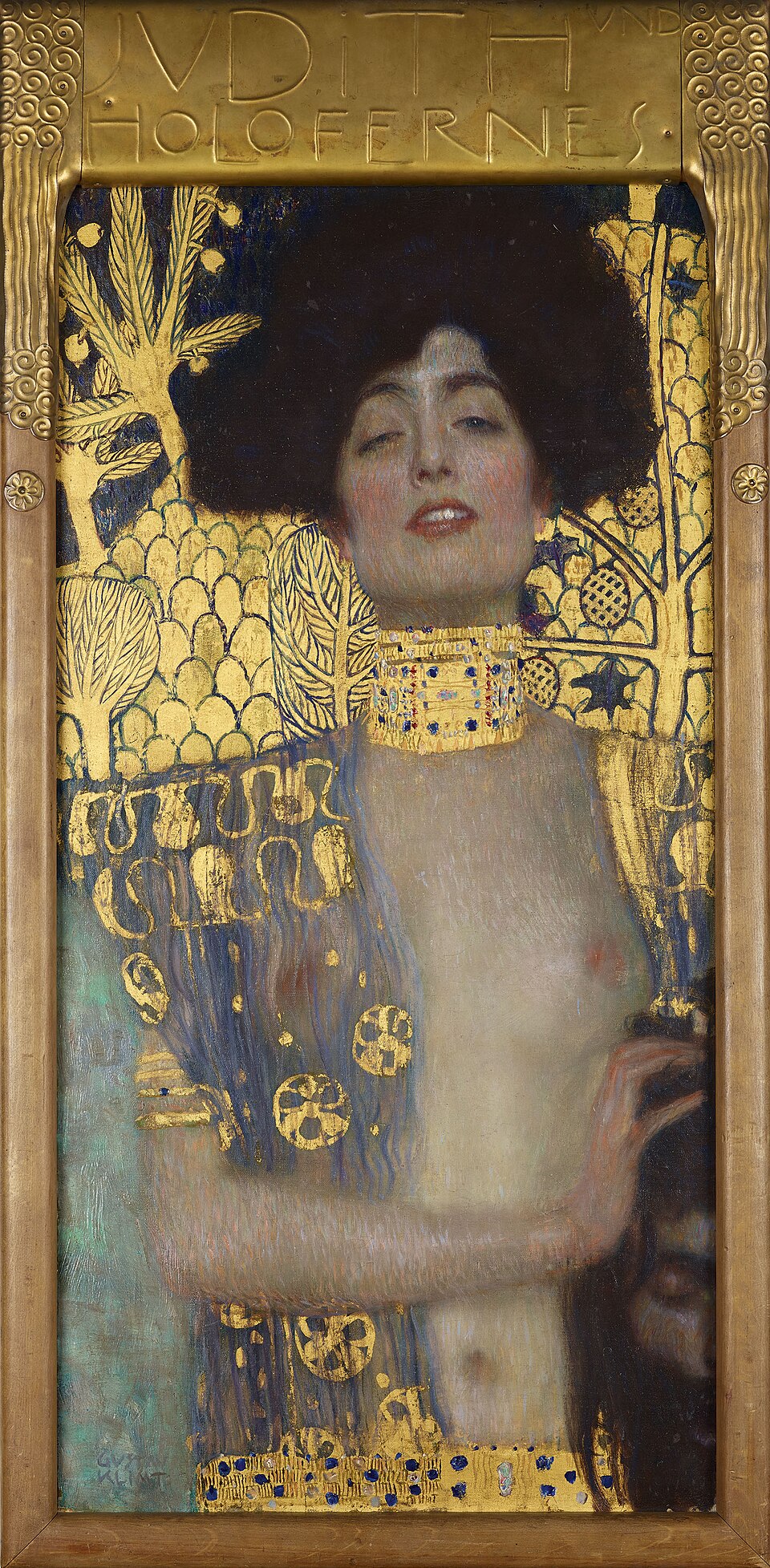
In 1901, Gustav Klimt sat down with an ancient story of salvation and violence and stripped away everything but the woman at its center. The biblical Judith had seduced the Assyrian general Holofernes and cut off his head to save her city of Bethulia from destruction. Painters for centuries — Caravaggio, Artemisia Gentileschi, Trophime Bigot — had rendered the killing itself in dramatic, bloody detail, framing Judith as God's righteous instrument.
Klimt refused that tradition entirely. In Judith and the Head of Holofernes, later known simply as Judith I, there is no sword, no blood, no scene of struggle. Holofernes' severed head is shoved almost out of the canvas, cropped at the right margin, an afterthought. The narrative collapses: the moment of seduction and the moment of death seem to fuse into one suspended instant, with nothing to explain how one led to the other.
What fills the canvas instead is Judith's face and body, rendered with a voluptuousness that unsettled viewers. Her head tilts back with pride, her lips part between defiance and pleasure, her eyes are half-closed in an expression the critic Felix Salten described in 1903 as carrying 'a sultry fire in her dark glances, cruelty in the lines of her mouth, and nostrils trembling with passion.' Klimt was borrowing heavily from Franz Stuck's painting The Sin, echoing its disrobed, evanescent body and its charged facial expression.
The composition is built on careful geometry: the verticality of Judith's body, matched by the falling line of Holofernes' head, is offset by horizontal bands across the lower part of the canvas — her arm, her shoulders bound by a jeweled collar, the base of her hair. Behind her, a golden background glows against her black hair, and stylized trees fan out on either side, echoing the fashionable hairstyle of the era.
Beneath the surface glamour lay a real woman. Though her features are transfigured toward maximum seduction, Klimt's Judith is recognizably modeled on Adele Bloch-Bauer, the Viennese socialite who was his friend and possibly his lover. Bloch-Bauer would sit for Klimt again in portraits made in 1907 and 1912, and she appears as well in his Pallas Athena.
More from Art

The Painting With No Foreground
A single robed figure stares out at an empty grey sea — and the emptiness itself became a scandal. When it was unveiled in Berlin in 1810, no one knew quite what to do with it.

The Painter Who Chased the Light
For a few purple minutes each evening, an American exile knelt in an English garden and raced the dying sun to paint two little girls lighting lanterns. It took him two years to finish.

When a President Became a God
Look straight up inside the U.S. Capitol dome and you will find George Washington enthroned among the clouds, surrounded by goddesses — the founding father transformed into myth.

Marble Brought Back to Life
A corpse asleep, a wing barely brushing her skin — and marble somehow learns to breathe. This is the moment Antonio Canova dared to carve.

The World Turned Upside Down
Look closely at a sixteenth-century Flemish village and you'll find a man biting a pillar, another carrying daylight in a basket, and a wife slipping a blue cloak over her husband's shoulders. Every gesture is a joke — if you know the language.

The Girl in the Glass Case
She stood two-thirds life size, dressed in a real tutu and human hair — and the critics who saw her in 1881 recoiled as if she were something obscene.