The Headless Goddess Who Conquered a Staircase
She has no head, no arms, and no name of her sculptor — yet for over a century she has stopped visitors cold at the top of a Parisian staircase. How does a broken statue become one of the most recognizable artworks on Earth?
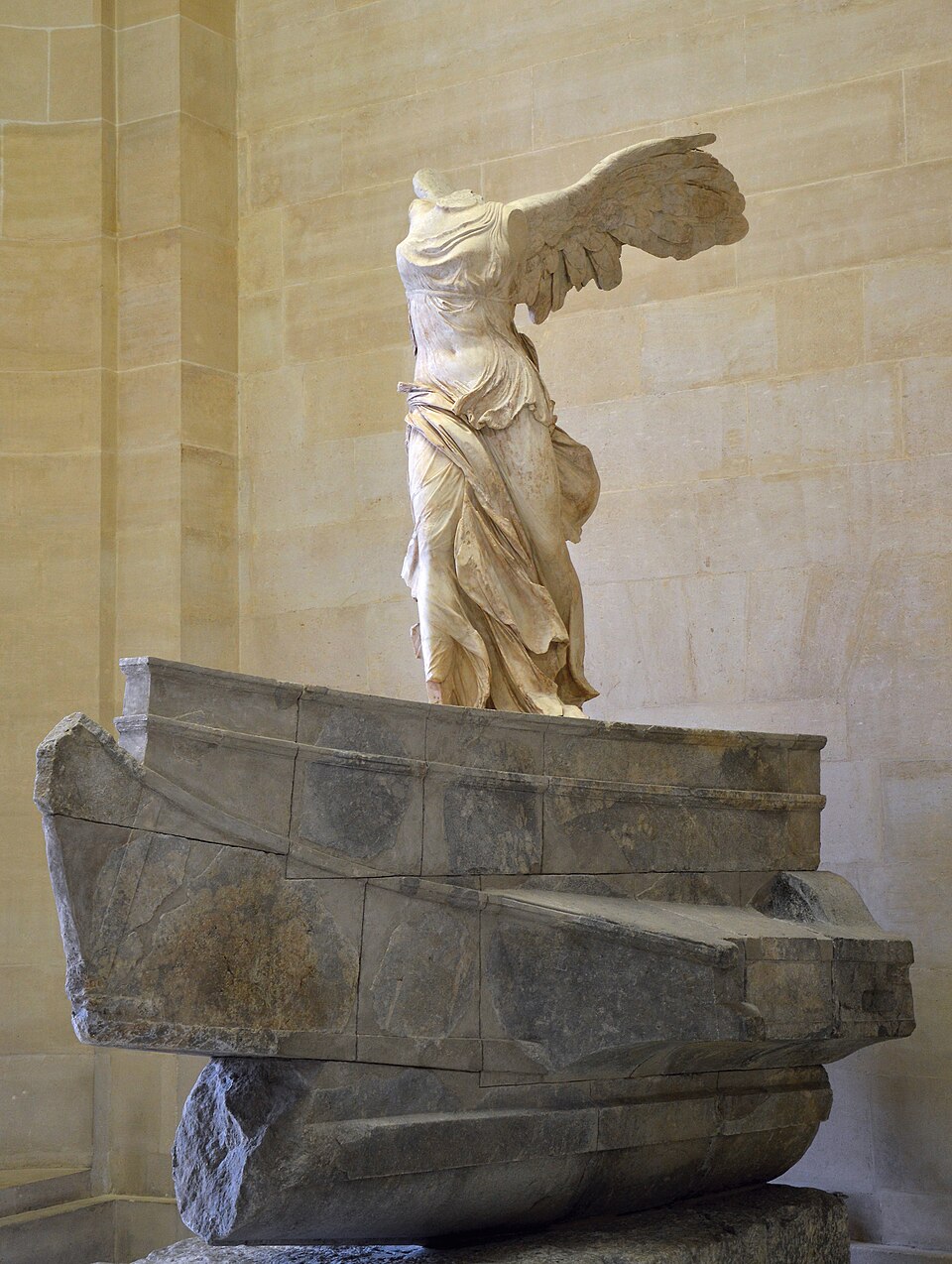
On April 13, 1863, Charles Champoiseau, acting chief of the French Consulate in Adrianopolis, was digging through the ruins of the sanctuary of the Great Gods on the island of Samothrace when he uncovered something extraordinary: the bust and body of a large white marble woman, surrounded by fragments of drapery and feathers. He recognized her immediately as Nike, the Greek goddess of Victory, always shown in antiquity with wings. Nearby lay a confused jumble of about fifteen grey marble blocks whose purpose Champoiseau could not decipher — he guessed, wrongly, that they belonged to a tomb.
Champoiseau shipped the statue and its fragments to the Louvre, leaving the grey blocks behind on the island. The statue left Samothrace in early May 1863, reached Toulon by the end of August, and arrived in Paris on May 11, 1864. Between 1864 and 1866, curator Adrien Prévost de Longpérier assembled the main body — 2.14 meters from upper belly to feet — onto a stone base, filling gaps with drapery fragments. Too many pieces, including the right bust and much of the left wing, remained too incomplete to attach, so they were stored away. The body alone was displayed among Roman statues until 1880.
The mystery of those abandoned grey blocks was solved by Austrian archaeologists working at Samothrace from 1870 under Alexander Conze. Architect Aloïs Hauser realized the blocks, once reassembled, formed the tapered bow of a warship — and that ancient coins, tetradrachms of Demetrios Poliorcetes struck between 301 and 292 BC, showed exactly this: a Victory standing on a ship's prow, wings spread, blowing a trumpet. Sculpture specialist Otto Benndorf matched this imagery to the stored Louvre fragments and proposed restoring the goddess with her right arm raised, blowing a trumpet.
Informed of this breakthrough, Champoiseau returned to Samothrace from August 15 to 29, 1879, this time solely to retrieve the base blocks and slabs, abandoning only the largest, unsculpted block. The pieces reached the Louvre two months later, and in December an experimental assembly was carried out in a courtyard. Curator Félix Ravaisson-Mollien then undertook a full reconstruction between 1880 and 1883, following the Austrian model: restoring the belt in plaster, attaching the marble right bust fragment, recreating the missing left side in plaster, mounting the marble left wing on a metal frame, and replacing the entire right wing with a plaster copy. The head, arms, and feet were never reconstructed. The ship's bow base was rebuilt, though the broken keel and a void at the top aft remained unfixed. The whole monument was then installed at the top of the Daru staircase, the Louvre's grand entrance stair.
Champoiseau made one more attempt in 1891, returning to Samothrace a third time hoping to find the missing head. He failed, but brought back drapery debris, an inscribed fragment, and pieces of coloured plaster — hints that the statue may once have been painted.
More from Art

The Painting With No Foreground
A single robed figure stares out at an empty grey sea — and the emptiness itself became a scandal. When it was unveiled in Berlin in 1810, no one knew quite what to do with it.

The Painter Who Chased the Light
For a few purple minutes each evening, an American exile knelt in an English garden and raced the dying sun to paint two little girls lighting lanterns. It took him two years to finish.

When a President Became a God
Look straight up inside the U.S. Capitol dome and you will find George Washington enthroned among the clouds, surrounded by goddesses — the founding father transformed into myth.

Marble Brought Back to Life
A corpse asleep, a wing barely brushing her skin — and marble somehow learns to breathe. This is the moment Antonio Canova dared to carve.

The World Turned Upside Down
Look closely at a sixteenth-century Flemish village and you'll find a man biting a pillar, another carrying daylight in a basket, and a wife slipping a blue cloak over her husband's shoulders. Every gesture is a joke — if you know the language.

The Girl in the Glass Case
She stood two-thirds life size, dressed in a real tutu and human hair — and the critics who saw her in 1881 recoiled as if she were something obscene.