The Horses That Outran Empires
Four bronze horses have been beheaded, smuggled, crowned atop a cathedral, stolen by an emperor, and marched back home again — and they're still standing.
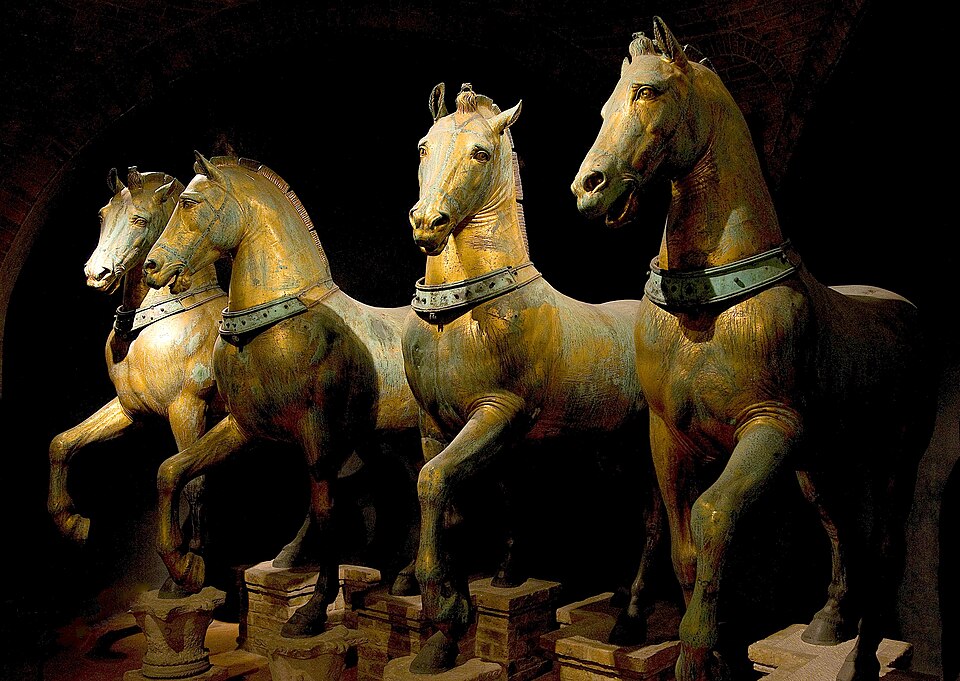
On the terrace above St Mark's Basilica in Venice, four bronze horses rear their necks toward the lagoon, collars gleaming around their throats. Those collars hide a secret: in 1204, the same year Constantinople fell, they were added to obscure where the animals' heads had been severed, the only way such massive statues could be hauled out of a conquered city and shipped to Venice.
That city was Constantinople, and the conquest was the Fourth Crusade. In 1204, Crusader and Venetian forces sacked the Byzantine capital, looting centuries of treasure. Among the spoils were these four horses, long displayed at the Hippodrome of Constantinople as part of a triumphal quadriga — a monument depicting a four-horse chariot once used in Roman victory processions and races.
Where they came from before that is murkier. An 8th- or 9th-century chronicle mentions gilt horses standing above the Hippodrome that arrived from the island of Chios under Emperor Theodosius II, and they may be the same animals, though this is not certain. Their sculptors remain unknown, though the technical mastery in their naturalistic forms has led some to date them to Classical Greece of the 5th or 4th century BC, while others see closer kinship with the Equestrian Statue of Marcus Aurelius from around 175 AD, placing them in the 2nd or 3rd century instead. Their short backs and long legs suggest they were built to be viewed from below, likely crowning a triumphal arch or grand structure — perhaps commissioned under Emperor Septimius Severus for the eastern capital itself.
Modern analysis has revealed another surprise: the statues are at least 96.67 percent copper, so pure that calling them 'bronze' is something of a misnomer. Their low tin content meant they had to be cast at scorching temperatures of 1200 to 1300 degrees Celsius, a formidable technical feat for whichever ancient workshop produced them.
Shortly after the Fourth Crusade, Doge Enrico Dandolo sent the horses to Venice, where in 1254 they were installed on the terrace facade of St Mark's Basilica. There they stood for centuries, admired by visitors including the poet Petrarch, watching over the Piazza San Marco as Venice built its maritime empire around them.
More from Art

The Painting With No Foreground
A single robed figure stares out at an empty grey sea — and the emptiness itself became a scandal. When it was unveiled in Berlin in 1810, no one knew quite what to do with it.

The Painter Who Chased the Light
For a few purple minutes each evening, an American exile knelt in an English garden and raced the dying sun to paint two little girls lighting lanterns. It took him two years to finish.

When a President Became a God
Look straight up inside the U.S. Capitol dome and you will find George Washington enthroned among the clouds, surrounded by goddesses — the founding father transformed into myth.

Marble Brought Back to Life
A corpse asleep, a wing barely brushing her skin — and marble somehow learns to breathe. This is the moment Antonio Canova dared to carve.

The World Turned Upside Down
Look closely at a sixteenth-century Flemish village and you'll find a man biting a pillar, another carrying daylight in a basket, and a wife slipping a blue cloak over her husband's shoulders. Every gesture is a joke — if you know the language.

The Girl in the Glass Case
She stood two-thirds life size, dressed in a real tutu and human hair — and the critics who saw her in 1881 recoiled as if she were something obscene.