The Hummingbird That Ate the Sun
He tore free from his mother's womb already armored for war, and beheaded his own sister on a mountaintop before the sun had even risen. Meet the god who demanded blood to keep the world turning.
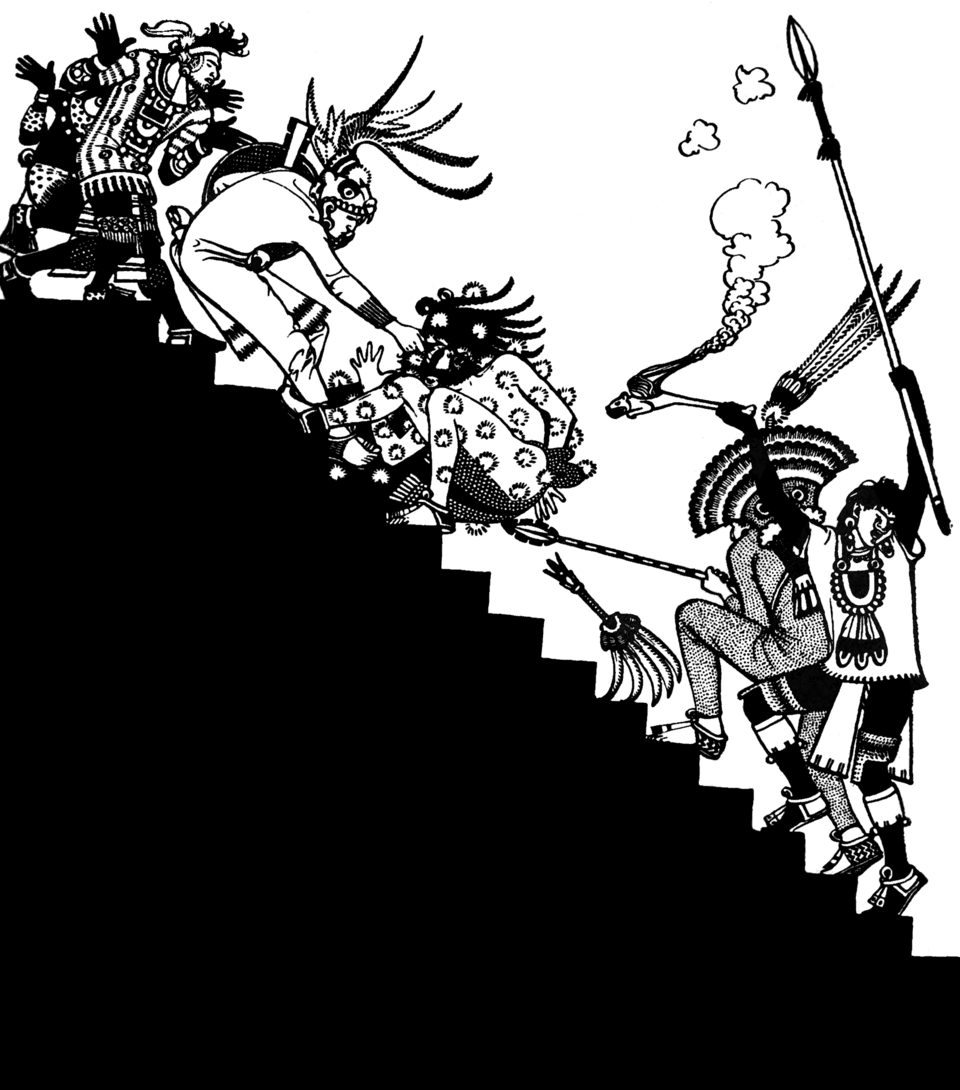
On a hill called Coatepec, near what is now Tula, Hidalgo, a goddess named Coatlicue swept the temple grounds when a ball of feathers drifted down and touched her. She became pregnant. Her other children, already grown — the four hundred Centzonuitznaua and their sister Coyolxauhqui — saw this as an insult, and they conspired to kill their mother before the child could be born.
They never got the chance. Huitzilopochtli burst from Coatlicue's womb fully grown and fully armed, in some tellings arming himself the instant he emerged. He turned on his siblings at once. Coyolxauhqui he beheaded, casting her body from the mountaintop. His four hundred brothers fled in terror and scattered across the sky, becoming the stars. In the Aztec telling, this is why the sun forever chases the moon and stars across the heavens — Huitzilopochtli, born as the sun, still pursuing the family that turned against his mother.
A second, gentler myth gives him a different beginning: as the smallest son of the creator couple Tonacatecuhtli and Tonacacihuatl, brother to Quetzalcoatl, Xipe Totec, and Tezcatlipoca. In that version, his parents charged him and Quetzalcoatl with bringing order to a formless world, and together the two brothers made fire, the first man and woman, the earth, and the sun itself.
Whichever origin the Aztecs told, Huitzilopochtli's role afterward was constant and demanding: he was locked in perpetual struggle against darkness, and only nourishment — sacrifice — kept him strong enough to hold back the night. The Aztecs believed they were literally 'people of the sun,' obligated to feed him tlaxcaltiliztli, sustenance in the form of blood and hearts, or risk the destruction of the world along with their mother-earth.
His name itself carries the memory of this cosmic violence in gentler form. Scholars generally break it into huitzilin, 'hummingbird,' and opochtli, 'left hand side,' giving translations like 'Left-Handed Hummingbird' or 'Hummingbird of the South,' since Aztec cosmology placed the south to the left of the body. The hummingbird held real spiritual weight in Aztec culture — the chronicler Diego Duran described how the bird appeared to die in winter, only to be reborn each spring, a small mirror of the god's own solar cycle of death and renewal.
More from Mythology

The Doctor Who Sang a Nation Into Being
A country doctor rode into the forests of Karelia armed with nothing but a notebook — and rode out with the soul of a nation.

The Boat That Carried the Sun
Every sunset, the ancient Egyptians believed, the sun climbed into a boat and sailed straight into the realm of the dead — only to fight a monstrous serpent before dawn could return.

The Wild Man of the Snows
At 21,000 feet, a colonel found tracks in the snow that he blamed on a wolf — but his guides knew better, and gave the world a name that would echo for a century.

The Knight Who Went Mad for Love: Orlando Furioso
A hero so devoted to duty he was Charlemagne's greatest paladin loses his mind—not to a sword wound, but to heartbreak. To cure him, a friend must ride a flying horse to the Moon.

The Book That Turned the World Into Myth
A poet condemned to exile spent his final years in Rome finishing a poem that would outlive empires—a poem about nothing standing still, not gods, not lovers, not even the shape of a man.

Paradise Lost: Milton's Rebel Angel
A blind poet, dictating verses in the dark, dared to explain the ways of God to men — and in doing so, made Hell's ruler unforgettable.