The Hunt That Never Ends
Seven tapestries, a slain mythical beast, and a mystery monogram hidden in wool and silk for centuries — nobody quite knows who wove them, or why.
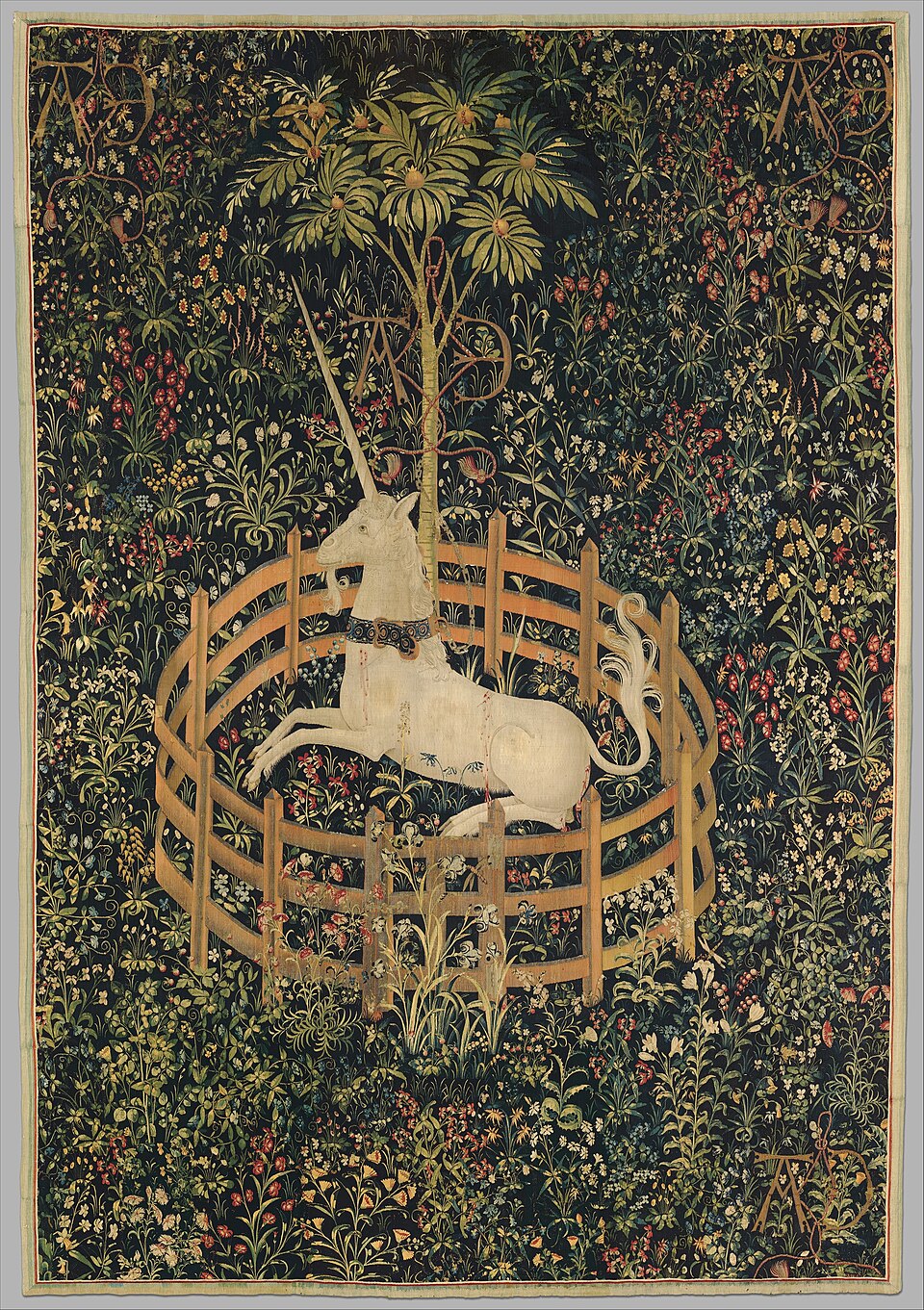
In a barn in the French countryside sometime in the 1850s, someone pulled back dust and cobwebs to reveal enormous panels of wool and silk, their colors still glowing after being forgotten for generations. These were the Unicorn Tapestries, seven monumental hangings depicting noblemen and hunters chasing a unicorn through an idealized French landscape, and their rediscovery was only the latest twist in a story that begins in mystery and, in many ways, remains there.
Woven around 1495–1505 in the Southern Netherlands, likely designed in Paris and executed on the looms of Brussels, the tapestries were made from wool, silk, and metallic thread. Their vivid colors, still visible today, came from dye plants: weld for yellow, madder for red, and woad for blue. Brussels was one of medieval Europe's great tapestry-weaving centers, and the costly silk threading signaled that whoever commissioned these works held real wealth and status.
The backgrounds are dense with a decorative style called millefleurs, a Gothic invention that scattered dozens of small botanical motifs across green fields. More than a hundred plant species appear across the panels, of which botanists have identified eighty-five. The hunt unfolds within a hortus conclusus, an 'enclosed garden' that carried both secular and religious meaning, echoing the Annunciation even as it staged a courtly chase.
The tapestries' documented history begins in 1680, when they were first recorded in the Paris home of the La Rochefoucauld family. Later, an inventory from 1728 shows five hanging in a bedroom at the family's Château de Verteuil in Charente, while two more were kept in a hall near the chapel. Scholars believe they were woven for François, son of Jean II de La Rochefoucauld and Marguerite de Barbezieux, and a mysterious 'AE' monogram appearing throughout the set may reference his son Antoine and Antoine's wife, Antoinette of Amboise.
The French Revolution brought disaster: the tapestries were looted from the château and, according to reports, used to cover potatoes in storage, damage from this period still visible today. By the end of the 1880s the family had recovered them, though a visitor at the time described the set as showing 'incomparable freshness and grace' despite one panel having deteriorated into fragments repurposed as bed curtains.
More from Art

The Painting With No Foreground
A single robed figure stares out at an empty grey sea — and the emptiness itself became a scandal. When it was unveiled in Berlin in 1810, no one knew quite what to do with it.

The Painter Who Chased the Light
For a few purple minutes each evening, an American exile knelt in an English garden and raced the dying sun to paint two little girls lighting lanterns. It took him two years to finish.

When a President Became a God
Look straight up inside the U.S. Capitol dome and you will find George Washington enthroned among the clouds, surrounded by goddesses — the founding father transformed into myth.

Marble Brought Back to Life
A corpse asleep, a wing barely brushing her skin — and marble somehow learns to breathe. This is the moment Antonio Canova dared to carve.

The World Turned Upside Down
Look closely at a sixteenth-century Flemish village and you'll find a man biting a pillar, another carrying daylight in a basket, and a wife slipping a blue cloak over her husband's shoulders. Every gesture is a joke — if you know the language.

The Girl in the Glass Case
She stood two-thirds life size, dressed in a real tutu and human hair — and the critics who saw her in 1881 recoiled as if she were something obscene.