The Hunters in the Snow: Bruegel's Winter Tale
Three weary men trudge home with almost nothing to show for their hunt—yet the painting they walk through would become one of the most beloved winter images in Western art.
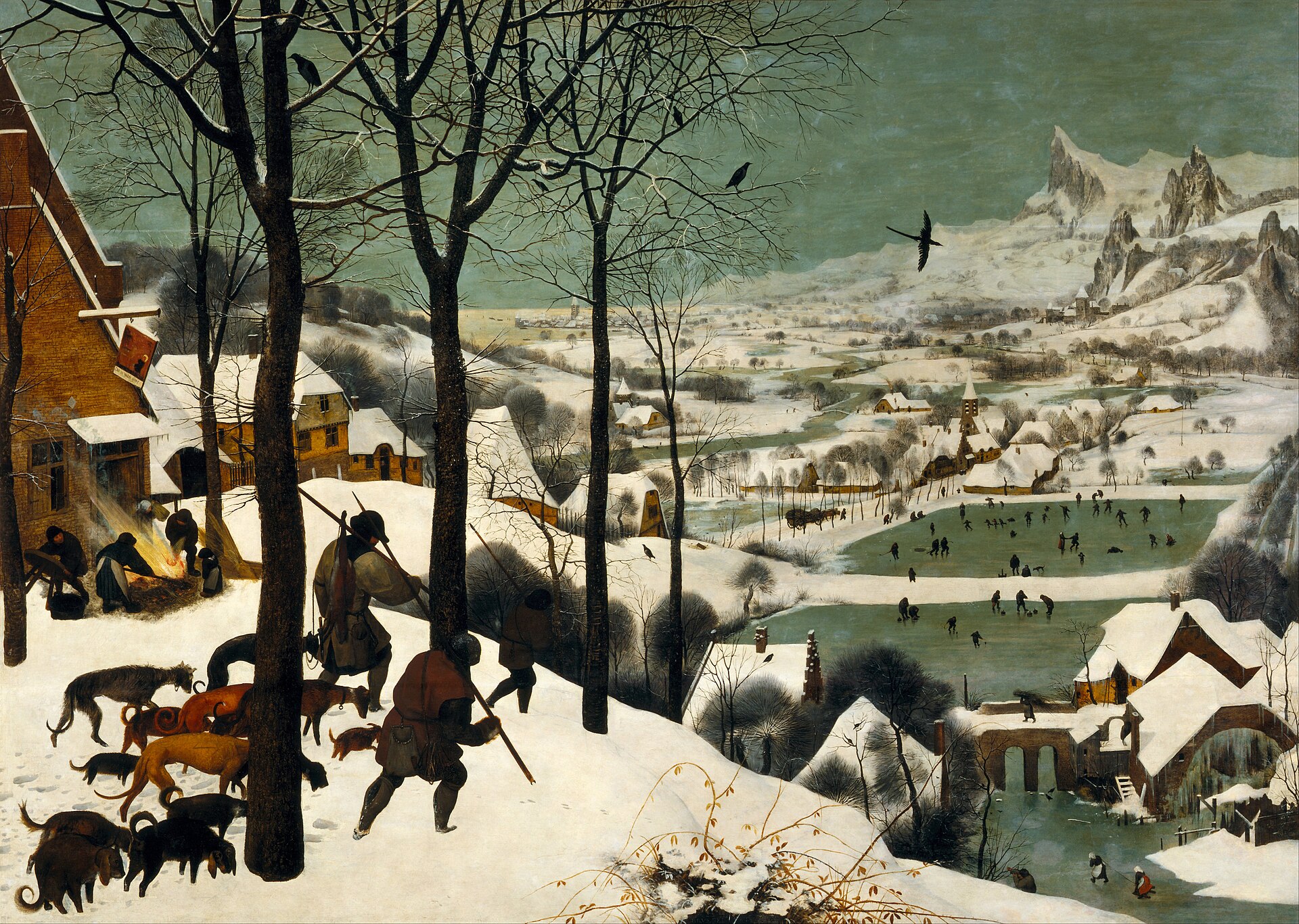
In the depths of December or January 1565, somewhere in the imagined lowlands of Pieter Bruegel the Elder's mind, three hunters make their way home across a snow-covered ridge. Their dogs trail behind them, lean and gaunt, seeming to share their masters' exhaustion. One hunter carries the meager corpse of a fox—a small, almost embarrassing trophy after what was clearly a long and disappointing expedition. In front of them, footprints of a hare cross the snow: the one that got away.
This is The Hunters in the Snow, painted in oil on wood, one of the surviving five panels from a series—originally perhaps six—depicting the different times of the year, a tradition rooted in the medieval and early Renaissance conception of the Labours of the Months. Bruegel painted it in a moment when Europe stood at the threshold of what would later be called the Little Ice Age, and the raw, biting cold of the scene feels less like poetic invention than lived observation.
The composition unfolds from a high vantage point, looking down over a flat-bottomed valley through which a river winds. On the far side rise jagged, improbable peaks—mountains that do not exist in the Low Countries, a fantastical flourish in an otherwise grounded scene. A watermill sits with its wheel frozen solid, testimony to the depth of the cold. In the distance, tiny silhouetted figures skate, play kolf, and knock at eisstock on the ice of a frozen lake, going about the ordinary business of winter leisure.
Near the foreground, an inn anchors the human warmth of the scene: several adults and a child are singeing a pig over an outdoor fire. Above the inn's entrance hangs a sign, half-detached from its hardware, reading 'Dit Is Gu(l)den Hert'—'This is the Golden Hart'—a nod to the vision of Saint Hubertus or Saint Eustace, the patron saint of hunters. The irony is quiet but unmistakable: the men trudging homeward have found little of the abundance the sign might promise.
Bruegel fills the bare branches of the trees with crows, and sends a single magpie flying across the upper center of the scene. In Dutch culture of the time, magpies carried associations with the Devil, and Bruegel used both birds elsewhere in his work as quiet signals of ill omen. Nothing in the painting shouts this darkness—the palette stays muted, whites and grays, wood smoke drifting through still, cold air—but the birds hint at something unresolved beneath the calm.
More from Art

The Painting With No Foreground
A single robed figure stares out at an empty grey sea — and the emptiness itself became a scandal. When it was unveiled in Berlin in 1810, no one knew quite what to do with it.

The Painter Who Chased the Light
For a few purple minutes each evening, an American exile knelt in an English garden and raced the dying sun to paint two little girls lighting lanterns. It took him two years to finish.

When a President Became a God
Look straight up inside the U.S. Capitol dome and you will find George Washington enthroned among the clouds, surrounded by goddesses — the founding father transformed into myth.

Marble Brought Back to Life
A corpse asleep, a wing barely brushing her skin — and marble somehow learns to breathe. This is the moment Antonio Canova dared to carve.

The World Turned Upside Down
Look closely at a sixteenth-century Flemish village and you'll find a man biting a pillar, another carrying daylight in a basket, and a wife slipping a blue cloak over her husband's shoulders. Every gesture is a joke — if you know the language.

The Girl in the Glass Case
She stood two-thirds life size, dressed in a real tutu and human hair — and the critics who saw her in 1881 recoiled as if she were something obscene.