The King's Blade That Refused to Rust
Buried for over two millennia in water-logged earth, this bronze sword still had an edge sharp enough to draw blood the moment it was drawn. How did it survive perfectly intact for 2,000 years?
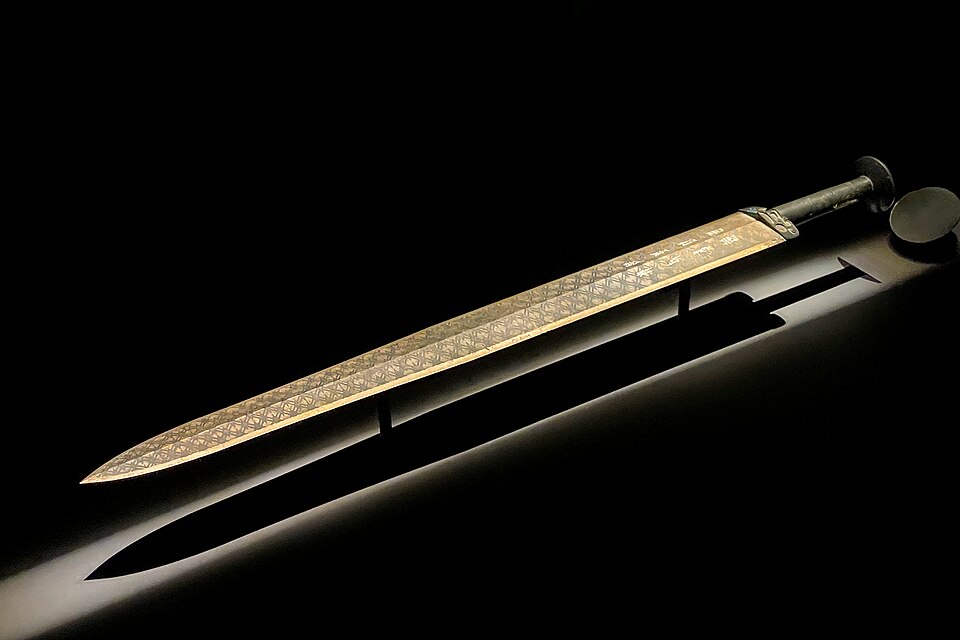
In December 1965, archaeologists working along the second main aqueduct of the Zhang River Reservoir in Jingzhou, Hubei, opened a wooden casket inside an ancient tomb known as Wangshan site #1. Beside a human skeleton lay a bronze sword sheathed in a wooden scabbard finished in black lacquer. The fit between blade and scabbard was so tight it was nearly air-tight, and when the sword was drawn, its blade emerged almost untarnished — despite the tomb having been soaked in underground water for more than 2,000 years.
The excavation was part of a larger dig that ran from mid-October 1965 to January 1966, uncovering more than fifty ancient tombs of the Chu State near the ruins of Ying, the old Chu capital now called Jinancheng. Across the sites, archaeologists recovered more than 2,000 artifacts, but none would prove as celebrated as this single sword.
On the blade, near the hilt, two columns of gilded text appeared in an ornate ancient script now called Bird-worm seal script. Analysts quickly deciphered six of the eight characters: 'King of Yue' and 'made this sword for his personal use.' The remaining two characters, presumed to name the specific king, sparked a scholarly debate that unfolded largely through letters among Chinese language experts, including the famous scholar Guo Moruo.
After more than two months of argument, the characters were identified as the name Goujian — a king of Yue who ruled from 496 to 465 BCE during the Spring and Autumn period. Goujian was already legendary for his perseverance through hardship and for his connoisseurship of fine swords. Between the sword's making and the fall of Yue to the state of Chu in 334 BCE, nine kings had ruled Yue, including Lu Cheng, Bu Shou, and Zhu Gou, making the identification no small feat.
Swords in this era were more than weapons — they were emblems of royal authority, a tradition reaching back to the early Zhou dynasty, when King Cheng was buried with a red blade later believed by Han historians such as Zheng Xuan to have belonged to the last king of the Shang dynasty. By the late Spring and Autumn period, a culture of sword-naming had flourished, especially in the rival states of Wu and Yue, where prized blades were given names describing their color, pattern, hardness, or sharpness.
More from Archaeology

The Bronze Disc That Rewrote the Sky
Two looters with a metal detector dug up something illegal, invisible in value, and older than Stonehenge's final stones — a map of the heavens buried for over three thousand years.

The Faceless Women of the Ice Age
Long before writing, before cities, before the wheel, someone carved a woman's body into stone and ivory — and left no name, no face, no explanation.

The Pebble That Might Be Human
A palm-sized stone found on a Moroccan riverbank may be humanity's oldest attempt to see itself — or simply a trick of erosion.

The Crown That Vanished: Deshret and the Red Land
A crown worn by kings for three thousand years has never once been found in a tomb — not one. So where did it go?

The Face That Traveled Between Empires
A farm worker's shovel struck stone in 1897 and unearthed a face so striking it would be sold to France, seized as war booty, and finally traded back for a Velázquez.

The Boy in the Dark Tunnel
A schoolboy fell into black water inside an ancient tunnel and surfaced with his fingers brushing letters no one had noticed for 2,600 years.