The King Who Never Left Versailles
Commissioned as a farewell gift for a grandson departing to rule Spain, this portrait became so magnificent that the king who ordered it refused to let it go.
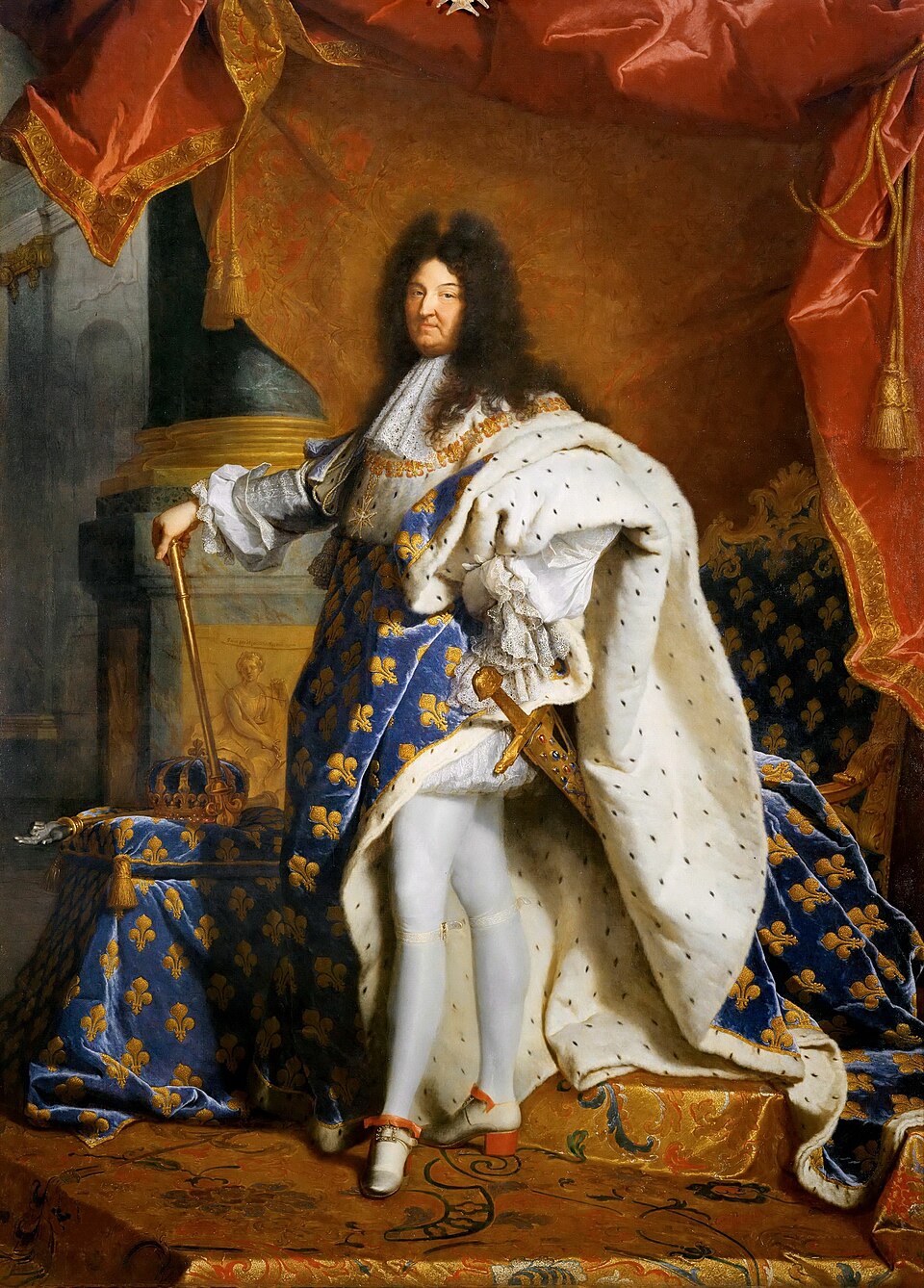
In November 1700, the death of Charles II of Spain without an heir threw Europe into crisis. The Spanish king's will named Philip, Duke of Anjou — second son of the Grand Dauphin and grandson of Louis XIV — as his successor, setting the stage for a war over the throne. Before Philip departed to claim his new kingdom, he wanted something to carry with him: an image of his grandfather, the Sun King, painted by the same artist who had already captured his own likeness.
That artist was Hyacinthe Rigaud, whose reputation had already reached Louis XIV through an earlier portrait of the Grand Dauphin as commander at the siege of Philippsburg. In 1700, Rigaud was commissioned to paint Philip V just before his departure for Spain. That painting so pleased the young king that he asked his grandfather for a portrait of himself, painted by the same hand. Louis XIV agreed, and Rigaud began work the following year.
The sittings were far from effortless. Madame de Maintenon, writing to the Duke of Noailles on 11 March 1701, described coaxing the king to sit still, joking that his gout came to their rescue — without it, she said, they would never have held him for three or four hours. The Marquis de Dangeau's journal confirms these sessions, noting on 10 and 11 March 1701 that the king, troubled by gout, was carried to Madame de Maintenon's apartments where Rigaud worked on the portrait.
On 19 January 1702, Dangeau again recorded a sitting, noting that the king, who had 'no advice to keep,' had the patience to be painted at Madame de Maintenon's — the portrait, he wrote, being meant for the King of Spain, who had been urging it on. Rigaud continued painting from life, refining the composition, and the portrait meant for Spain never actually made the journey. Later, on 3 September 1703, Philip V wrote to the Marquise, thanking her for helping secure his grandfather's portrait and saying he looked forward to receiving it.
More from Art

The Painting With No Foreground
A single robed figure stares out at an empty grey sea — and the emptiness itself became a scandal. When it was unveiled in Berlin in 1810, no one knew quite what to do with it.

The Painter Who Chased the Light
For a few purple minutes each evening, an American exile knelt in an English garden and raced the dying sun to paint two little girls lighting lanterns. It took him two years to finish.

When a President Became a God
Look straight up inside the U.S. Capitol dome and you will find George Washington enthroned among the clouds, surrounded by goddesses — the founding father transformed into myth.

Marble Brought Back to Life
A corpse asleep, a wing barely brushing her skin — and marble somehow learns to breathe. This is the moment Antonio Canova dared to carve.

The World Turned Upside Down
Look closely at a sixteenth-century Flemish village and you'll find a man biting a pillar, another carrying daylight in a basket, and a wife slipping a blue cloak over her husband's shoulders. Every gesture is a joke — if you know the language.

The Girl in the Glass Case
She stood two-thirds life size, dressed in a real tutu and human hair — and the critics who saw her in 1881 recoiled as if she were something obscene.