The Kiss That Hid a Revolution
A medieval couple locked in an embrace on a shadowy staircase — but the real story behind this 1859 painting was a secret message about war, alliance, and a nation about to be born.
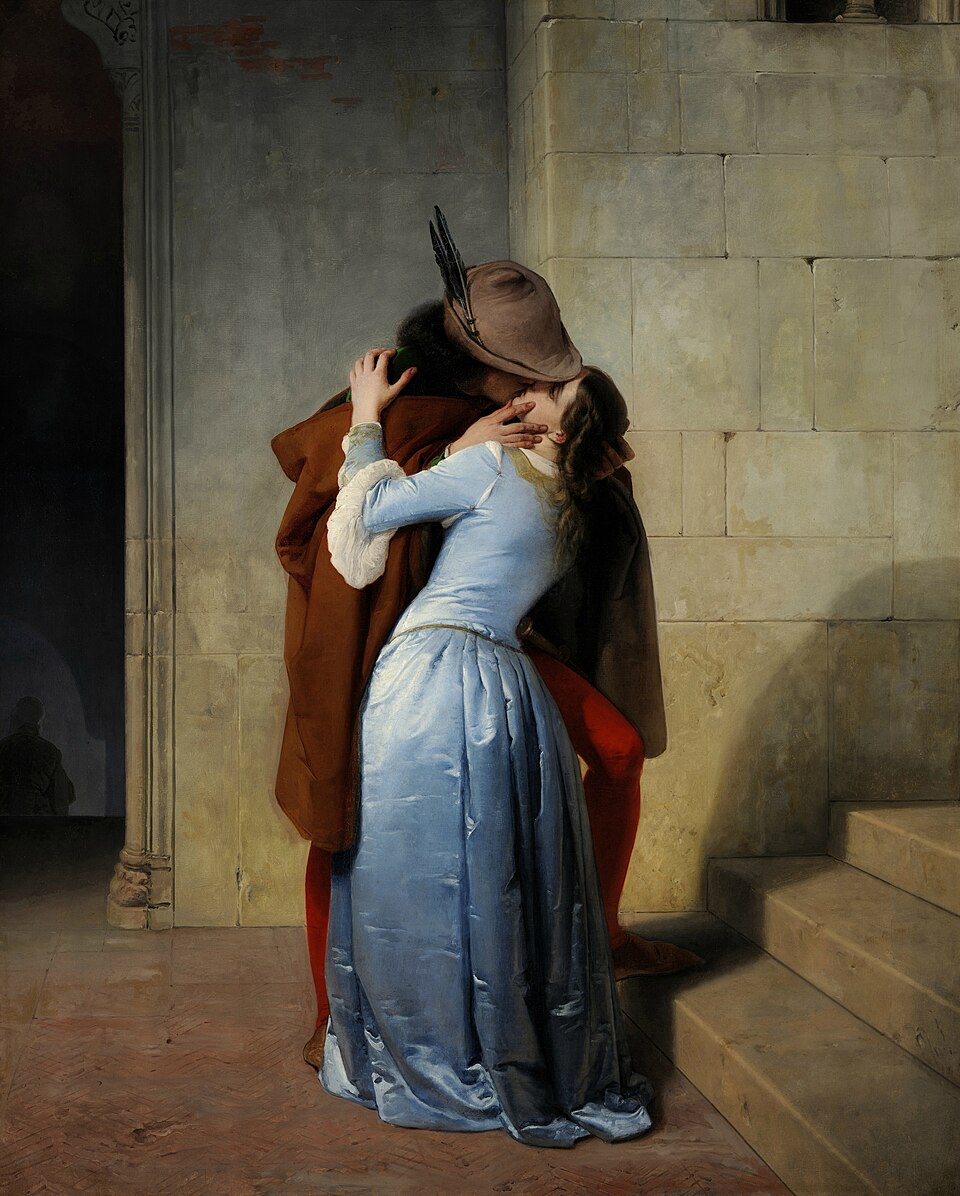
In 1859, in a Milan still chafing under Austrian rule, the painter Francesco Hayez unveiled a canvas that looked, at first glance, like nothing more than a tender embrace. A young man in a red-and-green mantle leans in to kiss a woman in a pale blue dress; she tilts backward into his arms on a shadowed stone staircase, one of his feet already poised on the step below, as if he might have to flee at any moment. It was commissioned by Count Alfonso Maria Visconti di Saliceto, and presented at the Pinacoteca di Brera on 9 September of that year.
The timing was no accident. Since the Congress of Vienna in 1815, Italy had been carved into states dominated by the Austrian Habsburgs, a fragmentation that fed a growing nationalist movement. Secret societies like the Carboneria and Young Italy had failed to win independence by force, and the First Italian War of Independence in 1848 had collapsed. But by 1859, Napoleon III and Camillo Benso, Count of Cavour, had struck a secret pact: an alliance between France and the Kingdom of Sardinia against Austria. That alliance would trigger the Second Italian War of Independence and, within two years, the proclamation of the Kingdom of Italy in 1861.
Hayez, well known among Milanese patriots, was mindful of the harsh repression that met open dissent. So he disguised his message. By dressing his lovers in medieval costume and setting their farewell on an anonymous staircase, he could smuggle a contemporary political statement past the censors under the cover of historical romance.
The clues are there for anyone who looks closely. The man's foot rests only briefly on the step, and the woman grips him tightly — a farewell, not a beginning. Shadowy, unidentifiable figures lurk in the left corner of the canvas, hinting at conspiracy and danger. Some historians read the scene as a young Italian soldier bidding goodbye to his beloved before leaving to fight the Austrians. On a broader level, the painting has been understood as an allegory for the alliance itself: the woman's blue-and-white clothing and the man's red-and-green garments echo the colors of the French and Italian flags.
More from Art

The Painting With No Foreground
A single robed figure stares out at an empty grey sea — and the emptiness itself became a scandal. When it was unveiled in Berlin in 1810, no one knew quite what to do with it.

The Painter Who Chased the Light
For a few purple minutes each evening, an American exile knelt in an English garden and raced the dying sun to paint two little girls lighting lanterns. It took him two years to finish.

When a President Became a God
Look straight up inside the U.S. Capitol dome and you will find George Washington enthroned among the clouds, surrounded by goddesses — the founding father transformed into myth.

Marble Brought Back to Life
A corpse asleep, a wing barely brushing her skin — and marble somehow learns to breathe. This is the moment Antonio Canova dared to carve.

The World Turned Upside Down
Look closely at a sixteenth-century Flemish village and you'll find a man biting a pillar, another carrying daylight in a basket, and a wife slipping a blue cloak over her husband's shoulders. Every gesture is a joke — if you know the language.

The Girl in the Glass Case
She stood two-thirds life size, dressed in a real tutu and human hair — and the critics who saw her in 1881 recoiled as if she were something obscene.