The Kraken: How a Crooked Stick Became the Sea's Greatest Terror
Long before Hollywood sent it crashing through galleons, the kraken began as a word for a bent old tree stump — and somewhere between Norwegian fjords and giant squid sightings, it became the ocean's most enduring monster.
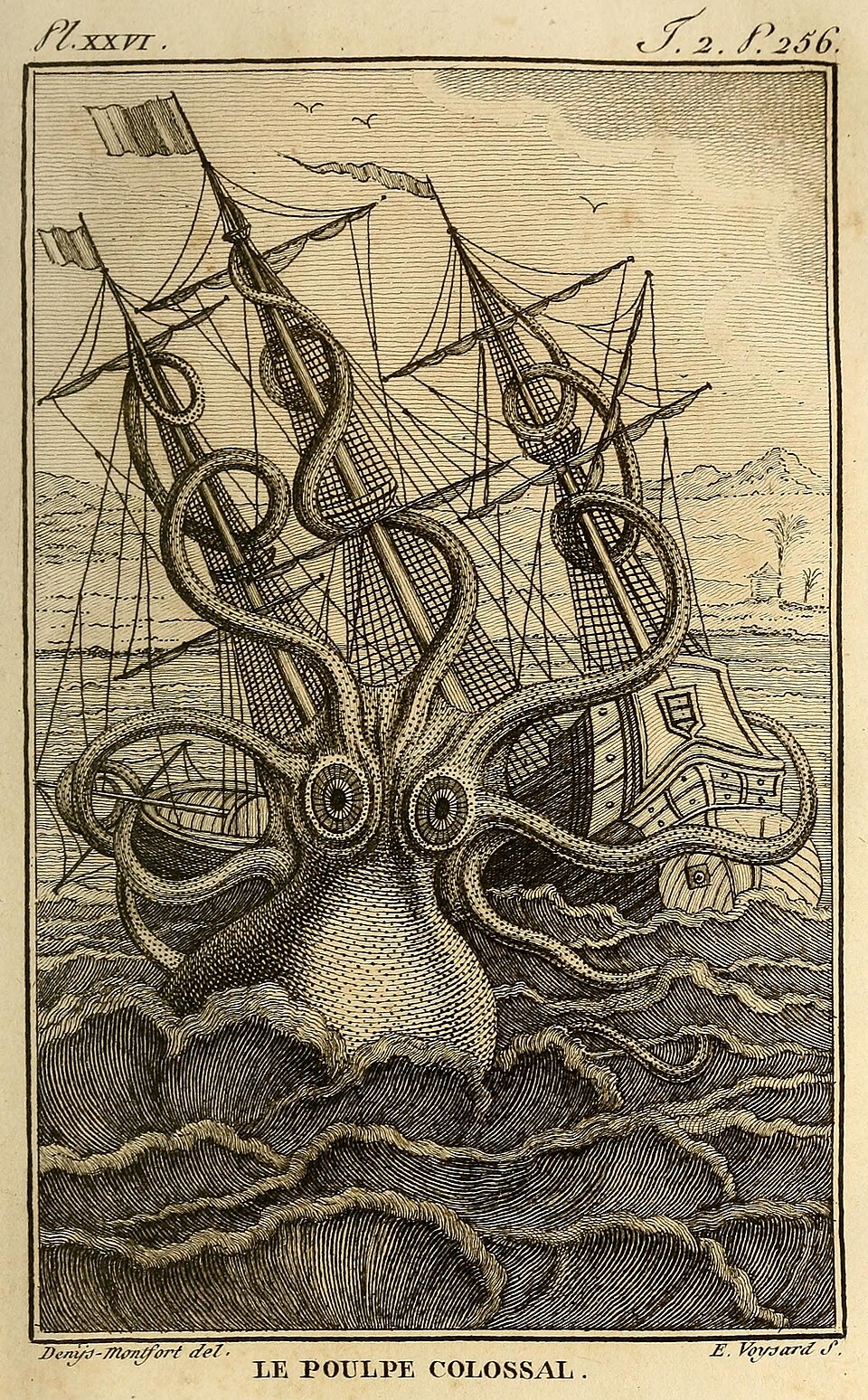
In 1646, a Norwegian glossary compiled by Christen Jensøn set down, almost in passing, a word that would outlive every sailor who ever whispered it: kraken. The entry gave little away, but it marked the first recorded appearance of a creature that would haunt Scandinavian waters for centuries in the imaginations of fishermen and clergymen alike.
The legend grew slowly, gathering detail with each retelling. Italian traveler Francesco Negri mentioned the beast in a 1700 travelogue, and in 1734 the Dano-Norwegian missionary Hans Egede offered a fuller account, describing a many-headed and clawed creature that he linked to the hafgufa of older medieval lore. Egede's kraken was not simply a big fish — it was something stranger, something that defied easy classification.
It was Danish bishop Erik Pontoppidan, in 1753, who gave the kraken its most enduring shape. He described it as a polypus — an octopus — of tremendous size, notorious among sailors for its supposed habit of dragging entire ships beneath the waves. Pontoppidan's account, delivered with the authority of a churchman rather than a sailor's tall tale, helped cement the kraken as something worth taking seriously, at least as folklore.
The scientific world flirted with the creature too, if only obliquely. Carl Linnaeus wrote of a genus he called Microcosmus, a term for an animal with various other organisms or growths attached to it, forming a kind of colony — a technical description, not a monster story. Later authors nonetheless linked Linnaeus's writing, along with Thomas Bartholin's cetus called hafgufa and Christian Franz Paullini's monstrum marinum, back to the kraken tradition, though the claim that Linnaeus himself wrote the word 'kraken' into a later edition of Systema Naturae has never been confirmed. Meanwhile, the French malacologist Denys-Montfort pursued his own investigations into gigantic octopuses in the 19th century, adding a layer of quasi-scientific inquiry to what had begun as fireside superstition.
Literature did the rest. In 1866, Victor Hugo folded the pieuvre — the giant octopus of Guernsey folklore — into his novel Toilers of the Sea, explicitly identifying it with the legendary kraken. Jules Verne picked up the thread soon after in Twenty Thousand Leagues Under the Seas, blurring the line between octopus and squid in his depiction of the beast, a confusion that persists in popular imagination to this day.
More from Mythology

The Doctor Who Sang a Nation Into Being
A country doctor rode into the forests of Karelia armed with nothing but a notebook — and rode out with the soul of a nation.

The Boat That Carried the Sun
Every sunset, the ancient Egyptians believed, the sun climbed into a boat and sailed straight into the realm of the dead — only to fight a monstrous serpent before dawn could return.

The Wild Man of the Snows
At 21,000 feet, a colonel found tracks in the snow that he blamed on a wolf — but his guides knew better, and gave the world a name that would echo for a century.

The Knight Who Went Mad for Love: Orlando Furioso
A hero so devoted to duty he was Charlemagne's greatest paladin loses his mind—not to a sword wound, but to heartbreak. To cure him, a friend must ride a flying horse to the Moon.

The Book That Turned the World Into Myth
A poet condemned to exile spent his final years in Rome finishing a poem that would outlive empires—a poem about nothing standing still, not gods, not lovers, not even the shape of a man.

Paradise Lost: Milton's Rebel Angel
A blind poet, dictating verses in the dark, dared to explain the ways of God to men — and in doing so, made Hell's ruler unforgettable.