The Lady Who Sailed Toward Her Doom
A woman drifts alone in a small boat, two of her three candles already snuffed out — she knows exactly how her story ends, and paints herself sailing into it anyway.
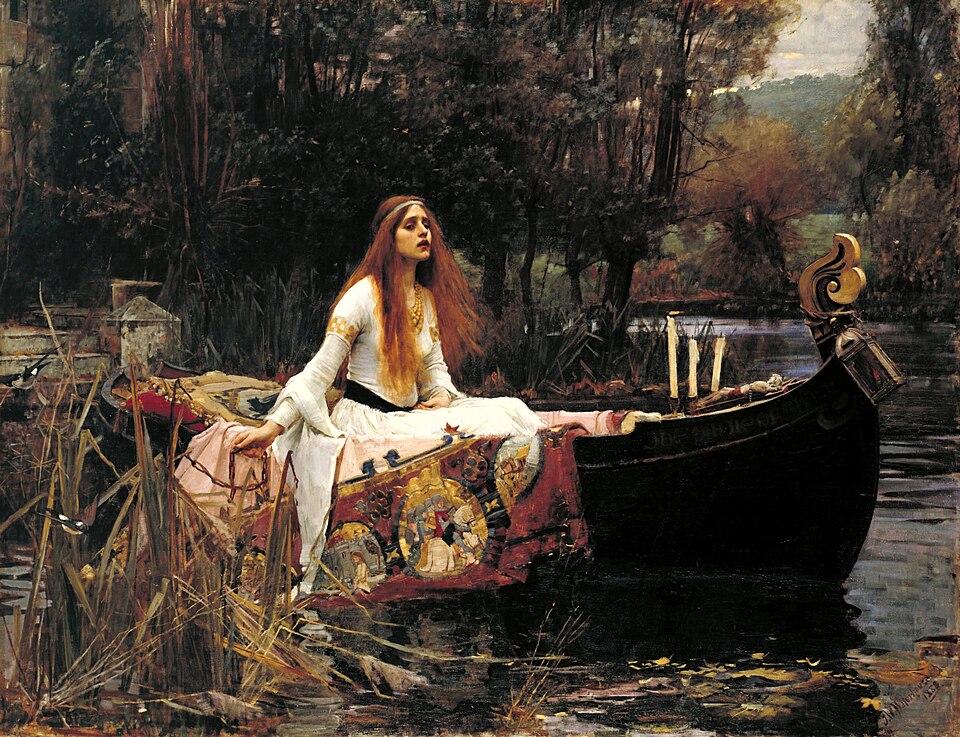
In 1888, the English painter John William Waterhouse set his brush to a moment of quiet, terrible resolve. A young woman sits in a boat, her white dress glowing against a darkening river, her face caught somewhere between longing and surrender. This is the Lady of Shalott, and she is sailing toward Camelot, and toward her death.
Waterhouse drew his subject from Alfred, Lord Tennyson's 1842 poem of the same name, which itself borrowed loosely from the medieval legend of Elaine of Astolat. In Tennyson's telling, the Lady was cursed to live shut away in a tower, forbidden to look directly at the world outside. She could only watch it pass by as reflections in a mirror, weaving what she saw into an endless tapestry.
Her isolation was bearable, if barely, until the mirror showed her something she could not resist: Sir Lancelot riding past on his horse. She rose, crossed the room, and looked at him directly through the window. In that instant the mirror cracked from side to side, and she understood the curse had finally come for her.
Knowing what awaited her, the Lady made her way to a boat and wrote her own name upon its prow. As an autumn storm gathered, she set off down the river toward Camelot, singing a lament as she went, fully aware she would not survive the journey. Waterhouse chose to paint this exact moment of departure — the instant before the end, rather than the end itself.
The painting is dense with quiet symbolism. A crucifix rests near the bow of the boat, flanked by three candles — one still burning, two already extinguished, a plain signal that death is close at hand. Two swallows dart nearby, and water plants native to the English countryside crowd the riverbank, grounding the mythic scene in something recognizably real. The Lady sits upon the very tapestry she wove during her captivity, her life's work now serving as her deathbed.
More from Art

The Painting With No Foreground
A single robed figure stares out at an empty grey sea — and the emptiness itself became a scandal. When it was unveiled in Berlin in 1810, no one knew quite what to do with it.

The Painter Who Chased the Light
For a few purple minutes each evening, an American exile knelt in an English garden and raced the dying sun to paint two little girls lighting lanterns. It took him two years to finish.

When a President Became a God
Look straight up inside the U.S. Capitol dome and you will find George Washington enthroned among the clouds, surrounded by goddesses — the founding father transformed into myth.

Marble Brought Back to Life
A corpse asleep, a wing barely brushing her skin — and marble somehow learns to breathe. This is the moment Antonio Canova dared to carve.

The World Turned Upside Down
Look closely at a sixteenth-century Flemish village and you'll find a man biting a pillar, another carrying daylight in a basket, and a wife slipping a blue cloak over her husband's shoulders. Every gesture is a joke — if you know the language.

The Girl in the Glass Case
She stood two-thirds life size, dressed in a real tutu and human hair — and the critics who saw her in 1881 recoiled as if she were something obscene.