The Lady with the Ermine's Gaze
A young woman turns her head toward someone just out of frame, an animal coiled in her arms like a held breath. Four centuries of doubt would settle onto her portrait before the truth of its brushwork was finally uncovered.
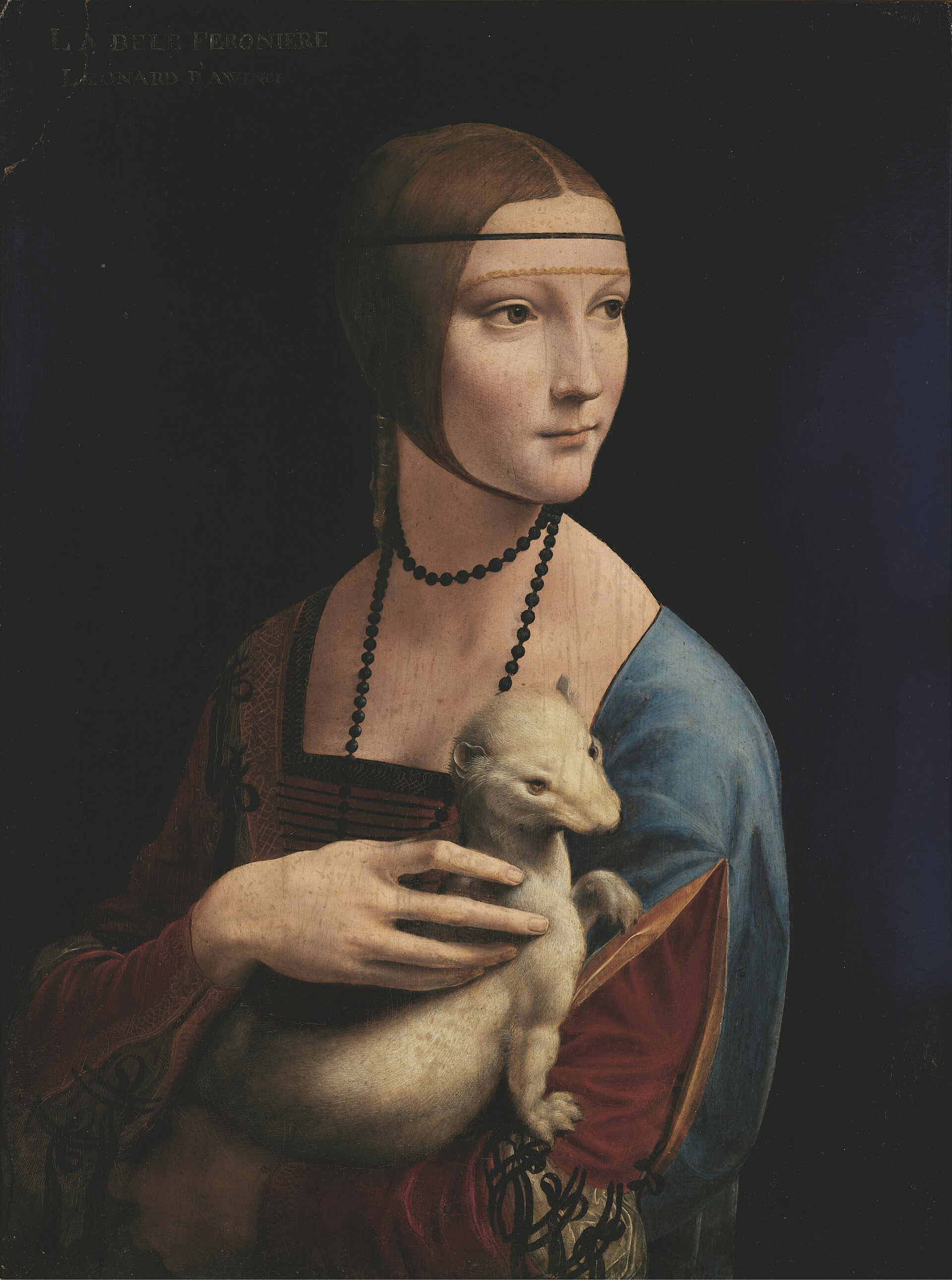
In a small walnut panel no larger than a windowpane, a woman glances sideways into a darkness that was not always dark. She holds a small white animal, an ermine, against her chest, its body twisted to mirror her own turning shoulders. This is the Lady with an Ermine, painted by Leonardo da Vinci sometime between 1489 and 1491, and it is the second of only four surviving portraits of women Leonardo ever painted, the others being Ginevra de' Benci, La Belle Ferronnière, and the Mona Lisa.
The sitter has been identified, with reasonable confidence, as Cecilia Gallerani, mistress of Ludovico Sforza, called Il Moro, Duke of Milan. Leonardo was painter to the Sforza court at the time, and the portrait captures Cecilia in fashionable 'Spanish style' dress, popularized after the marriage of Isabella of Aragon to Gian Galeazzo Sforza. Her hair is bound in a coazzone, smoothed against her skull with two bands and a long plait falling behind, held by a gauze veil trimmed in gold thread.
Leonardo painted her at a three-quarter angle, her body turning one way and her face another, the ermine twisting to match — a spiral composition he had explored before in the angel of the Virgin of the Rocks. The court poet Bernardo Bellincioni was the first to suggest that Cecilia appears poised as if listening to an unseen speaker; biographer Walter Isaacson has proposed that the source of her attention, and of the light striking her face, might be Ludovico himself, standing just beyond the frame.
The technical craft is extraordinary even by Leonardo's standards. The panel, a single piece of walnut about four to five millimetres thick, was likely cut from the same tree as the wood used later for La Belle Ferronnière. Beneath the paint lie the ghostly traces of Leonardo's process: spolvero dust outlining the face, underdrawing along the arms and hands, and fingerprints pressed into the paint of both the woman's face and the ermine's head — a signature habit of his hand.
For decades, art historians believed the painting had suffered extensive damage. Kenneth Clark argued in 1961 that the entire left side of the figure and the background had been repainted, a view echoed by scholars including Adolfo Venturi, Angela Ottino della Chiesa, and Jack Wasserman. Some even proposed, following 1955 X-ray testing led by Kazimierz Kwiatkowski, that a window had once been visible in the background.
More from Art

The Painting With No Foreground
A single robed figure stares out at an empty grey sea — and the emptiness itself became a scandal. When it was unveiled in Berlin in 1810, no one knew quite what to do with it.

The Painter Who Chased the Light
For a few purple minutes each evening, an American exile knelt in an English garden and raced the dying sun to paint two little girls lighting lanterns. It took him two years to finish.

When a President Became a God
Look straight up inside the U.S. Capitol dome and you will find George Washington enthroned among the clouds, surrounded by goddesses — the founding father transformed into myth.

Marble Brought Back to Life
A corpse asleep, a wing barely brushing her skin — and marble somehow learns to breathe. This is the moment Antonio Canova dared to carve.

The World Turned Upside Down
Look closely at a sixteenth-century Flemish village and you'll find a man biting a pillar, another carrying daylight in a basket, and a wife slipping a blue cloak over her husband's shoulders. Every gesture is a joke — if you know the language.

The Girl in the Glass Case
She stood two-thirds life size, dressed in a real tutu and human hair — and the critics who saw her in 1881 recoiled as if she were something obscene.