The Laughter That Took Eleven Years to Paint
A sultan demands surrender in the most grandiose language imaginable. A band of Cossacks answers with the filthiest insults they can invent — and dies laughing while writing it.
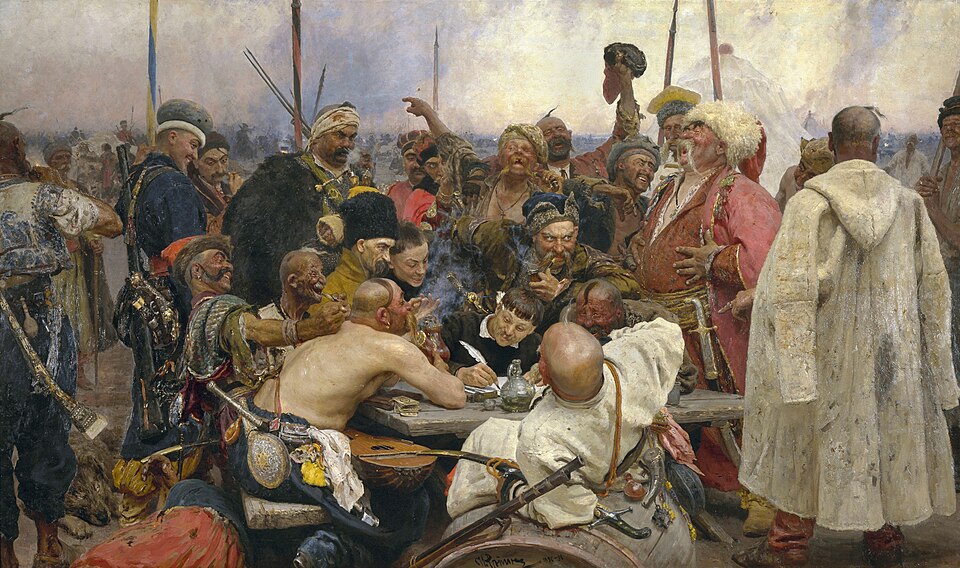
According to a legend fixed in Ukrainian memory, in 1676 Mehmed IV, Sultan of the Ottoman Empire, sent an ultimatum to the Zaporozhian Cossacks, the fierce free communities living beyond the rapids of the lower Dnieper River. Despite Ottoman forces having recently suffered defeat at Cossack hands, Mehmed's letter piled on titles — ruler of Macedonia, Babylon, Jerusalem, Upper and Lower Egypt, emperor of emperors — and ordered the Cossacks to submit without resistance. It was less a request than a performance of power.
The Cossacks, led by Ivan Sirko, answered in kind, but inverted. Their reply mocked every one of the sultan's titles, calling him things no polite record dares repeat in full, and refused submission with gleeful, profane defiance. No original of either letter has ever surfaced in Ottoman archives, and historians such as Daniel C. Waugh have traced how an older, more restrained correspondence between the sultan and Cossacks of Chyhyryn was transformed over the eighteenth century into this vulgar, wildly popular version, of which some seventeen variants circulated in Russian and Ukrainian sources.
Whether the letter was ever truly sent to Mehmed IV or is a piece of folk literature that only later attached itself to his name remains disputed. But the story's appeal was irresistible to nineteenth-century Russian imagination, which saw in the Zaporozhians a picture of primitive vitality and contempt for authority — a striking counterpoint to the more regimented subjects of the Russian state. Nikolai Gogol's 1842 novella Taras Bulba mentioned the episode in passing, helping cement its place in popular memory.
It was through Gogol's circle, and specifically through his association with the patron Savva Mamontov, that the Ukrainian-born Russian painter Ilya Repin encountered the tale and made his first sketches for a painting at Mamontov's home. Repin began the canvas in 1880 and did not finish it until 1891, gathering studies from stanitsa Pashkovskaya, Yekaterinoslav, and Kachanivka along the way, and recording the years of labor along the painting's lower edge. The historian Dmytro Yavornytsky, an expert on Cossack history, helped Repin get the details right.
The men who posed as roaring, tear-streaked Cossacks were not actual descendants of the Sich but friends of Repin and academics from Saint Petersburg University, drawn from Ukrainian, Russian, Cossack, Jewish, and Polish backgrounds — a quietly cosmopolitan cast standing in for a legend of fierce Cossack unity. When the painting was complete, Alexander III bought it for 35,000 rubles, a record sum for a Russian painting at the time.
More from Art

The Painting With No Foreground
A single robed figure stares out at an empty grey sea — and the emptiness itself became a scandal. When it was unveiled in Berlin in 1810, no one knew quite what to do with it.

The Painter Who Chased the Light
For a few purple minutes each evening, an American exile knelt in an English garden and raced the dying sun to paint two little girls lighting lanterns. It took him two years to finish.

When a President Became a God
Look straight up inside the U.S. Capitol dome and you will find George Washington enthroned among the clouds, surrounded by goddesses — the founding father transformed into myth.

Marble Brought Back to Life
A corpse asleep, a wing barely brushing her skin — and marble somehow learns to breathe. This is the moment Antonio Canova dared to carve.

The World Turned Upside Down
Look closely at a sixteenth-century Flemish village and you'll find a man biting a pillar, another carrying daylight in a basket, and a wife slipping a blue cloak over her husband's shoulders. Every gesture is a joke — if you know the language.

The Girl in the Glass Case
She stood two-thirds life size, dressed in a real tutu and human hair — and the critics who saw her in 1881 recoiled as if she were something obscene.