The Leap Across the Canvas
A god flies through the air toward a woman he has never met, and in that single frozen instant, a painter changed how mythology could be seen forever.
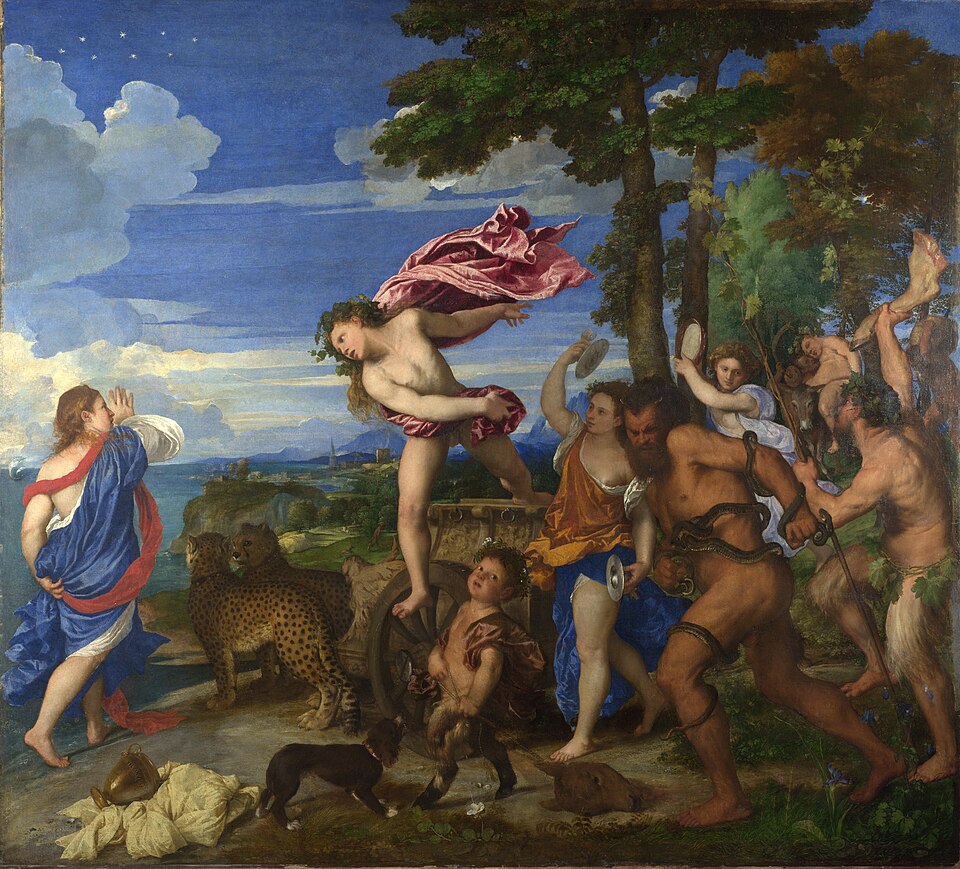
In 1520, a young painter named Titian faced an unusual problem: he had to finish a job left behind by a dead genius. Raphael, who had received an advance payment to paint a Triumph of Bacchus for Alfonso I d'Este, Duke of Ferrara, died before completing more than a preliminary drawing. The commission passed to Titian, who was tasked with adding to a cycle of mythological paintings destined for the Duke's Camerino d'Alabastro, a private chamber in his Ferrara palazzo devoted entirely to scenes drawn from classical literature.
Titian turned to the ancient poets for his subject. Catullus and Ovid had both written of Ariadne, the woman abandoned on the island of Naxos by her lover Theseus, whose departing ship can be seen sailing away in the distance of the finished painting. Left alone on the shore, Ariadne is suddenly discovered by Bacchus, god of wine, who arrives in a chariot pulled by two cheetahs — animals likely modeled on real cheetahs kept in the Duke's own menagerie, even though Ovid's original text described tigers.
The moment Titian chose to paint is the instant of falling in love. Bacchus, smitten at first sight, leaps out of his moving chariot in mid-air, reaching toward Ariadne even before he has landed. The National Gallery, where the painting now hangs, describes Ariadne's expression in that instant as one of fear — she does not yet know that Bacchus will lift her into the heavens and transform her into the constellation Corona Borealis, the Northern Crown, visible glittering above her head in the sky.
Titian built his composition around a striking diagonal split. One triangle of the canvas is dominated by still, expensive ultramarine sky, calm except for the two lovers caught mid-motion. The other triangle churns with movement, rendered in earthy greens and browns, full of Bacchus's riotous followers. Among them is a satyr entangled with snakes, a figure that echoes the recently rediscovered ancient sculpture of Laocoön and His Sons — a work Titian is known to have sketched more than once, though in his painting the satyr is simply girding himself with serpents, as Catullus described, rather than fighting for his life.
Smaller details reveal Titian's wit and attention. A King Charles Spaniel, a motif that recurs throughout his career and probably reflects an actual court pet, barks at a boy satyr in the crowd. A gold urn bears the artist's own signature, TICIANVS, echoing real antiquities in the Duke's collection. Scholars have also pointed to the boy satyr Ampelos, strutting near the center of the scene, as a deliberate reference to Bacchus's love for him as told by the Greek poet Nonnos — a boy whose death and transformation into a grapevine gave Bacchus the very gift of wine.
More from Art

The Painting With No Foreground
A single robed figure stares out at an empty grey sea — and the emptiness itself became a scandal. When it was unveiled in Berlin in 1810, no one knew quite what to do with it.

The Painter Who Chased the Light
For a few purple minutes each evening, an American exile knelt in an English garden and raced the dying sun to paint two little girls lighting lanterns. It took him two years to finish.

When a President Became a God
Look straight up inside the U.S. Capitol dome and you will find George Washington enthroned among the clouds, surrounded by goddesses — the founding father transformed into myth.

Marble Brought Back to Life
A corpse asleep, a wing barely brushing her skin — and marble somehow learns to breathe. This is the moment Antonio Canova dared to carve.

The World Turned Upside Down
Look closely at a sixteenth-century Flemish village and you'll find a man biting a pillar, another carrying daylight in a basket, and a wife slipping a blue cloak over her husband's shoulders. Every gesture is a joke — if you know the language.

The Girl in the Glass Case
She stood two-thirds life size, dressed in a real tutu and human hair — and the critics who saw her in 1881 recoiled as if she were something obscene.