The Library That Held the World's Memory
Half a million scrolls, a temple to the Muses, and a question that still haunts historians: how did it all disappear?
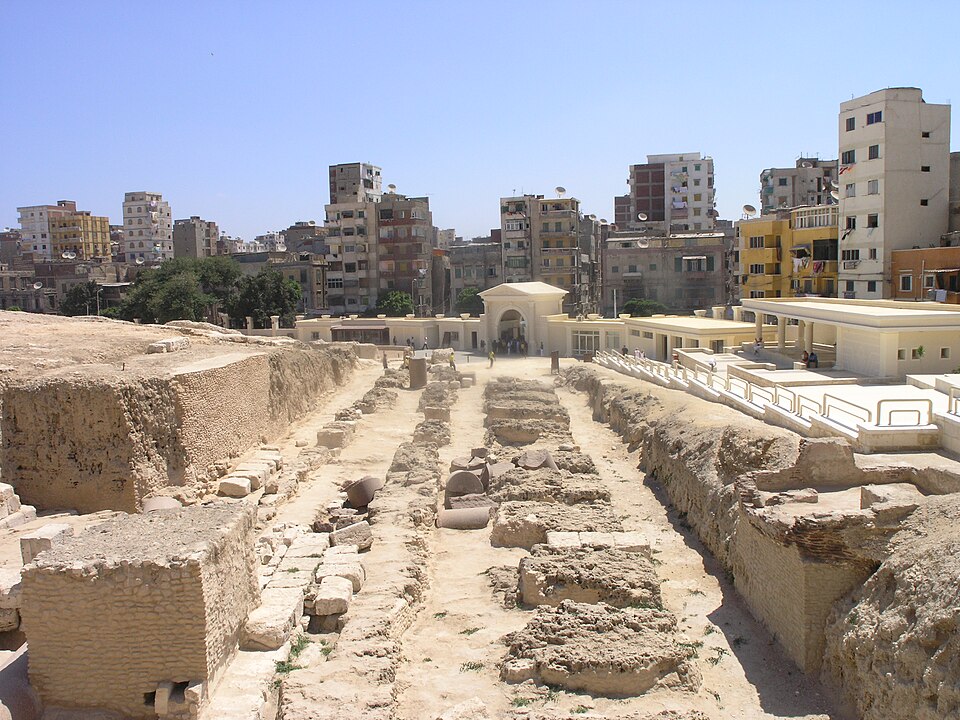
In the third century BC, a ship could not legally dock in Alexandria without surrendering its books. Officials would seize any scroll found aboard, copy it, and hand the copy back to its owner while the original stayed in the city — a policy so aggressive that within a few generations, Alexandria had assembled what may have been the largest collection of written knowledge the ancient world had ever seen. Estimates of its holdings range wildly, from 40,000 to as many as 700,000 papyrus scrolls, but even the low end would have dwarfed any library then in existence.
The institution had grown out of an idea attributed to Demetrius of Phalerum, an exiled Athenian statesman who proposed to Ptolemy I Soter that Alexandria should host a universal library. Ptolemy I may have drawn up the plans, but it was his son, Ptolemy II Philadelphus, who likely saw the Library built. It formed part of a larger complex called the Mouseion, dedicated to the nine Muses, goddesses of the arts — a research institution rather than a simple archive, stocked with texts gathered through the Ptolemies' relentless acquisition policy.
Alexandria itself had been founded in 332 BC by Alexander the Great, and after his death the city fell under the control of Ptolemy I Soter, founder of a dynasty that would rule Egypt for three centuries. Uninterested in expanding his borders through war, Ptolemy instead cultivated science and literature, adopting Egyptian customs and even the title of Pharaoh. The city he rebuilt became the most celebrated capital of its age, and the Library was its crowning achievement.
Scholars flocked there. Zenodotus of Ephesus worked to standardize the texts of Homer. Callimachus compiled the Pinakes, sometimes called the world's first library catalog. Apollonius of Rhodes wrote the epic Argonautica. Eratosthenes of Cyrene calculated the Earth's circumference to within a few hundred kilometers of the true figure. Hero of Alexandria built the first recorded steam engine. Aristophanes of Byzantium devised the system of Greek diacritics, and Aristarchus of Samothrace produced the definitive texts of Homer's poems along with extensive commentary. Euclid, Archimedes, Herophilos, and Ptolemy the astronomer are also linked to this remarkable scientific community. Under Ptolemy III Euergetes, a daughter library was established at the Serapeum, a temple to the god Serapis.
The decline began long before any single fire. In 145 BC, Ptolemy VIII Physcon purged intellectuals from Alexandria, prompting the head librarian Aristarchus of Samothrace to resign and exile himself to Cyprus. Other scholars, including Dionysius Thrax and Apollodorus of Athens, scattered to other cities. In 48 BC, Julius Caesar's forces accidentally set fire to part of Alexandria during his civil war, and some of the Library's holdings may have burned — though it seems to have survived or been rebuilt soon after, since the geographer Strabo visited the Mouseion around 20 BC, and the scholar Didymus Chalcenterus produced prodigious work there.
More from Art

The Painting With No Foreground
A single robed figure stares out at an empty grey sea — and the emptiness itself became a scandal. When it was unveiled in Berlin in 1810, no one knew quite what to do with it.

The Painter Who Chased the Light
For a few purple minutes each evening, an American exile knelt in an English garden and raced the dying sun to paint two little girls lighting lanterns. It took him two years to finish.

When a President Became a God
Look straight up inside the U.S. Capitol dome and you will find George Washington enthroned among the clouds, surrounded by goddesses — the founding father transformed into myth.

Marble Brought Back to Life
A corpse asleep, a wing barely brushing her skin — and marble somehow learns to breathe. This is the moment Antonio Canova dared to carve.

The World Turned Upside Down
Look closely at a sixteenth-century Flemish village and you'll find a man biting a pillar, another carrying daylight in a basket, and a wife slipping a blue cloak over her husband's shoulders. Every gesture is a joke — if you know the language.

The Girl in the Glass Case
She stood two-thirds life size, dressed in a real tutu and human hair — and the critics who saw her in 1881 recoiled as if she were something obscene.