The Life Picasso Painted Over a Death
Beneath the surface of one of the bleakest paintings of the 20th century lies another picture entirely — a hidden self-portrait, a dead friend's face, and a birdman that vanished into blue.
In May 1903, in a Barcelona studio, Pablo Picasso stood before a canvas he had already used once before. Underneath the paint that would become La Vie lay The derniers Moments, a work painted in 1899 that Picasso had presented at the Paris International Exhibition in 1900. Picasso painted over it, and in doing so, buried one story to tell another.
What emerged was a haunting composition, 196.5 by 129.2 centimetres, dominated by blue. On one side stands a naked couple; confronting them is a mother cradling a child. Behind them, within the space of what appears to be an artist's studio, two smaller paintings hang on the wall — one showing an embracing nude couple, the other a solitary crouching figure that echoes Vincent van Gogh's Sorrow. X-ray analysis later revealed that Picasso had painted over yet another image hidden beneath this one: a birdman attacking a reclining naked woman, traces of which remain faintly visible.
The male figure in the final composition is not, as X-rays also showed, a self-portrait — though Picasso started with one. He replaced his own face with that of his friend Carlos Casagemas, a fellow painter who had died by suicide not long before. That substitution, scholars agree, is the key that unlocks the painting's mystery: La Vie is not simply an allegory of life, but a meditation staged inside a studio, where questions of art, mortality, and identity collapse into one another.
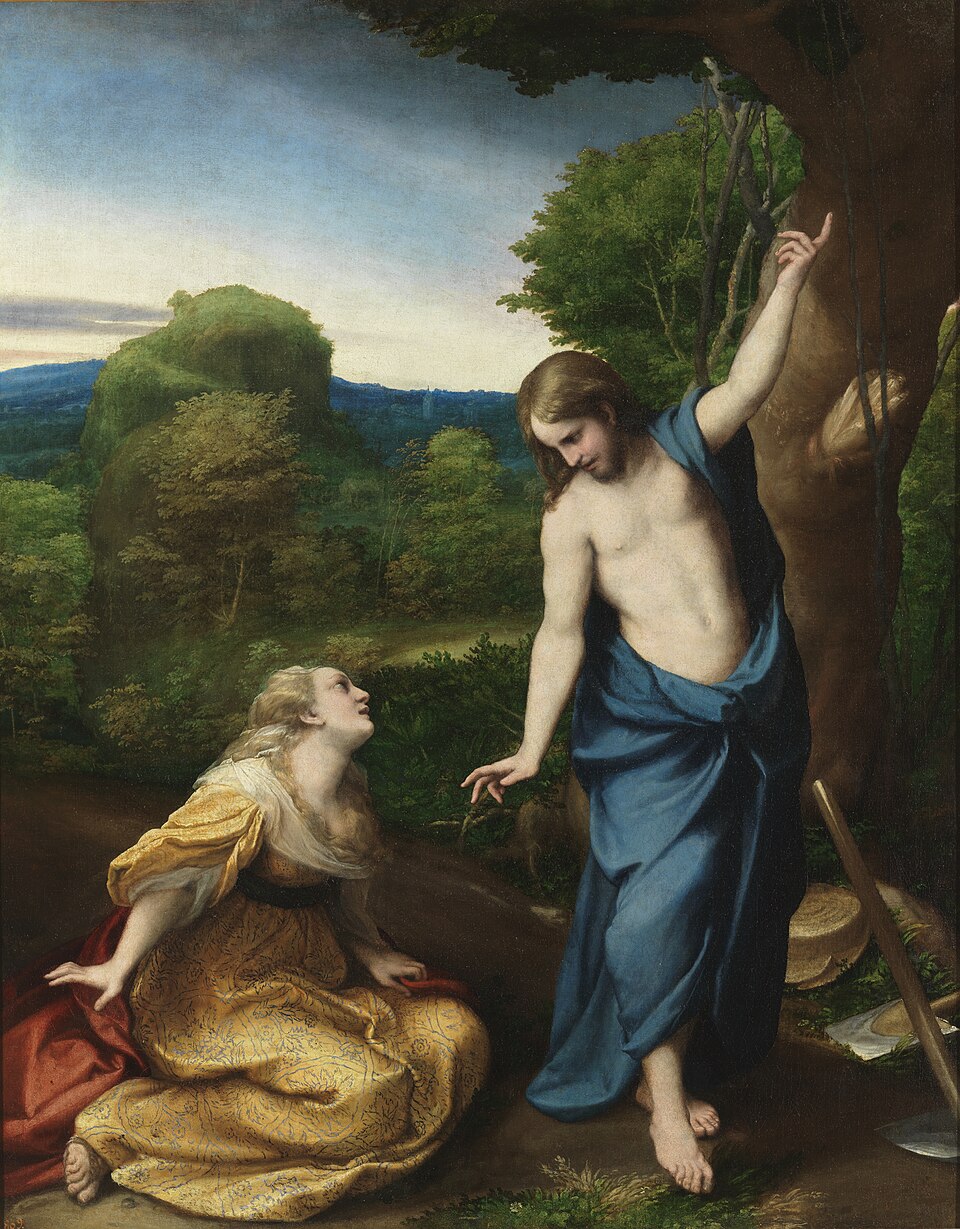
At the center of the canvas is a gesture — an enigmatic motion between the figures that has puzzled viewers for over a century. In 2003, scholars Gereon Becht-Jördens and Peter M. Wehmeier proposed that Picasso drew this gesture from Antonio da Correggio's Noli me tangere, the Prado masterpiece depicting Christ appearing to Mary Magdalene after his resurrection. Their reading operates on two levels: one biographical, tied to the pain of separation from a mother who had once adored and encouraged her son's early gift; the other self-referential, casting the young artist as a kind of modern Messiah — one who must detach from his first admiring audience to fulfill a new artistic mission.
There is real poignancy in the idea that Picasso's own mother, in this reading, represents his earliest audience — dazzled by his youthful mastery of academic painting, but unable to follow him into the modern art he was inventing. To become who he needed to become, Picasso had to leave behind both her comprehension and, symbolically, her embrace. La Vie, filled with borrowed Christian iconography — echoes of the Last Supper, of resurrection, of veiled and gesturing hands — turns this personal rupture into something almost sacred.
More from Art

The Painting With No Foreground
A single robed figure stares out at an empty grey sea — and the emptiness itself became a scandal. When it was unveiled in Berlin in 1810, no one knew quite what to do with it.

The Painter Who Chased the Light
For a few purple minutes each evening, an American exile knelt in an English garden and raced the dying sun to paint two little girls lighting lanterns. It took him two years to finish.

When a President Became a God
Look straight up inside the U.S. Capitol dome and you will find George Washington enthroned among the clouds, surrounded by goddesses — the founding father transformed into myth.

Marble Brought Back to Life
A corpse asleep, a wing barely brushing her skin — and marble somehow learns to breathe. This is the moment Antonio Canova dared to carve.

The World Turned Upside Down
Look closely at a sixteenth-century Flemish village and you'll find a man biting a pillar, another carrying daylight in a basket, and a wife slipping a blue cloak over her husband's shoulders. Every gesture is a joke — if you know the language.

The Girl in the Glass Case
She stood two-thirds life size, dressed in a real tutu and human hair — and the critics who saw her in 1881 recoiled as if she were something obscene.