The Lightning Rod of Madness: Van Gogh's Irises
Weeks after committing himself to an asylum, Vincent van Gogh walked into its walled garden and found something that, for a moment, held his unraveling mind together.
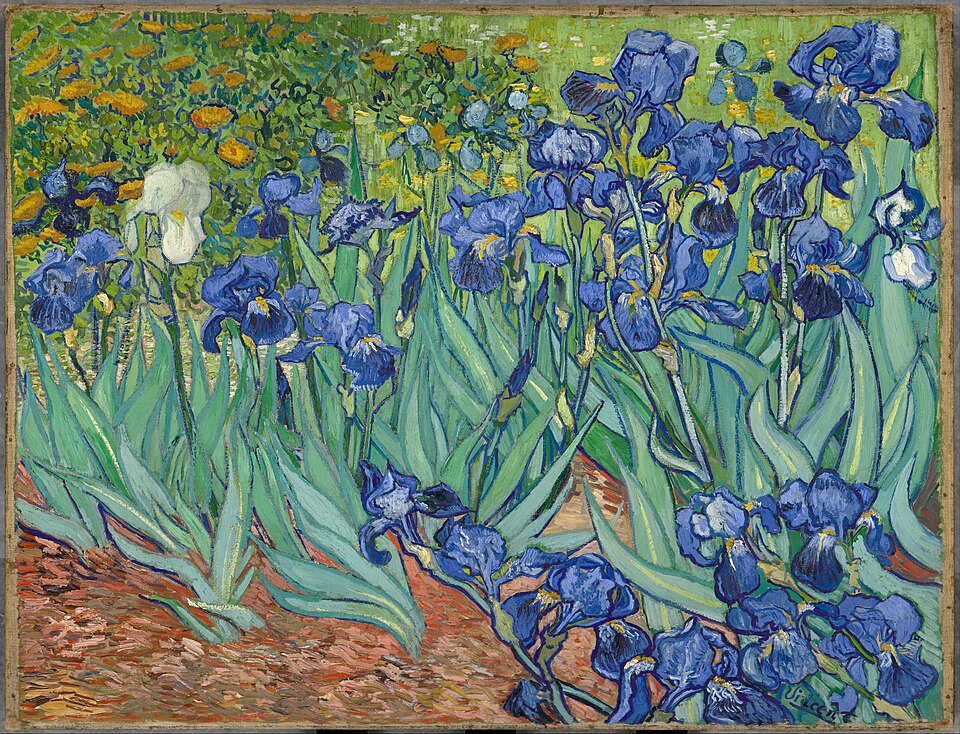
In May 1889, Vincent van Gogh voluntarily entered the Saint-Paul-de-Mausole asylum in Saint-Rémy-de-Provence. Within the same week of his arrival, restricted almost entirely to the hospital grounds, he began painting the irises blooming in its enclosed garden — the only nature he could reach beyond the view from his spare-room studio window.
He worked directly from life, with no preparatory drawings. Embedded in the paint itself, researchers would later find a pollen cone that had fallen from one of the garden's umbrella pines — a literal trace of the afternoon he spent among the flowers. Van Gogh regarded the painting as a study rather than a finished statement, but he described the act of painting itself as something closer to survival, calling it, in his own words, the lightning rod for his illness.
The canvas is packed with deep blues and violets, tangled among lush green leaves, red-orange earth, and touches of yellow in the background. Van Gogh's thick, energetic impasto strokes give the flowers a rippling, almost overflowing presence, with blooms pushing right to the edges of the composition, pulling the eye restlessly across the canvas.
Van Gogh had likely already painted a related work, Iris, showing a single mature bloom surrounded by developing buds — probably finished just before his admission. Bearded irises flower for roughly three weeks, and since Irises shows a field already thick with blossoms, some beginning to wilt, it seems the two paintings were separated by about ten days.
Japanese woodblock prints, which Van Gogh collected avidly, shaped his eye. He associated irises with Japan, where the flower held a prized place in art, and he blended that imagined Japan with the sun-drenched world of Provence in his mind. Color theory mattered too: Van Gogh leaned on Michel-Eugène Chevreul's ideas about complementary colors — violet intensified by yellow — filtered through Charles Blanc's writings on Delacroix, an artist he revered.
More from Art

The Painting With No Foreground
A single robed figure stares out at an empty grey sea — and the emptiness itself became a scandal. When it was unveiled in Berlin in 1810, no one knew quite what to do with it.

The Painter Who Chased the Light
For a few purple minutes each evening, an American exile knelt in an English garden and raced the dying sun to paint two little girls lighting lanterns. It took him two years to finish.

When a President Became a God
Look straight up inside the U.S. Capitol dome and you will find George Washington enthroned among the clouds, surrounded by goddesses — the founding father transformed into myth.

Marble Brought Back to Life
A corpse asleep, a wing barely brushing her skin — and marble somehow learns to breathe. This is the moment Antonio Canova dared to carve.

The World Turned Upside Down
Look closely at a sixteenth-century Flemish village and you'll find a man biting a pillar, another carrying daylight in a basket, and a wife slipping a blue cloak over her husband's shoulders. Every gesture is a joke — if you know the language.

The Girl in the Glass Case
She stood two-thirds life size, dressed in a real tutu and human hair — and the critics who saw her in 1881 recoiled as if she were something obscene.