The Little Man Who Outlasted Empires
A bronze boy no taller than a toddler has been peeing into a Brussels fountain for four centuries — and somehow become one of Europe's most beloved monuments.
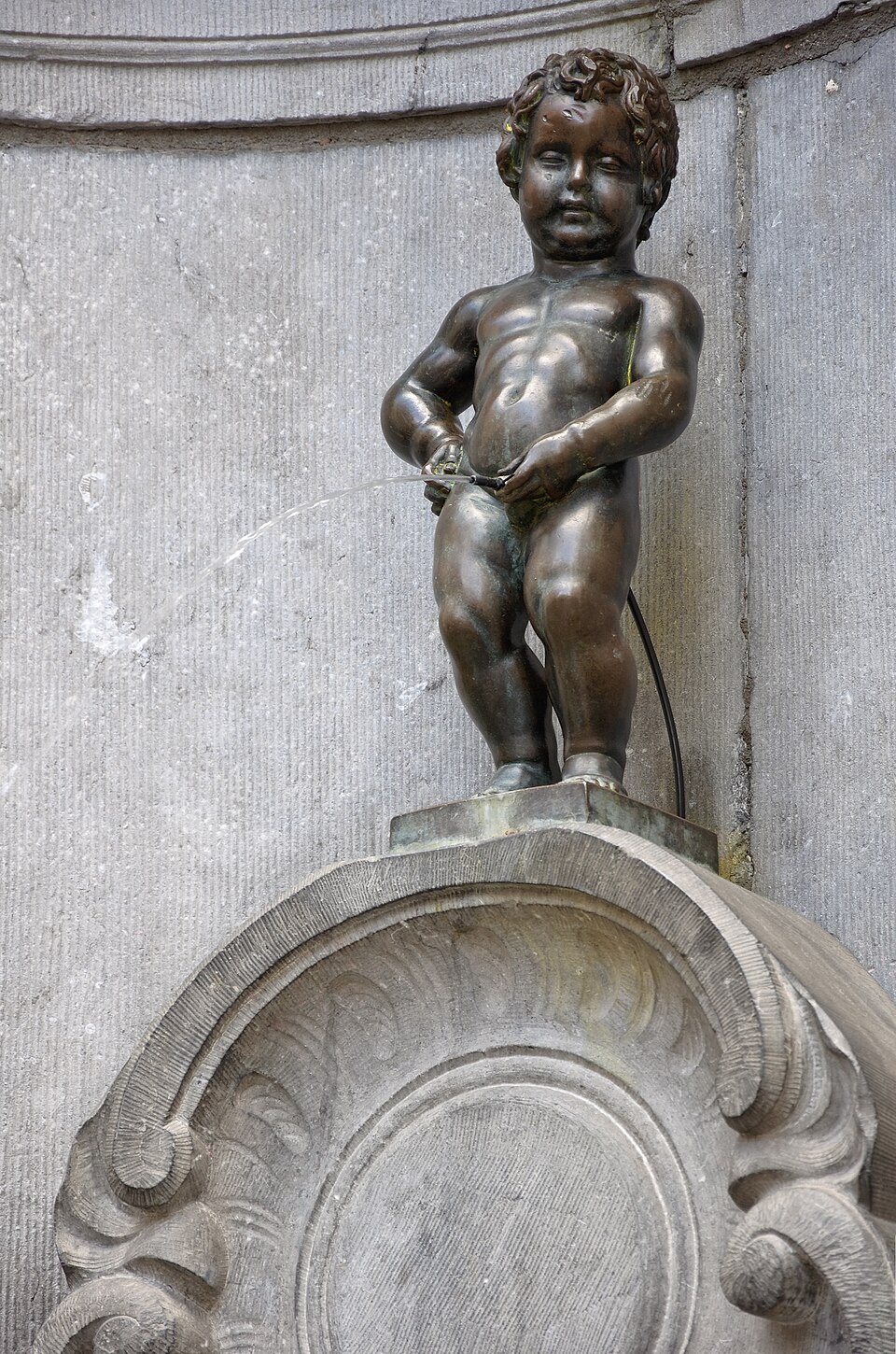
On a narrow corner where the Rue du Chêne meets the pedestrian Rue de l'Étuve in central Brussels, a small crowd always gathers around something you might expect to walk past without noticing: a bronze statue barely 55.5 centimeters tall, depicting a nude boy urinating into a stone basin. This is Manneken Pis, and despite its diminutive size and irreverent subject, it has become one of the most recognized symbols of Brussels and of Belgium itself.
The statue's story begins earlier than most visitors realize. An administrative document from 1451–52, concerning the water lines that supplied Brussels' fountains, contains the earliest known reference to Manneken Pis. In its original form, the little fountain stood on a column, pouring water into a double rectangular stone basin, and served a genuinely practical purpose: distributing drinking water to the city. A 16th-century map by cartographers Georg Braun and Frans Hogenberg shows it standing directly in the street rather than tucked into a corner niche as it is today. A 1616 painting of Brussels' Ommegang procession, the work of court painters Denis Van Alsloot and Antoon Sallaert, along with its preparatory drawing, even shows the figure dressed as a shepherd.
The statue Brussels knows today dates to 1618 or 1619, when the City Council commissioned a new bronze version from the Brabantine sculptor Jérôme Duquesnoy the Elder — father of the architect Jérôme Duquesnoy the Younger and the sculptor François Duquesnoy. It was put in place at the corner of the Rue de l'Étuve and Rue des Grands Carmes. At the same time, stone cutter Daniel Raessens remodeled the supporting column and the basin beneath it.
Manneken Pis has weathered its share of hazards over the centuries. During the French bombardment of Brussels in 1695, the statue survived undamaged, though the water pipes feeding it were affected and it stopped flowing for a time. A pamphlet published that same year is the earliest text describing Manneken Pis as an object of glory admired by all, renowned throughout the world — the first documented moment the little statue became a symbol of the people of Brussels. Tradition holds that after the bombardment, it was triumphantly restored to its pedestal, with a Latin inscription placed above its head: a passage declaring that the Lord had raised it on a stone base, now lifting its head above its enemies.
An engraving by Jacobus Harrewijn from 1697 shows that by then the fountain had moved from the open street into a recessed corner at the junction of Rue du Chêne and Rue de l'Étuve, protected behind a gate. In 1770, the original column and double basin were removed altogether, and the statue was set into a new blue stone niche in rocaille style — repurposed from another dismantled Brussels fountain. Water now simply flowed through a grating in the ground, later replaced by a basin in the 19th century. The new setting, ironically, made the little figure appear even smaller than before. Wrought iron railings have protected the whole ensemble since, the current version dating from 1851.
More from Art

The Painting With No Foreground
A single robed figure stares out at an empty grey sea — and the emptiness itself became a scandal. When it was unveiled in Berlin in 1810, no one knew quite what to do with it.

The Painter Who Chased the Light
For a few purple minutes each evening, an American exile knelt in an English garden and raced the dying sun to paint two little girls lighting lanterns. It took him two years to finish.

When a President Became a God
Look straight up inside the U.S. Capitol dome and you will find George Washington enthroned among the clouds, surrounded by goddesses — the founding father transformed into myth.

Marble Brought Back to Life
A corpse asleep, a wing barely brushing her skin — and marble somehow learns to breathe. This is the moment Antonio Canova dared to carve.

The World Turned Upside Down
Look closely at a sixteenth-century Flemish village and you'll find a man biting a pillar, another carrying daylight in a basket, and a wife slipping a blue cloak over her husband's shoulders. Every gesture is a joke — if you know the language.

The Girl in the Glass Case
She stood two-thirds life size, dressed in a real tutu and human hair — and the critics who saw her in 1881 recoiled as if she were something obscene.