The Madonna Who Emerged from the Clouds
A pope commissioned it to honor his dead uncle, an artist reportedly wept before it, and a revolutionary once wanted to hang it on a barricade — few paintings have carried this much myth.
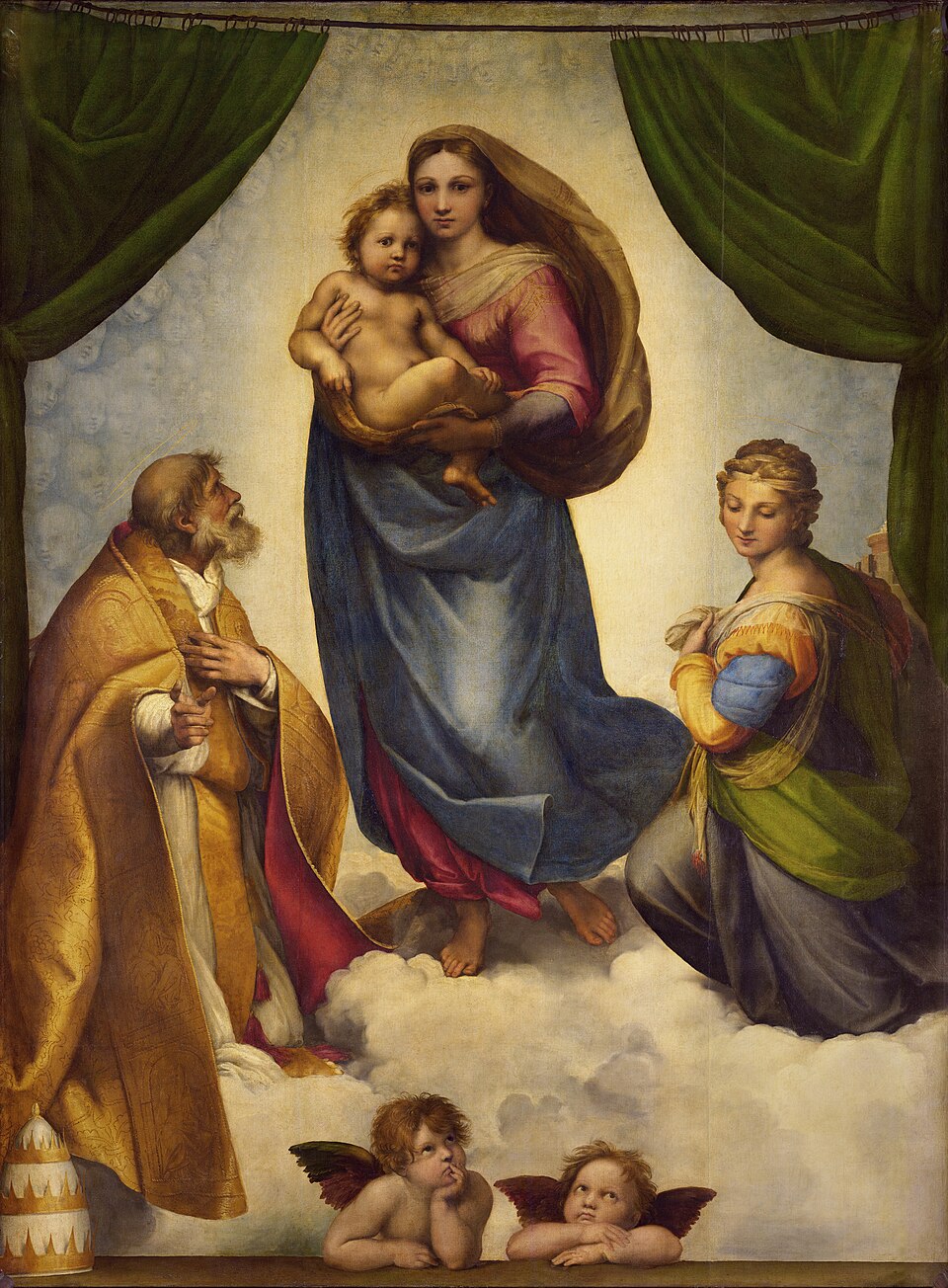
In 1512, Pope Julius II commissioned Raphael to paint an altarpiece for the church of the Benedictine Monastery of San Sisto in Piacenza, in honor of his late uncle, Pope Sixtus IV. The Rovere family, to which both popes belonged, had long-standing ties to the monastery, and the commission stipulated that the painting include both Saint Sixtus and Saint Barbara. Raphael executed the work around 1513–1514, one of the last Madonnas he would ever paint.
The result was an oil on canvas measuring 265 by 196 centimeters, showing the Madonna holding the Christ Child, flanked by Saint Sixtus and Saint Barbara, standing on clouds before dozens of half-hidden putti. Beneath her rest two distinctive winged putti, leaning on their elbows — a detail that would go on to become one of the most reproduced images in Western art. Pigment analysis later revealed the materials of the Renaissance palette Raphael used: malachite mixed with orpiment in the green drapery, natural ultramarine blended with lead white in the Madonna's blue robe, and a mixture of lead-tin-yellow, vermilion, and lead white in Saint Barbara's yellow sleeve.
Giorgio Vasari called it 'a truly rare and extraordinary work.' Legend holds that when the painter Antonio da Correggio first saw it, he was moved to cry out, 'And I also, I am a painter!' Whether or not that moment happened exactly as told, the painting's reputation for provoking awe followed it for centuries.
In 1754, Augustus III of Poland purchased the Sistine Madonna for between 110,000 and 120,000 francs — the highest price paid for any painting for decades to come — and moved it to Dresden. There it achieved a new kind of fame. Stories say Augustus himself moved his throne to display it better. The painting was soon drawn into German intellectual life: Johann Joachim Winckelmann celebrated it in his 1764 history of ancient art, and it became a touchstone in debates over the relationship between Classical and Christian ideals.
A legend called 'Raphael's Dream' arose in the late 18th century, claiming the painter had received a heavenly vision that allowed him to create such a divine Madonna. The painting was said to have stirred viewers into states resembling religious ecstasy — even one of Sigmund Freud's patients was reportedly affected this way. It influenced Goethe, Wagner, and Nietzsche, and Dostoyevsky called it 'the greatest revelation of the human spirit.' During the 1849 Dresden uprising, the anarchist Mikhail Bakunin is said to have urged revolutionaries to hang the painting on the city's barricades, reasoning that the Prussians would be too cultured to fire on a Raphael. In 1855, it was given a room of its own in the newly opened Neues Königliches Museum, designed by Gottfried Semper.
More from Art

The Painting With No Foreground
A single robed figure stares out at an empty grey sea — and the emptiness itself became a scandal. When it was unveiled in Berlin in 1810, no one knew quite what to do with it.

The Painter Who Chased the Light
For a few purple minutes each evening, an American exile knelt in an English garden and raced the dying sun to paint two little girls lighting lanterns. It took him two years to finish.

When a President Became a God
Look straight up inside the U.S. Capitol dome and you will find George Washington enthroned among the clouds, surrounded by goddesses — the founding father transformed into myth.

Marble Brought Back to Life
A corpse asleep, a wing barely brushing her skin — and marble somehow learns to breathe. This is the moment Antonio Canova dared to carve.

The World Turned Upside Down
Look closely at a sixteenth-century Flemish village and you'll find a man biting a pillar, another carrying daylight in a basket, and a wife slipping a blue cloak over her husband's shoulders. Every gesture is a joke — if you know the language.

The Girl in the Glass Case
She stood two-thirds life size, dressed in a real tutu and human hair — and the critics who saw her in 1881 recoiled as if she were something obscene.