The Man Who Became a Question: Rodin's Thinker
He was meant to be a poet gazing at Dante's hell — but somewhere along the way he lost his clothes, his name, and became the whole world's picture of a mind at work.
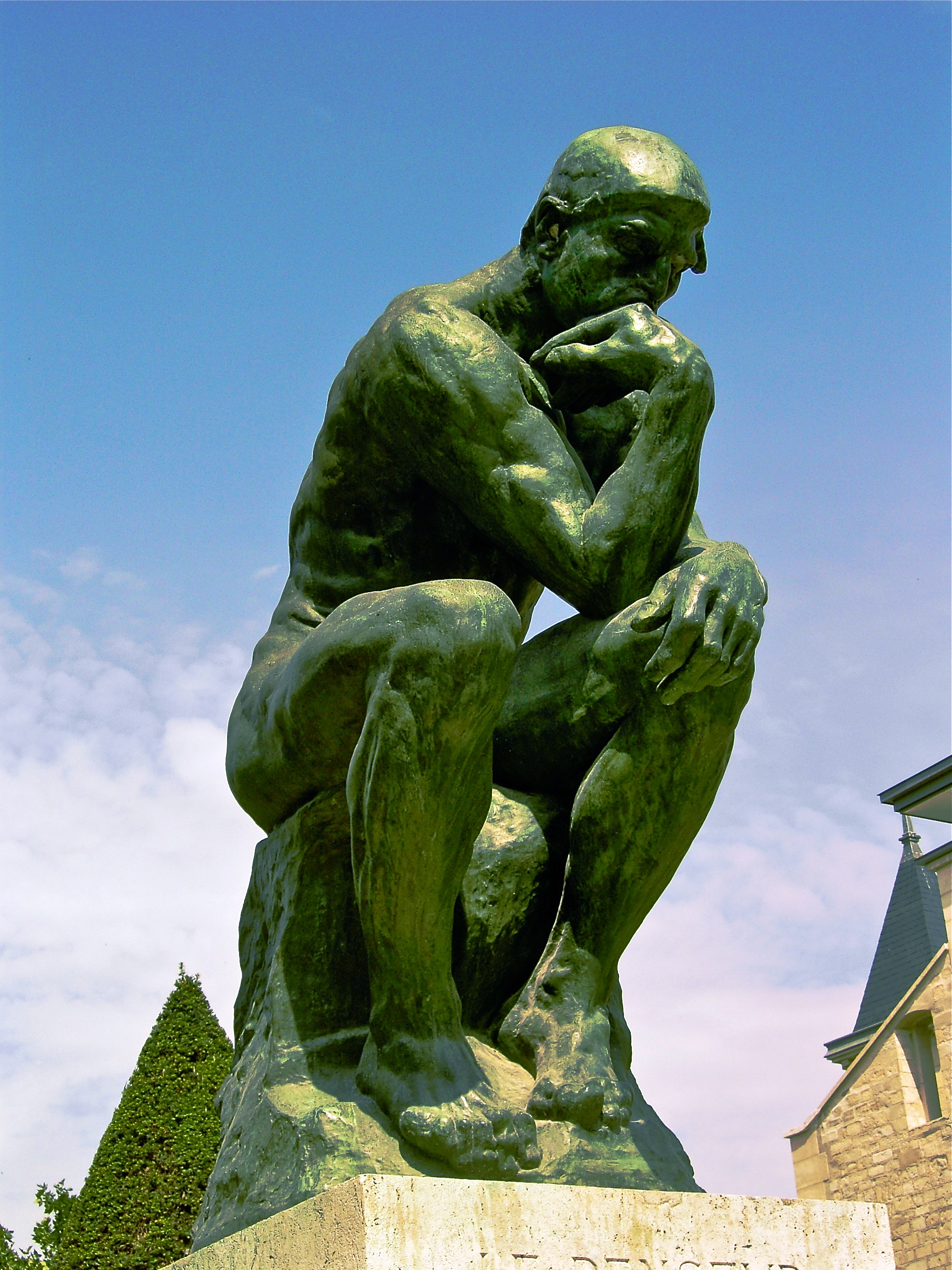
In 1880, Auguste Rodin received a commission to design a monumental bronze doorway for a planned Museum of Decorative Arts in Paris, drawing on Dante Alighieri's Divine Comedy. He chose the Inferno as his subject and began populating the door, later called The Gates of Hell, with dozens of tormented, twisting figures. Among them, perched above the doorway, sat a single brooding man.
Rodin first called this figure The Poet, imagining him as Dante himself, bent forward to observe the suffering souls below and meditate on the poem he was writing. In early studies the man wore clothing and a Florentine-style hat. But as Rodin kept reworking the piece, he abandoned the idea of portraying a specific historical person. He stripped the figure bare, wanting instead a heroic, universal body in the tradition of Michelangelo — a symbol of intellect and poetry rather than one man's likeness.
The pose that resulted is now instantly recognizable: a nude man of heroic scale, seated on a rock, leaning forward, right elbow braced on left thigh, chin resting on the back of his hand. Rodin modeled the muscular body on Jean Baud, a French prizefighter and wrestler who also appeared, separately, on a 1911 Swiss 50-franc banknote. Foundry workers, noticing the figure's resemblance to Michelangelo's seated Lorenzo de' Medici — nicknamed Il Pensieroso — began calling Rodin's man 'The Thinker,' and the name stuck.
Rodin exhibited the figure independently in Copenhagen in 1888, well before its most famous form existed. In 1902 he began enlarging it into a monumental bronze, working with his assistant Henri Lebossé, finishing in 1904. That year it appeared at the International Society in London, at the Paris Salon, and at the St. Louis World's Fair. In 1906 it was installed in front of the Panthéon in Paris — the first time Rodin's work stood in a public space. The following year, on 16 January 1905 by some accounts of the sequence — though installed before the attack — the statue was damaged by a mentally disturbed man, prompting Rodin to cast a replacement.
That Panthéon cast moved in 1922 to the Hôtel Biron, the building Rodin had used as his studio and which became the Musée Rodin after his death; it remains there today, in the museum garden. During his lifetime Rodin authorized ten bronze castings of the monumental Thinker, and the Musée Rodin later produced twelve more posthumous copies from the original mold. A copy also marks his grave at Meudon. In total, about 29 monumental-sized bronze casts — each roughly 185 centimeters tall — exist in museums and public squares worldwide, alongside numerous smaller studies and plaster versions.
More from Art

The Painting With No Foreground
A single robed figure stares out at an empty grey sea — and the emptiness itself became a scandal. When it was unveiled in Berlin in 1810, no one knew quite what to do with it.

The Painter Who Chased the Light
For a few purple minutes each evening, an American exile knelt in an English garden and raced the dying sun to paint two little girls lighting lanterns. It took him two years to finish.

When a President Became a God
Look straight up inside the U.S. Capitol dome and you will find George Washington enthroned among the clouds, surrounded by goddesses — the founding father transformed into myth.

Marble Brought Back to Life
A corpse asleep, a wing barely brushing her skin — and marble somehow learns to breathe. This is the moment Antonio Canova dared to carve.

The World Turned Upside Down
Look closely at a sixteenth-century Flemish village and you'll find a man biting a pillar, another carrying daylight in a basket, and a wife slipping a blue cloak over her husband's shoulders. Every gesture is a joke — if you know the language.

The Girl in the Glass Case
She stood two-thirds life size, dressed in a real tutu and human hair — and the critics who saw her in 1881 recoiled as if she were something obscene.