The Man Who Drew Impossible Stairs
He insisted he had no talent for mathematics — yet mathematicians would spend decades unpacking the puzzles hidden inside his prints.
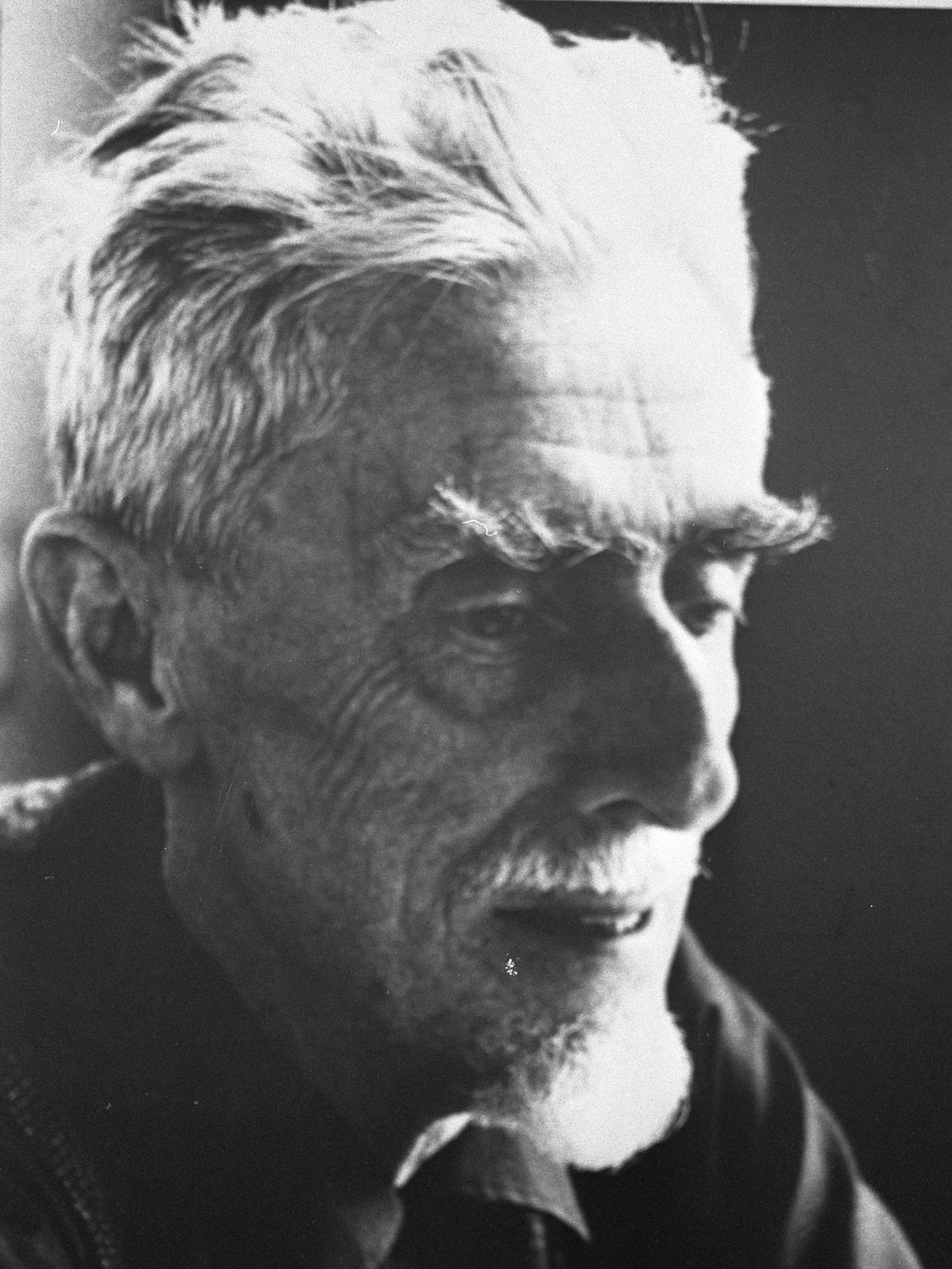
Maurits Cornelis Escher was born on 17 June 1898 in Leeuwarden, in a house that is now part of the Princessehof Ceramics Museum. The youngest son of civil engineer George Arnold Escher and his second wife Sara Gleichman, he was a sickly, indifferent student known to family as 'Mauk,' who failed second grade and struggled through school despite an obvious gift for drawing. In 1918 he entered the Technical College of Delft, then studied at the Haarlem School of Architecture and Decorative Arts from 1919 to 1922, where a skin infection and poor grades in architecture pushed him toward decorative arts under graphic artist Samuel Jessurun de Mesquita.
In 1922, Escher traveled through Italy — Florence, San Gimignano, Volterra, Siena, Ravello — and then through Spain, visiting Madrid, Toledo, and Granada. It was in Granada, at the fourteenth-century Alhambra, that he first encountered the interlocking geometric tilework that would define his life's obsession: tessellation. He returned to Italy and settled in Rome from 1923 to 1935, where he met Jetta Umiker, a Swiss woman he married in 1924. Their first son, Giorgio (George), was born in Rome, followed later by Arthur and Jan.
Throughout the 1920s and early 1930s, Escher traveled restlessly through the Italian countryside — Viterbo, the Abruzzi, Corsica, Calabria, the Amalfi coast, Gargano, Sicily — sketching towns and landscapes that would populate his early, more observational work. In May and June 1936 he returned to Spain and spent days at the Alhambra making detailed drawings of its mosaics, later admitting the pursuit had become 'a real mania to which I have become addicted.' He also studied the Mezquita of Cordoba. This journey marked a turning point: after 1937 his art moved from the studio-bound observation of nature and architecture toward pure geometric analysis and visual imagination.
Politics forced the next move. By 1935, Mussolini's Italy had grown intolerable to Escher, who had no interest in ideology but abhorred fanaticism. When his eldest son George was made, at age nine, to wear a Balilla fascist youth uniform to school, the family left, settling for two years in Château-d'Œx, Switzerland. In 1937 his brother Berend, after seeing some of his work, steered him toward mathematics — a meeting that changed everything. Escher began reading about symmetry, and by the late 1930s the family had moved again, to Belgium.
The outbreak of war upended them once more: in 1941, the German occupation forced the family to flee Belgium for the Netherlands. It was in these years, and the decades after, that Escher produced the work for which he is remembered — Metamorphosis I in 1937, Day and Night and Sky and Water I in 1938, Metamorphosis II in 1940, and later Reptiles, Drawing Hands, House of Stairs, and in 1953 what many consider his masterpiece, Relativity. In the mid-1950s his fascination turned toward depicting infinity within a two-dimensional plane, and in 1958 he met the mathematician H.S.M. Coxeter, whose work became a lasting influence and whose friendship endured for the rest of Escher's life.
More from Art

The Painting With No Foreground
A single robed figure stares out at an empty grey sea — and the emptiness itself became a scandal. When it was unveiled in Berlin in 1810, no one knew quite what to do with it.

The Painter Who Chased the Light
For a few purple minutes each evening, an American exile knelt in an English garden and raced the dying sun to paint two little girls lighting lanterns. It took him two years to finish.

When a President Became a God
Look straight up inside the U.S. Capitol dome and you will find George Washington enthroned among the clouds, surrounded by goddesses — the founding father transformed into myth.

Marble Brought Back to Life
A corpse asleep, a wing barely brushing her skin — and marble somehow learns to breathe. This is the moment Antonio Canova dared to carve.

The World Turned Upside Down
Look closely at a sixteenth-century Flemish village and you'll find a man biting a pillar, another carrying daylight in a basket, and a wife slipping a blue cloak over her husband's shoulders. Every gesture is a joke — if you know the language.

The Girl in the Glass Case
She stood two-thirds life size, dressed in a real tutu and human hair — and the critics who saw her in 1881 recoiled as if she were something obscene.