The Man Who Named the Pacific and Never Saw It End
He set out to find a shortcut to the Spice Islands and instead found the width of the whole Earth — a discovery that killed him before he could see it proven.
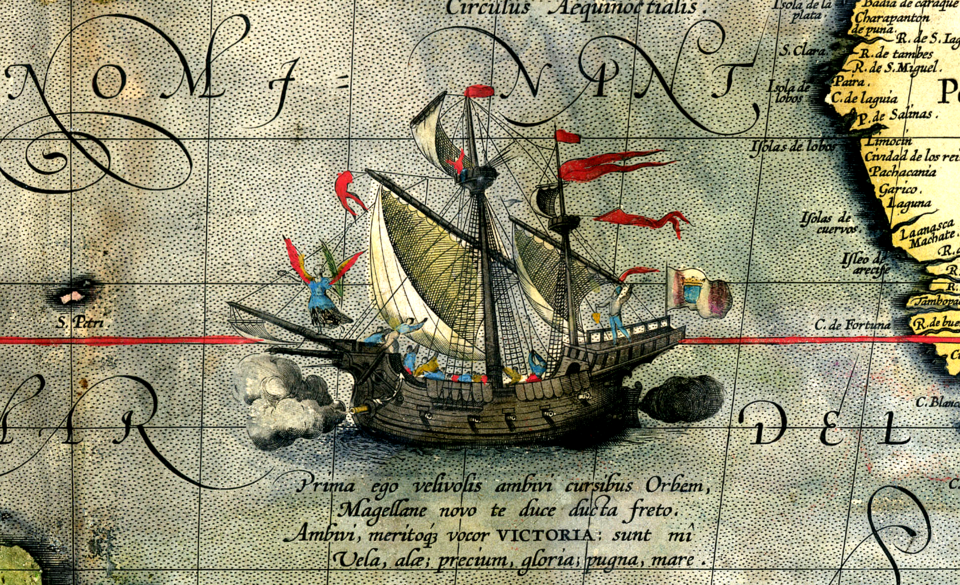
Around 1480, in northern Portugal, a boy named Fernão de Magalhães was born into minor nobility. He grew up a page in the royal court, and by March 1505, at twenty-five, he had sailed for Portuguese India in a fleet of 22 ships. Over the following years he fought at Cannanore in 1506, where he was wounded, and later at the Battle of Diu in 1509.
In September 1509 he sailed under Diogo Lopes de Sequeira on the first Portuguese embassy to Malacca, alongside his friend Francisco Serrão. When the expedition fell victim to a native conspiracy, Magellan risked his life to warn Sequeira and help rescue Serrão and others stranded ashore. Two years later, in 1511, under the new governor Afonso de Albuquerque, Magellan and Serrão took part in the actual conquest of Malacca. Afterward he returned to Portugal with plunder and a baptized Malay servant named Enrique, who would travel with him for the rest of his life.
Magellan's fortunes soured. Sent to fight at the Moroccan stronghold of Azemmour, he was wounded again in August 1513, left with a permanent limp, and accused (falsely) of illegal trade with the Moors. Denied further royal favor by King Manuel I, he found his repeated proposals to sail west to the Spice Islands flatly rejected. In 1517 he left Portugal for Spain. In Seville he married Beatriz Barbosa, had two children who died young, and pitched his westward route to King Charles I — who, unlike Manuel, said yes.
Charles named him admiral of a five-ship fleet, the Armada of Molucca, and made him a Commander of the Order of Santiago. On 10 August 1519 the ships left Seville, delayed more than five weeks at Sanlúcar de Barrameda while suspicious Spanish officials replaced much of the Portuguese-heavy crew. On 20 September, Magellan finally sailed with roughly 270 men, evading a Portuguese naval force sent by King Manuel to stop him.
The fleet crossed the Atlantic via the Canary and Cape Verde islands, sighted Brazil in December 1519, and searched the coastline for a passage south. At Puerto San Julián in March 1520, mutiny broke out among two ship captains; Magellan crushed it, executing Quesada and abandoning Cartagena and a priest on the desolate shore. The Santiago was later lost in a storm scouting the coast, though its crew survived.
More from Explorations

Humboldt: The Man Who Measured the World
A Prussian noble's son, once mocked as a sickly child, would climb a volcano to a world-record height and rewrite how humanity understood nature itself.

The Man Who Named Canada
A Breton mariner planted a wooden cross on a foreign shore and claimed a kingdom he did not understand — then spent a winter frozen into its river, praying a stranger's remedy would save his men.

Sixty Ships Into the Unknown: Hanno's Voyage Down the African Coast
A Carthaginian fleet of sixty ships and thousands of settlers vanished past the Pillars of Hercules to found cities on an unmapped coast — and came home with the skins of hairy, hostile 'gorillas' as proof of how far they had gone.

HMS Challenger: The Voyage That Charted the Deep
A stripped-down warship, its guns torn out to make room for microscopes, set sail from Portsmouth to answer a question no one had ever properly asked: what lies at the bottom of the sea?

Scott's Last Expedition: The Letters Written at the End of the World
Five men reached the bottom of the world only to find a Norwegian flag already planted there. What followed was not glory, but a slow, frozen unraveling that the world would remember for a century.

Marco Polo: In the Court of Kublai Khan
A fifteen-year-old boy meets the father he barely knew — and is soon swept toward the richest court on Earth. Twenty-four years later, he returns home with tales so vast that Venice simply calls him 'Mister Millions'.