The Man Who Never Actually Laughed
He is not laughing. He never was. Yet for a century and a half, an entire nation has insisted he is — and that misunderstanding made him famous.
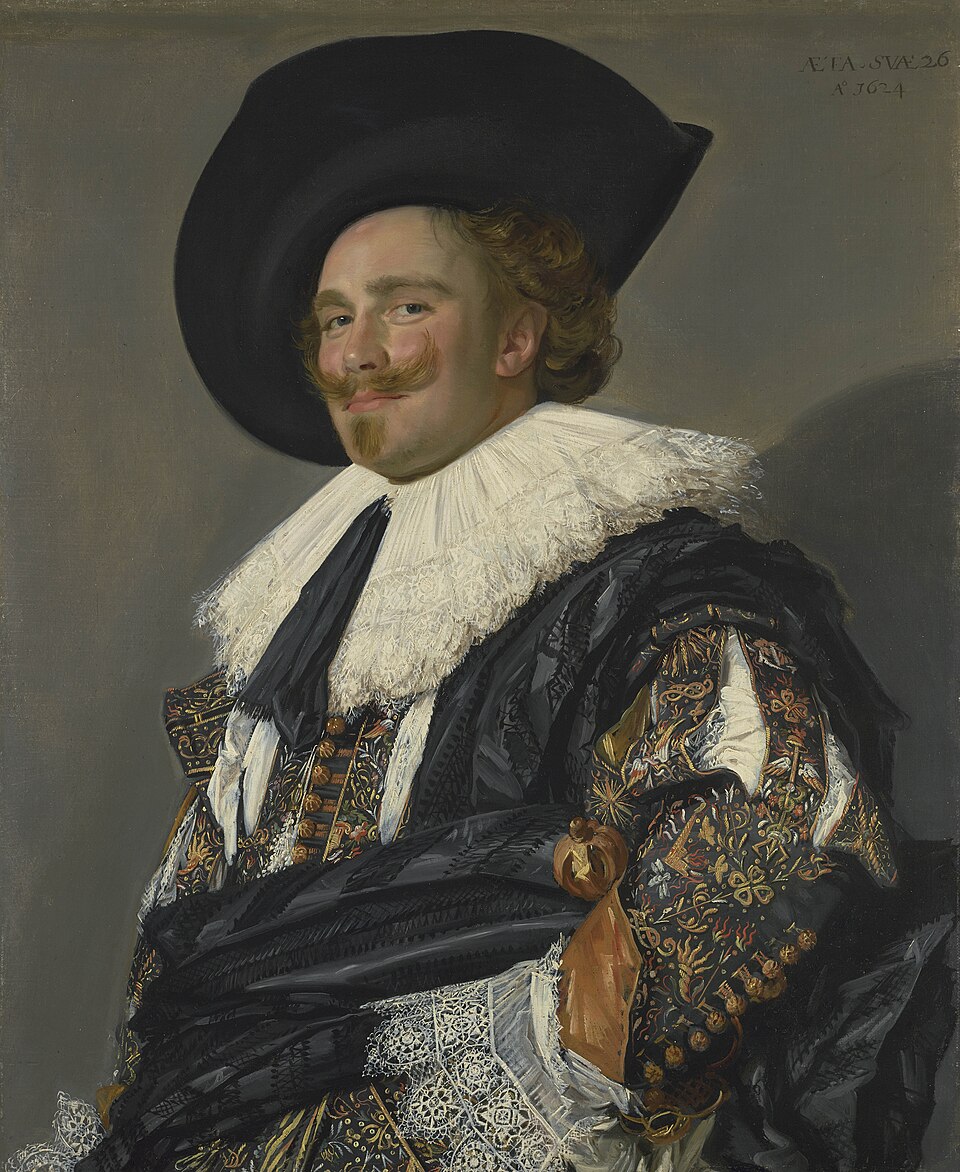
In 1624, in the Dutch city of Haarlem, a young man sat for the painter Frans Hals wearing an extraordinary suit of black silk embroidered with bees, arrows, flaming cornucopiae, lovers' knots and tongues of fire. An inscription in the corner records that he was twenty-six years old that year, which places his birth around 1597 or 1598. Beyond that, nobody wrote down who he was. The identity of one of the most recognizable faces in British art history has simply been lost.
Art historian Pieter Biesboer has suggested the sitter may be Tieleman Roosterman, a wealthy Haarlem cloth merchant born in 1598, who sat for Hals on another occasion too. If true, the man in the famous upturned moustache and gorgeous costume was no soldier at all, just a prosperous civilian who could afford spectacular silk. Nineteenth-century titles in Dutch, English and French often implied a military officer, the sort who populated Dutch militia group portraits alongside works like Rembrandt's later Night Watch, but that was guesswork dressed as fact.
What Hals actually painted was technically daring: long, quick brushstrokes beneath what looks like a painstakingly detailed costume, a turning pose and low viewpoint that gives the picture life and immediacy. The man's eyes look straight out at the viewer, which is why, from any angle in a room, they seem to follow you — a trick of two-dimensional representation that has delighted and unnerved viewers for two centuries.
The painting itself vanishes from clear record until a sale in The Hague in 1770. It passed through Dutch hands until 1822, when the Franco-Swiss banker Comte de Pourtalès-Gorgier acquired it. After his death, it went to auction in Paris in 1865, where Richard Seymour-Conway, 4th Marquess of Hertford, outbid Baron James de Rothschild, paying more than six times the estimate. As late as 1871, in Hertford's Paris home, it was still catalogued simply as 'portrait d'un homme' — portrait of a man.
Everything changed when it crossed the Channel. Hertford brought the painting to London, likely for a major loan exhibition of old master paintings staged at the Bethnal Green Museum between 1872 and 1875 — deliberately located away from the fashionable West End to draw in London's working classes. The exhibition catalogue called it simply 'A Cavalier'. But the Victorian public and press had other ideas, and the nickname 'Laughing Cavalier' took hold, spreading through countless printed reproductions until it became one of the best-known old master paintings in Britain.
More from Art

The Painting With No Foreground
A single robed figure stares out at an empty grey sea — and the emptiness itself became a scandal. When it was unveiled in Berlin in 1810, no one knew quite what to do with it.

The Painter Who Chased the Light
For a few purple minutes each evening, an American exile knelt in an English garden and raced the dying sun to paint two little girls lighting lanterns. It took him two years to finish.

When a President Became a God
Look straight up inside the U.S. Capitol dome and you will find George Washington enthroned among the clouds, surrounded by goddesses — the founding father transformed into myth.

Marble Brought Back to Life
A corpse asleep, a wing barely brushing her skin — and marble somehow learns to breathe. This is the moment Antonio Canova dared to carve.

The World Turned Upside Down
Look closely at a sixteenth-century Flemish village and you'll find a man biting a pillar, another carrying daylight in a basket, and a wife slipping a blue cloak over her husband's shoulders. Every gesture is a joke — if you know the language.

The Girl in the Glass Case
She stood two-thirds life size, dressed in a real tutu and human hair — and the critics who saw her in 1881 recoiled as if she were something obscene.