The Man Who Painted Christ as Doubt
He was offered a professorship for it and turned it down flat. What did Ivan Kramskoi see in his own painting that made independence matter more than honor?
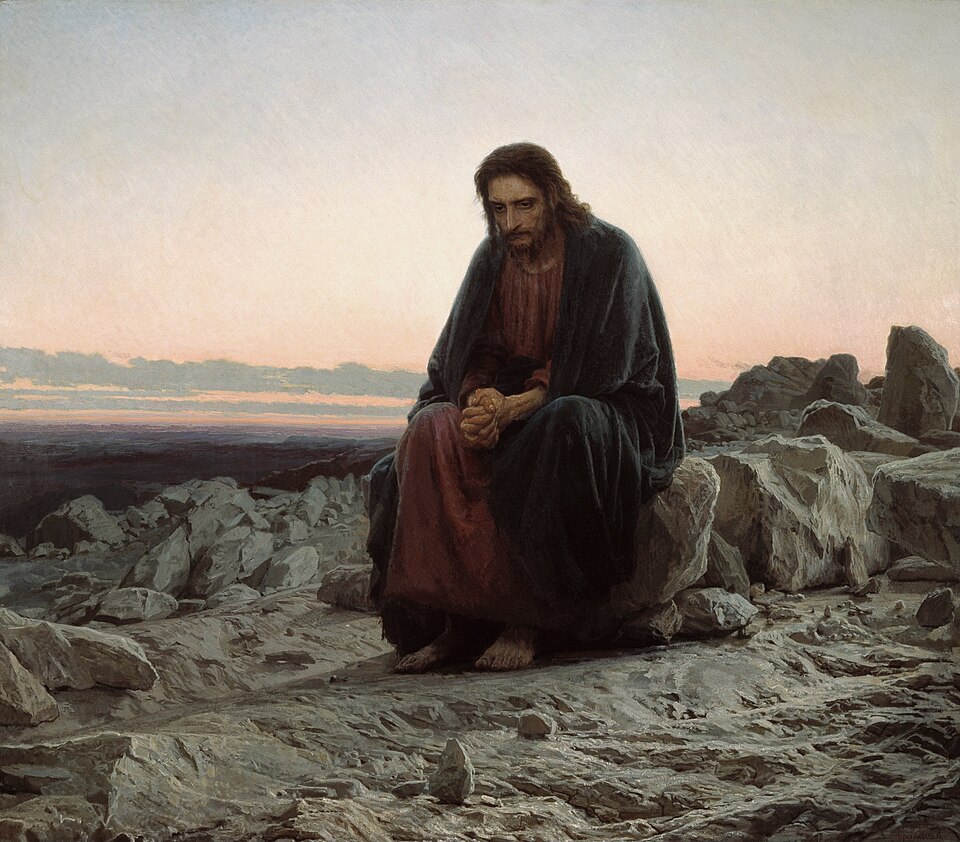
In the cold light of an imagined dawn, a solitary figure sits on a rock in a pallid, stony wilderness, hands clenched, eyes lowered — not triumphant, not divine in any obvious sense, but exhausted by thought. This is Christ in the Desert, painted in 1872 by the Russian artist Ivan Kramskoi, and it is less a religious icon than a portrait of a mind at war with itself.
The idea had haunted Kramskoi since the early 1860s, when he made his first sketches of Christ's temptation in the wilderness. A first attempt, completed in 1867, failed. Kramskoi came to believe the vertical format he had chosen was wrong for the subject. He reworked the composition horizontally, letting the pale, rocky desert stretch behind the figure, and let the horizon slice the canvas almost exactly in half — a choice that let Christ's brooding form dominate the space while remaining harmonized with the sternness of the land around him.
He used cold colors throughout, evoking the chill of early morning, and dressed his Christ in a dark wrap over a red tunic, the figure shifted slightly right of center. Kramskoi described the painting's early history in letters to the writer Vsevolod Garshin, who would later become one of its most passionate defenders.
When critics questioned how he could claim to know what Christ looked like, Kramskoi had a ready answer: even the actual, living Christ, he said, was never fully recognized by those around him. That reply captures what he was after — not likeness, but a human being caught in the grip of decision, the divine nature folded almost entirely into mortal struggle.
The painting was finished in 1872, and the Russian Academy of Arts Council was impressed enough to offer Kramskoi a professorship for it. He refused. Years earlier he had been expelled from the Academy, and he chose to preserve what he called his youthful commitment to independence rather than accept the institution's embrace.
More from Art

The Painting With No Foreground
A single robed figure stares out at an empty grey sea — and the emptiness itself became a scandal. When it was unveiled in Berlin in 1810, no one knew quite what to do with it.

The Painter Who Chased the Light
For a few purple minutes each evening, an American exile knelt in an English garden and raced the dying sun to paint two little girls lighting lanterns. It took him two years to finish.

When a President Became a God
Look straight up inside the U.S. Capitol dome and you will find George Washington enthroned among the clouds, surrounded by goddesses — the founding father transformed into myth.

Marble Brought Back to Life
A corpse asleep, a wing barely brushing her skin — and marble somehow learns to breathe. This is the moment Antonio Canova dared to carve.

The World Turned Upside Down
Look closely at a sixteenth-century Flemish village and you'll find a man biting a pillar, another carrying daylight in a basket, and a wife slipping a blue cloak over her husband's shoulders. Every gesture is a joke — if you know the language.

The Girl in the Glass Case
She stood two-thirds life size, dressed in a real tutu and human hair — and the critics who saw her in 1881 recoiled as if she were something obscene.