The Man Who Sold Yogurt Culture to a Lake
A turbaned man rides his donkey backward through the centuries, cracking jokes so sharp they outlived empires — but did he even exist?
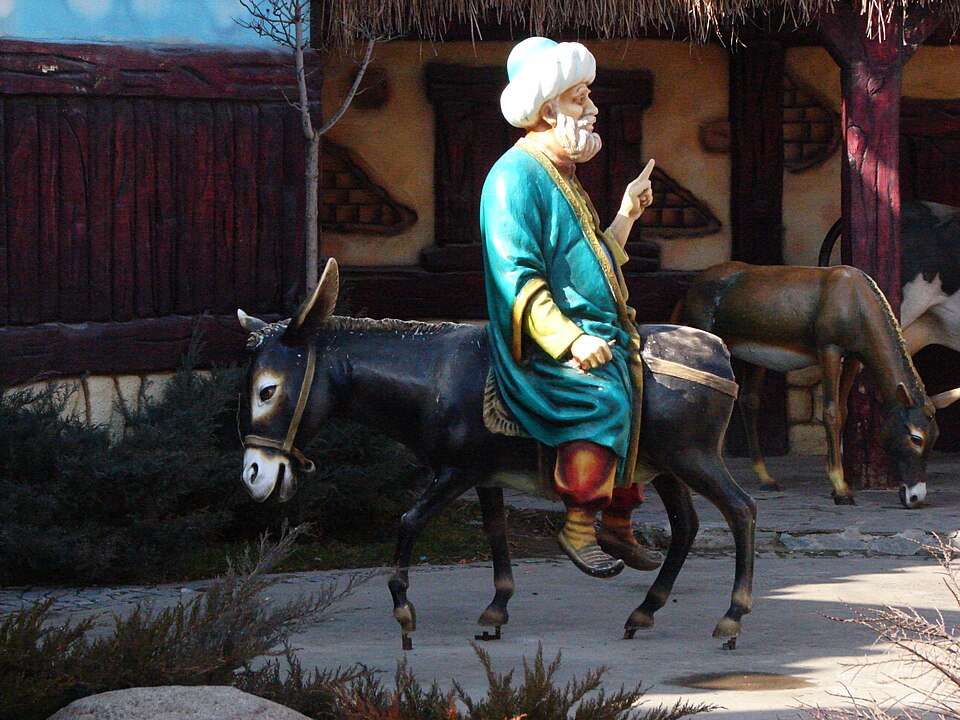
In a small village called Hortu, near Sivrihisar in what is now Eskişehir Province, a boy was born in 1208 who would become one of the most retold characters in world storytelling. His name was Nasreddin, and centuries later people would still argue about whether he was a real man, a legend, or something in between.
According to accounts gathered from historical documents, Nasreddin received his early education in Hortu, then studied at a madrasa in Sivrihisar. When his father died, he returned home to take up the position of village imam. It was a modest, ordinary beginning for a man who would eventually become a household name across half the world.
He later moved to Akşehir, then a center of Sufi thought under Seljuk rule, where he became a dervish of Mahmûd-ı Hayrânî, connected to Mevlevi, Yesevi, or Rufai spiritual paths. He is said to have taken on civic duties in Akşehir and spent time in the surrounding region before his death there in 1285. He was buried in what is now known as the Nasreddin Hoca Tomb, and the International Nasreddin Hodja Festival is still held every year in Akşehir, from 5 to 10 July.
But almost as soon as he died, his legend began to outgrow him. Within the same century as his death, stories bearing his name multiplied — from a handful to, over the centuries, the thousands. Some show him as a quick-witted sage; others as a fool blurting out nonsense; still others cast him somewhere between a saint and a madman. Scholars suspect many anonymous folk tales were simply attached to his name over time, absorbed into a single legendary figure.
The oldest known written trace of Nasreddin's tales appears in the Saltuknâme, compiled in 1480. Centuries later, one particular compilation — the Povest o Hoce Nasreddine series — became the best-selling Nasreddin collection ever, moving 1.5 million copies. His stories are told not only across Anatolia but throughout the Turkic Republics of Central Asia and Russia, a shared inheritance of humor and wisdom across the Turkic world.
More from Mythology

The Doctor Who Sang a Nation Into Being
A country doctor rode into the forests of Karelia armed with nothing but a notebook — and rode out with the soul of a nation.

The Boat That Carried the Sun
Every sunset, the ancient Egyptians believed, the sun climbed into a boat and sailed straight into the realm of the dead — only to fight a monstrous serpent before dawn could return.

The Wild Man of the Snows
At 21,000 feet, a colonel found tracks in the snow that he blamed on a wolf — but his guides knew better, and gave the world a name that would echo for a century.

The Knight Who Went Mad for Love: Orlando Furioso
A hero so devoted to duty he was Charlemagne's greatest paladin loses his mind—not to a sword wound, but to heartbreak. To cure him, a friend must ride a flying horse to the Moon.

The Book That Turned the World Into Myth
A poet condemned to exile spent his final years in Rome finishing a poem that would outlive empires—a poem about nothing standing still, not gods, not lovers, not even the shape of a man.

Paradise Lost: Milton's Rebel Angel
A blind poet, dictating verses in the dark, dared to explain the ways of God to men — and in doing so, made Hell's ruler unforgettable.