The Man Who Would Not Play His Flute
An old man stands in a crumbling room, flute in hand, trying to teach five tortoises to march in time — but they would rather eat the leaves at his feet. It is one of the strangest, most quietly devastating paintings the Ottoman Empire ever produced.
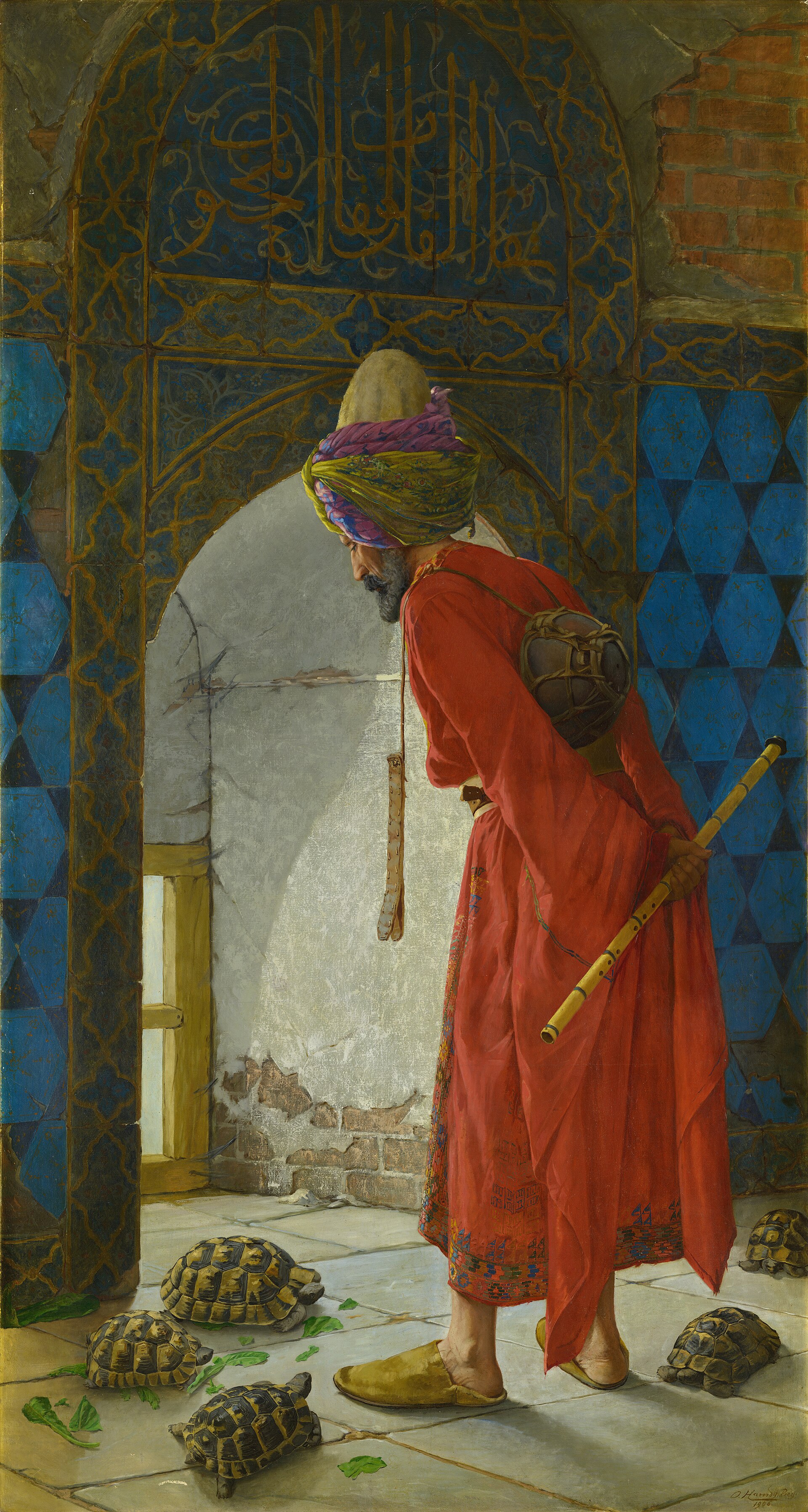
In 1906, at the Grand Palais in Paris, a painting titled L'homme aux Tortues went on display among the crowded canvases of the Salon. It showed a bearded man in an anachronistic red robe and turban, his back half-turned to the viewer, standing in a dilapidated room whose walls were once covered in blue tiles. At his feet, five tortoises crawled and grazed on scattered leaves, utterly indifferent to him. The painter was Osman Hamdi Bey. When the Ottoman Painters Society published its own gazette, the work appeared there under the title Kaplumbağalar ve Adam — Tortoises and Man — before it was later renamed to the title by which it is known today: Kaplumbağa Terbiyecisi, The Tortoise Trainer.
The setting is specific and real: a dilapidated upper room of the Green Mosque in Bursa, its walls flaking, its tilework chipped. Above a pointed window runs an inscription — Şifa'al-kulûp lika'al Mahbub, 'The healing of the hearts is meeting with the beloved.' The man himself wears a costume that predates the Tanzimat reforms of the mid-19th century — a long red garment belted at the waist, a turban rather than a fez. He carries a ney flute, and on his back hangs a nakkare drum, its drumstick hanging to his front. His clothing and instruments suggest he may be a dervish. Many believe the figure is a self-portrait of Osman Hamdi himself.
And yet none of the tortoises are listening. He holds the ney but does not play it; the drum hangs uselessly behind him. The animals simply eat. It is a scene of quiet, almost comic futility — an educator, or a reformer, patiently attempting to instill discipline in creatures who have no interest in learning it.
Osman Hamdi Bey painted a second, smaller version in 1907. It was this later version — not the first — that he dedicated to his child's father-in-law, Salih Münir Pasha. This second painting contains six tortoises instead of five, along with a framed calligraphy panel and a pitcher near a window that don't appear in the first. Both paintings may trace back to an article Osman Hamdi had read in the French travel journal Le Tour du Monde decades before he painted either canvas — he mentioned reading a Tour du Monde issue in a letter to his father dated 13 July 1869 — describing Korean tortoise trainers in Japan who taught their animals to march in lines to the beat of a small drum.
The historical moment in which these paintings were made matters enormously. The Ottoman Empire at the turn of the 20th century was straining under reforms that had either failed outright or were blamed for deepening unrest. Nationalist movements were rising within its borders, foreign powers were circling its edges, and the empire that still stretched across the Balkans, North Africa, Anatolia, the Levant and much of Arabia was visibly fraying. Read against this backdrop, the tortoise trainer's futile patience becomes something sharper: a satire on the slow, ineffective machinery of Ottoman reform itself.
More from Art

The Painting With No Foreground
A single robed figure stares out at an empty grey sea — and the emptiness itself became a scandal. When it was unveiled in Berlin in 1810, no one knew quite what to do with it.

The Painter Who Chased the Light
For a few purple minutes each evening, an American exile knelt in an English garden and raced the dying sun to paint two little girls lighting lanterns. It took him two years to finish.

When a President Became a God
Look straight up inside the U.S. Capitol dome and you will find George Washington enthroned among the clouds, surrounded by goddesses — the founding father transformed into myth.

Marble Brought Back to Life
A corpse asleep, a wing barely brushing her skin — and marble somehow learns to breathe. This is the moment Antonio Canova dared to carve.

The World Turned Upside Down
Look closely at a sixteenth-century Flemish village and you'll find a man biting a pillar, another carrying daylight in a basket, and a wife slipping a blue cloak over her husband's shoulders. Every gesture is a joke — if you know the language.

The Girl in the Glass Case
She stood two-thirds life size, dressed in a real tutu and human hair — and the critics who saw her in 1881 recoiled as if she were something obscene.