The Marble Moment of Divine Piercing
A nun swoons on a cloud of stone, an angel raises a golden spear above her — and for over 350 years, viewers have argued about whether they are witnessing prayer or something far more intimate.
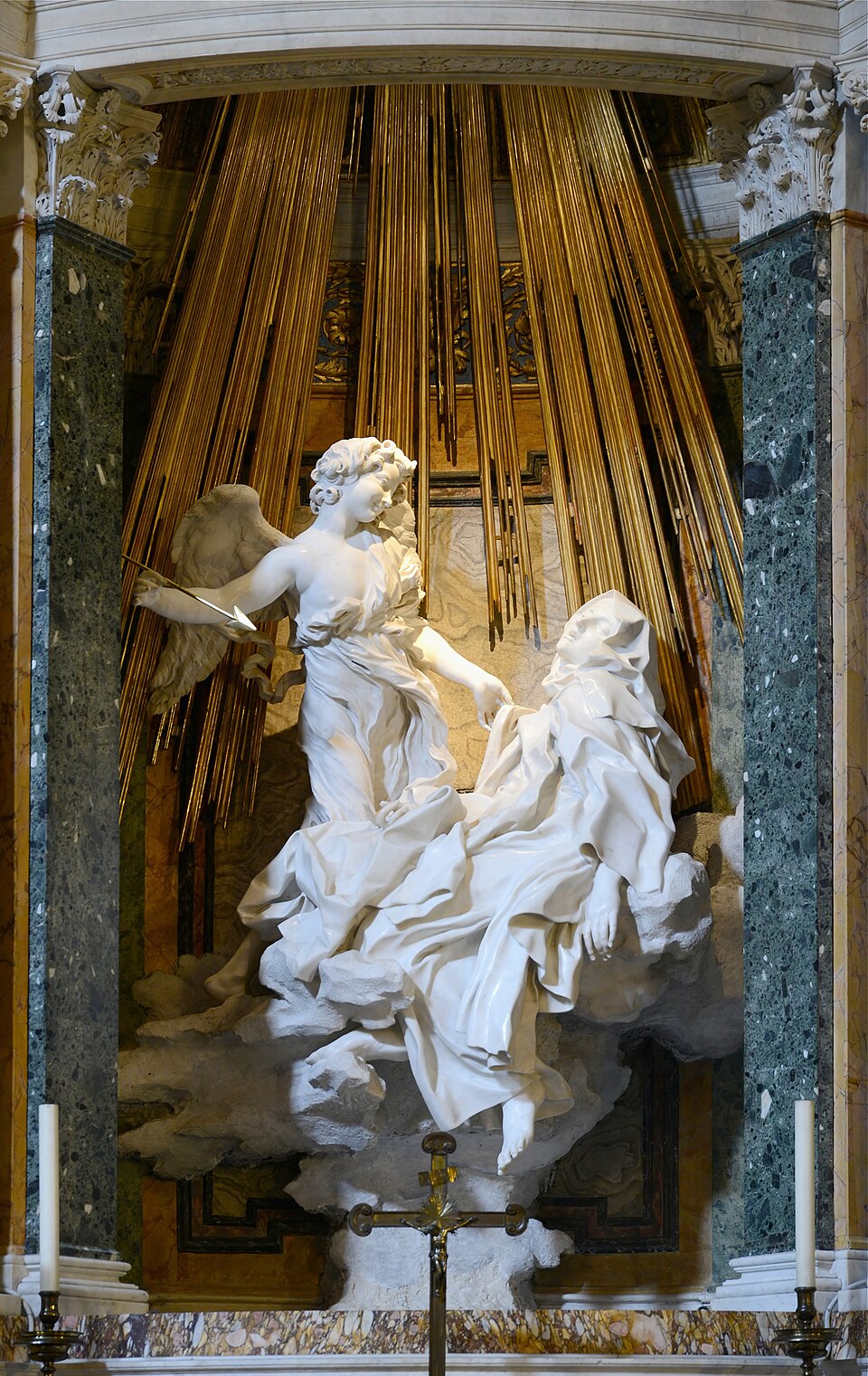
In the left transept of Santa Maria della Vittoria in Rome, light falls through a hidden window in a way that seems almost engineered by heaven itself, striking a group of white marble figures suspended above an altar. This is the Ecstasy of Saint Teresa, carved by Gian Lorenzo Bernini and completed in 1652, and it remains one of the defining images of the High Roman Baroque.
The commission came to Bernini through the Venetian Cardinal Federico Cornaro, who chose the once-unremarkable Discalced Carmelite church for his family burial chapel. Bernini had lost papal favor when Innocent X succeeded the lavish Barberini pope Urban VIII, Bernini's great patron — but Cornaro's private commission gave the sculptor's studio new purpose. The chapel's site had previously held an image of Saint Paul in Ecstasy, which Bernini's dramatization replaced. The finished work cost the princely sum of 12,000 scudi, and a small terracotta model made between 1644 and 1647, still bearing traces of Bernini's fingerprints, survives today in the Hermitage Museum.
The subject is Teresa of Ávila, a Spanish Carmelite nun who lived from 1515 to 1582 and had been canonized in 1622, not long before the chapel's design. Bernini drew directly on her autobiography, The Life of Teresa of Jesus, in which she described an angel piercing her with a golden spear tipped in fire — an experience of pain so sweet, she wrote, that she could not wish to be free of it, calling it a caressing of love between the soul and God.
Bernini translated this vision into stone with startling literalness. Teresa lies on a cloud, marking the scene as a divine apparition rather than an earthly moment, while the angel stands over her with his spear raised. Gilded stucco rays radiate from a hidden window in the dome above, flooding the marble with what looks like actual celestial light.
The sculpture does not stand alone. On the side walls, life-size relief portraits of Cornaro family members — including Cardinal Federico Cornaro and Doge Giovanni I Cornaro — appear as if seated in theater boxes, watching and discussing the vision unfolding before them. The art historian Rudolf Wittkower observed that Bernini deliberately separated levels of reality: the Cornaro figures belong to our world, while Teresa's ecstasy occupies a distinct, elevated realm, isolated by canopy and heavenly light. Above it all, a frescoed vault fills the vault with cherubs and the descending light of the Holy Spirit, imagined as a dove.
More from Art

The Painting With No Foreground
A single robed figure stares out at an empty grey sea — and the emptiness itself became a scandal. When it was unveiled in Berlin in 1810, no one knew quite what to do with it.

The Painter Who Chased the Light
For a few purple minutes each evening, an American exile knelt in an English garden and raced the dying sun to paint two little girls lighting lanterns. It took him two years to finish.

When a President Became a God
Look straight up inside the U.S. Capitol dome and you will find George Washington enthroned among the clouds, surrounded by goddesses — the founding father transformed into myth.

Marble Brought Back to Life
A corpse asleep, a wing barely brushing her skin — and marble somehow learns to breathe. This is the moment Antonio Canova dared to carve.

The World Turned Upside Down
Look closely at a sixteenth-century Flemish village and you'll find a man biting a pillar, another carrying daylight in a basket, and a wife slipping a blue cloak over her husband's shoulders. Every gesture is a joke — if you know the language.

The Girl in the Glass Case
She stood two-thirds life size, dressed in a real tutu and human hair — and the critics who saw her in 1881 recoiled as if she were something obscene.