The Marble That Learned to Grow Bark
A young sculptor once made stone do something it should not be able to do: turn into skin, then into wood, in a single frozen breath. This is the story of the moment he carved.
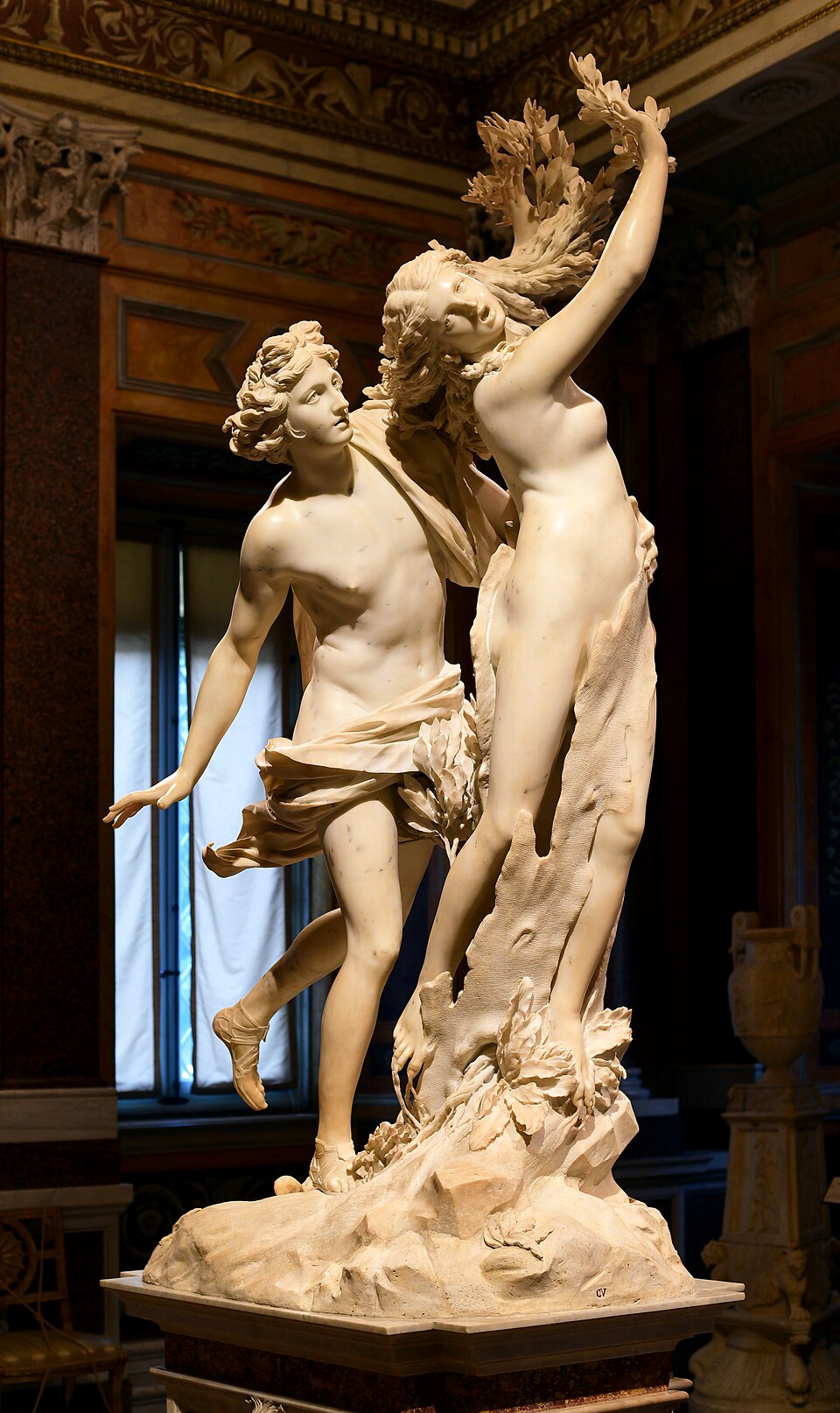
In the Galleria Borghese in Rome stands a life-sized marble that seems to be caught mid-motion, as if the museum's stillness has trapped a scene that refuses to stop moving. A young man reaches for a woman's hip; her fingers are already sprouting twigs. This is Apollo and Daphne, carved between 1622 and 1625 by Gian Lorenzo Bernini, and it captures the single instant when a chase ends not in capture but in transformation.
The subject comes from Ovid's Metamorphoses. Apollo, struck by Cupid's love-exciting arrow, becomes consumed with desire for the nymph Daphne, daughter of the river god Peneus. Daphne, struck by Cupid's love-repelling arrow, wants nothing to do with him. She flees as he chases, boasting and pleading. When her strength gives out, she begs her father to destroy the beauty that has caused her such trouble. Before her prayer even ends, bark closes over her skin, her hair becomes leaves, her arms become branches, her feet become roots fixed to the earth. Even so, Apollo does not stop loving her — he declares the laurel will forever be his tree, wreathing his hair, his lyre, his quiver, accompanying Roman generals in triumph.
Bernini was working for Cardinal Scipione Borghese, who had commissioned a run of sculptures that would come to define Baroque art. Apollo and Daphne was the last in that series. It came about, in part, from an act of political generosity: Borghese had given Bernini's earlier work, The Rape of Proserpina (1621–22), to Cardinal Ludovico Ludovisi, nephew of the newly elected Pope Gregory XV, hoping to win his favor. Apollo and Daphne followed as Borghese's own great commission.
The work was not swift. Much of it was carved in 1622 and 1623, but Bernini's attention was pulled away to complete his sculpture of David, and Apollo and Daphne was not finished until 1625. That September, it was moved into the Cardinal's Villa Borghese. Like many sculptures of the era, it was not entirely the hand of one man: Bernini's workshop assisted, and Giuliano Finelli, a gifted young member of that workshop, helped carve the finer details that show Daphne's conversion from human to tree — the twigs and leaves springing from her hands, and her windswept hair. Some historians downplay the importance of Finelli's contribution, since he was realizing Bernini's creative vision, but the delicacy of that transformation remains part of the work's legend.
Bernini did not intend the sculpture to be seen from just anywhere. He designed it to be viewed slightly from the right, the angle from which it would first appear to a visitor entering through the doorway of the room it originally occupied. From that position, both faces — Apollo's astonishment, Daphne's terror — become visible at once, letting the viewer grasp the entire story in a single glance. Seen from the left, the illusion falls apart: neither face is visible, and the structural braces Bernini built into the marble to support its delicate limbs become obvious, along with a tangle of carved hair. Eventually the statue was relocated to the center of the room, allowing viewers to walk around it and see both sides.
More from Art

The Painting With No Foreground
A single robed figure stares out at an empty grey sea — and the emptiness itself became a scandal. When it was unveiled in Berlin in 1810, no one knew quite what to do with it.

The Painter Who Chased the Light
For a few purple minutes each evening, an American exile knelt in an English garden and raced the dying sun to paint two little girls lighting lanterns. It took him two years to finish.

When a President Became a God
Look straight up inside the U.S. Capitol dome and you will find George Washington enthroned among the clouds, surrounded by goddesses — the founding father transformed into myth.

Marble Brought Back to Life
A corpse asleep, a wing barely brushing her skin — and marble somehow learns to breathe. This is the moment Antonio Canova dared to carve.

The World Turned Upside Down
Look closely at a sixteenth-century Flemish village and you'll find a man biting a pillar, another carrying daylight in a basket, and a wife slipping a blue cloak over her husband's shoulders. Every gesture is a joke — if you know the language.

The Girl in the Glass Case
She stood two-thirds life size, dressed in a real tutu and human hair — and the critics who saw her in 1881 recoiled as if she were something obscene.