The Marble That Made a Young Man Immortal
He was in his early twenties, unproven, and had been handed a block of Carrara marble by a French cardinal preparing for his own death. What emerged would be signed only once in his life.
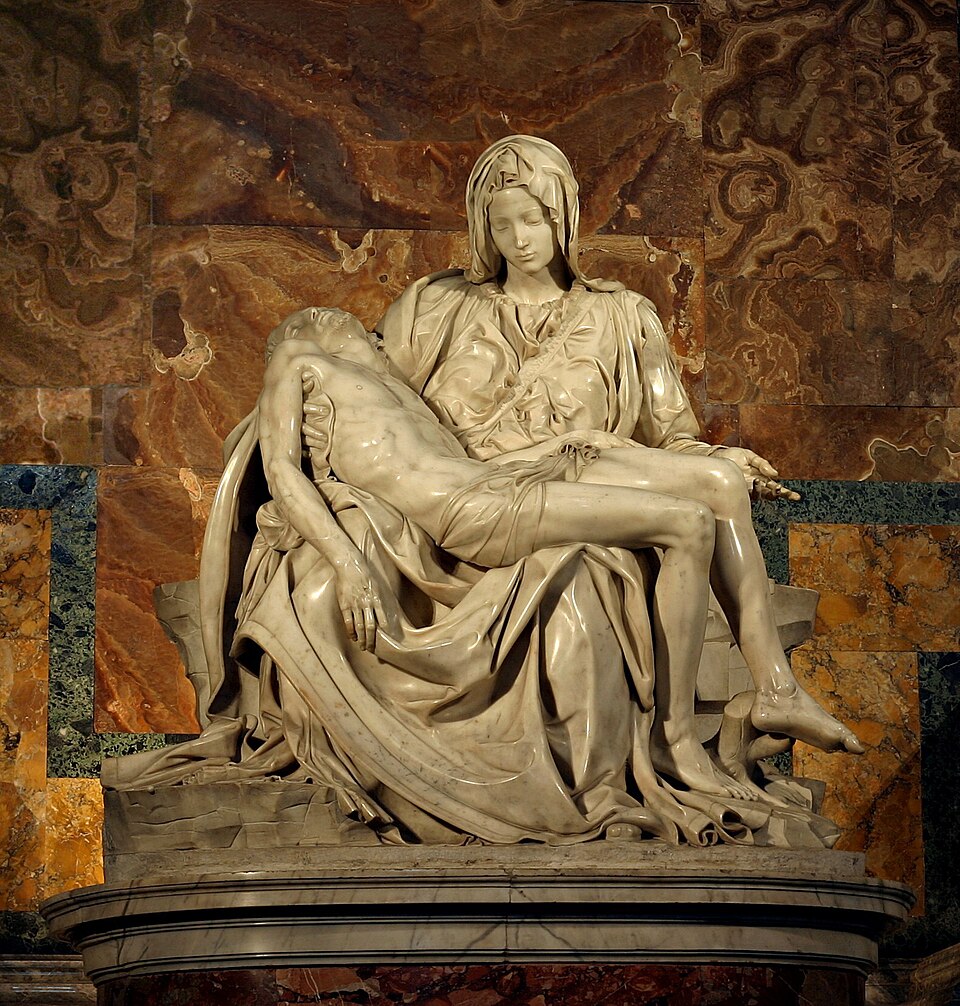
Between 1497 and 1499, a young sculptor named Michelangelo Buonarroti carved a commission for Cardinal Jean Bilhères de Lagraulas, then French ambassador in Rome and former Bishop of Condom. The cardinal wanted an altarpiece for his funeral chapel in Old Saint Peter's Basilica, a work depicting the Virgin Mary cradling the dead body of Christ after the Crucifixion — a theme known as the Sixth Sorrow of Mary. By the end of that span, Michelangelo had finished the piece: a marble sculpture that would come to be called the Pietà.
What set his interpretation apart from earlier Pietàs was immediately visible. Mary is carved not as a grieving woman in her mid-forties, commensurate with the age of her thirty-three-year-old son, but as strikingly young and serene. Michelangelo built the composition as a pyramid, its apex at Mary's head, widening down through the monumental folds of her drapery to the rocky base representing Golgotha. The marks of the Crucifixion are barely visible — small nail wounds, a hint of the wound in Christ's side — and his face shows none of the anguish of the Passion.
Michelangelo's own explanation for Mary's youth, recorded by his biographer Ascanio Condivi, was theological: chaste women, he argued, remain fresher than those who are not, and the Virgin, having never known lascivious desire, would not show the marks of age. Art historians have also pointed to Dante's Divine Comedy, a text Michelangelo knew so well that he reportedly paid for hospitality in Bologna by reciting its verses. In Canto XXXIII of Paradiso, Saint Bernard of Clairvaux addresses Mary as 'virgin mother, daughter of your son' — a paradox of youth and motherhood that mirrors the sculpture's central tension.
The work was, by Michelangelo's own account, meant to be 'the heart's image.' It balanced an emerging naturalism with the classical ideals of beauty that would soon define the High Renaissance — so much so that the Pietà is often cited as the movement's starting point.
A story recorded by Giorgio Vasari explains why the sculpture bears an inscription at all. Shortly after it was installed, Michelangelo reportedly overheard visitors crediting the work to another sculptor, Cristoforo Solari. In response, he carved his name across the sash running over Mary's chest: MICHAELANGELVS BONAROTVS FLORENTINVS FACIEBAT. It remains the only piece he ever signed.
More from Art

The Painting With No Foreground
A single robed figure stares out at an empty grey sea — and the emptiness itself became a scandal. When it was unveiled in Berlin in 1810, no one knew quite what to do with it.

The Painter Who Chased the Light
For a few purple minutes each evening, an American exile knelt in an English garden and raced the dying sun to paint two little girls lighting lanterns. It took him two years to finish.

When a President Became a God
Look straight up inside the U.S. Capitol dome and you will find George Washington enthroned among the clouds, surrounded by goddesses — the founding father transformed into myth.

Marble Brought Back to Life
A corpse asleep, a wing barely brushing her skin — and marble somehow learns to breathe. This is the moment Antonio Canova dared to carve.

The World Turned Upside Down
Look closely at a sixteenth-century Flemish village and you'll find a man biting a pillar, another carrying daylight in a basket, and a wife slipping a blue cloak over her husband's shoulders. Every gesture is a joke — if you know the language.

The Girl in the Glass Case
She stood two-thirds life size, dressed in a real tutu and human hair — and the critics who saw her in 1881 recoiled as if she were something obscene.