The Marble Warriors Under Sidon
Deep beneath a Lebanese hillside, twenty-two royal coffins waited in silence for over two thousand years — one of them carved with the face of a man who had conquered the world.
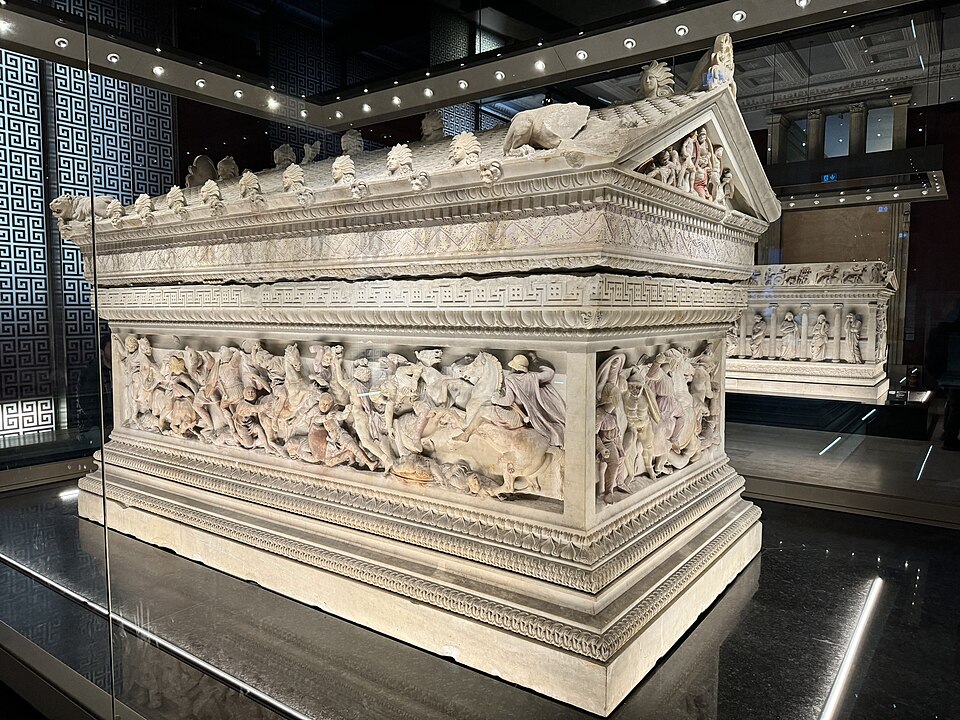
In 1887, the archaeologist and painter Osman Hamdi Bey descended into a subterranean necropolis near Sidon, in what is now Lebanon, and uncovered something that would astonish the archaeological world: a royal burial ground containing twenty-two sarcophagi, arranged in a sequence spanning generations of Sidonian kings. Among them was a colossal marble coffin so finely carved, so vividly painted, that it seemed to breathe with motion — a battle raging across one long side, a hunt unfolding in friendly chaos across the other. News of the discovery raced through European and American journals. This was the Alexander Sarcophagus.
The sarcophagus is not, in fact, the tomb of Alexander the Great himself — that much has long been agreed upon. But its long frieze depicts a battle between Greeks and Persians, widely believed to represent the Battle of Issus of 333 BC, the clash that shattered Persian power in the region and opened the gates of Phoenicia and Syria to the young Macedonian king. It was this depiction, more than anything, that gave the sarcophagus its name — for on the far left of that scene rides a horseman wearing the skin of the Nemean lion upon his head, a ram's horn of the Egyptian god Ammon curling near his ear. He can only be Alexander, styled as a descendant of Herakles.
The likely owner of the tomb was Abdalonymus, a man whose life pivoted entirely on the outcome of that battle. After Issus, Alexander pressed south along the Mediterranean coast into Syria. Sidon, weary of Persian rule, threw open its gates to the Macedonians and asked Alexander to choose them a new king. Too occupied to handle the matter himself, Alexander delegated the task to his companion Hephaestion, who found Abdalonymus — a distant relative of the Sidonian royal line living quietly outside the city — and placed him on the throne. It is likely no coincidence, then, that decades later, the tomb prepared for this unlikely king included carved portraits of both Alexander and Hephaestion among its ornaments.
The hunting scene on the sarcophagus's other long face tells a gentler story, though no less charged with meaning. Persians and Macedonians hunt lions and panthers together, side by side, in a scene of shared danger and cooperation — a striking contrast to the battlefield carved just opposite. At its center, a lion has sunk its teeth into a Persian horse; the endangered rider raises his spear fearlessly while a mounted Macedonian and a Persian foot soldier rush to his aid. Scholars have proposed that the threatened rider is Abdalonymus himself, and that his rescuer may be Alexander or Hephaestion — a visual reconciliation, carved in marble, of enemies who became something else entirely.
The artistry is extraordinary by any measure. Carved from gleaming Pentelic marble quarried in Greece, the sarcophagus originally blazed with color — a practice called polychromy, common across the ancient world but rarely preserved so vividly. In the early 1980s, German researchers Christa Wolters and Volkmar von Graeve scanned the surface with ultraviolet fluorescence and conducted chemical analysis, confirming that traces of paint were original to the sculpture, not later additions. In 1980, the German Archaeological Institute and the German Archaeological Foundation launched a broader effort to recover the original colors of ancient artworks; over twenty-five years, that project produced a full color reconstruction of the sarcophagus, later sent to exhibitions in museums around the world.
More from Art

The Painting With No Foreground
A single robed figure stares out at an empty grey sea — and the emptiness itself became a scandal. When it was unveiled in Berlin in 1810, no one knew quite what to do with it.

The Painter Who Chased the Light
For a few purple minutes each evening, an American exile knelt in an English garden and raced the dying sun to paint two little girls lighting lanterns. It took him two years to finish.

When a President Became a God
Look straight up inside the U.S. Capitol dome and you will find George Washington enthroned among the clouds, surrounded by goddesses — the founding father transformed into myth.

Marble Brought Back to Life
A corpse asleep, a wing barely brushing her skin — and marble somehow learns to breathe. This is the moment Antonio Canova dared to carve.

The World Turned Upside Down
Look closely at a sixteenth-century Flemish village and you'll find a man biting a pillar, another carrying daylight in a basket, and a wife slipping a blue cloak over her husband's shoulders. Every gesture is a joke — if you know the language.

The Girl in the Glass Case
She stood two-thirds life size, dressed in a real tutu and human hair — and the critics who saw her in 1881 recoiled as if she were something obscene.