The Monk Who Illuminated an Island's Faith
On a windswept tidal island off the Northumbrian coast, one monk spent years bent over vellum, coaxing Mediterranean, Celtic and Anglo-Saxon art into a single, dazzling gospel book.
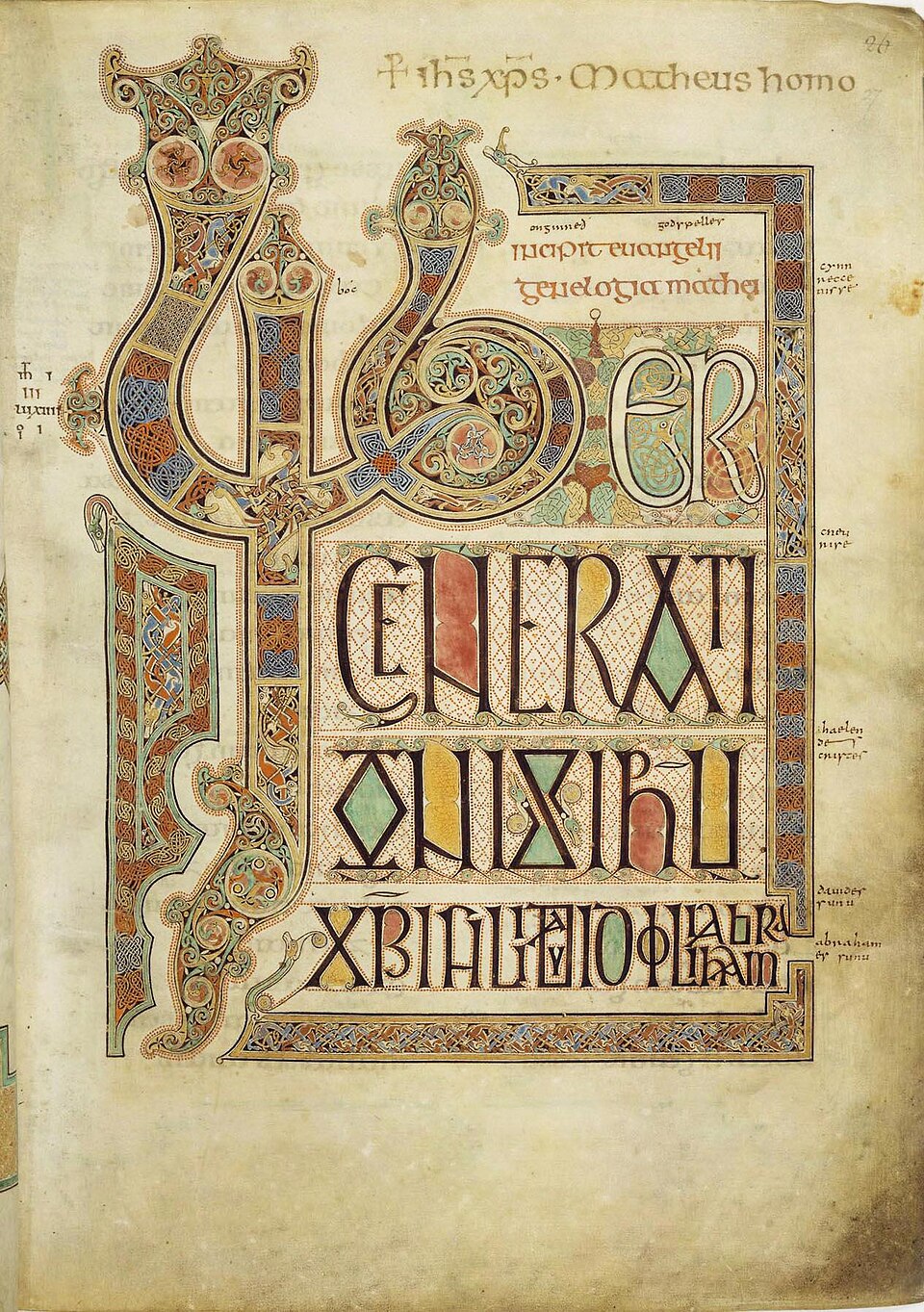
Around 635 AD, the Irish missionary Aidan founded a monastery on Lindisfarne, a small outcrop of land known today as Holy Island, off the coast of Northumberland. King Oswald of Northumbria had sent him from Iona to convert the pagan Anglo-Saxons, and by the time Aidan died in 651, Christianity had taken firm root in the region. Decades later, the monastery would produce one of the most extraordinary manuscripts of the early medieval world.
That manuscript, now known as the Lindisfarne Gospels, is presumed to be the work of Eadfrith, who became Bishop of Lindisfarne in 698 and died in 721. Scholarship points to a production date around 715–720, and the book is believed to have been made in honour of Saint Cuthbert, an ascetic monk of the Lindisfarne community who died in 687. Some pages were left unfinished, suggesting Eadfrith may still have been working on it at the time of his death.
Cuthbert's body had been buried at Lindisfarne, and in 698 his relics were elevated to a shrine there, an event that made the island an important pilgrimage destination through the 7th and 8th centuries. Two accounts of Cuthbert's life were written shortly after his death — one by an anonymous Lindisfarne monk, the other by the historian and theologian Bede — giving later generations a rich record of the man the Gospels were meant to honour.
The manuscript itself is written in Latin, in insular script, and richly illustrated in the unique Hiberno-Saxon or Insular style that blends Mediterranean, Anglo-Saxon and Celtic artistic traditions. It stands as the best documented and most complete insular manuscript of its period. Because most of the Northumbrian audience could not read, let alone understand Latin, the Gospels used decorative techniques reminiscent of elite metalwork to impress and awe those who saw them, reinforcing the growing cult of Saint Cuthbert.
The book was not Eadfrith's work alone. A colophon added centuries later names three other men involved: Ethelwald, Bishop of the Lindisfarne islanders, who bound the manuscript; Billfrith, an anchorite, who ornamented it with a treasure binding covered in jewels and metals in the 8th century; and Aldred, who centuries afterward added his own contribution. Some scholars have questioned whether Eadfrith and Ethelwald personally produced the work rather than commissioning others, but the manuscript is widely regarded as the product of a single scribe and painter — Eadfrith himself.
More from Art

The Painting With No Foreground
A single robed figure stares out at an empty grey sea — and the emptiness itself became a scandal. When it was unveiled in Berlin in 1810, no one knew quite what to do with it.

The Painter Who Chased the Light
For a few purple minutes each evening, an American exile knelt in an English garden and raced the dying sun to paint two little girls lighting lanterns. It took him two years to finish.

When a President Became a God
Look straight up inside the U.S. Capitol dome and you will find George Washington enthroned among the clouds, surrounded by goddesses — the founding father transformed into myth.

Marble Brought Back to Life
A corpse asleep, a wing barely brushing her skin — and marble somehow learns to breathe. This is the moment Antonio Canova dared to carve.

The World Turned Upside Down
Look closely at a sixteenth-century Flemish village and you'll find a man biting a pillar, another carrying daylight in a basket, and a wife slipping a blue cloak over her husband's shoulders. Every gesture is a joke — if you know the language.

The Girl in the Glass Case
She stood two-thirds life size, dressed in a real tutu and human hair — and the critics who saw her in 1881 recoiled as if she were something obscene.