The Mountain of Severed Gods
On a windswept summit in southeastern Turkey, giant stone heads lie scattered in the grass — their bodies still seated nearby, waiting for faces that iconoclasts tore away two thousand years ago.
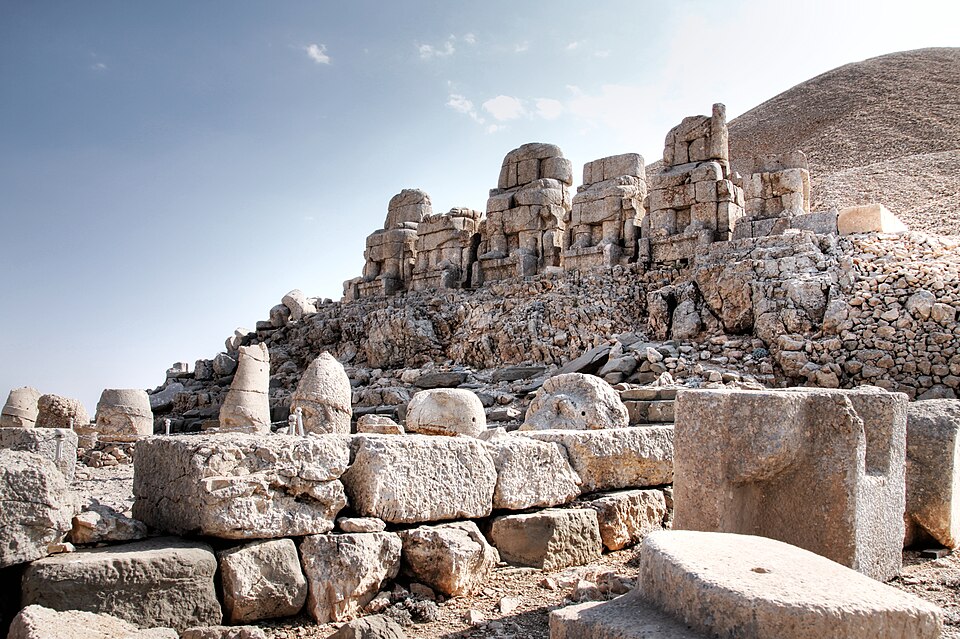
At 2,150 meters, Mount Nemrut rises as one of the highest peaks in the eastern Taurus range, in what is today Adıyaman Province. It is a barren, wind-scoured place, the kind of summit that seems to demand something monumental — and in 62 BC, King Antiochus I of Commagene delivered exactly that. He ordered the construction of a tomb-sanctuary at the very top, flanked by colossal statues, 8 to 9 meters tall, of himself, two lions, two eagles, and a pantheon of composite Greek and Iranian gods: Heracles-Artagnes-Ares, Zeus-Oromasdes, Apollo-Mithras-Helios-Hermes.
Antiochus was not simply building a monument to vanity. Commagene was a small kingdom squeezed between larger powers north of Syria and the Euphrates, born from the breakup of Alexander's empire. To assert legitimacy, Antiochus wove together the political and religious traditions of Cappadocia, Pontus, and Armenia, claiming descent from both the Achaemenid Persians and the Seleucid Greeks. The hybrid pantheon carved into the mountainside was a visual argument for his dual heritage — Greek-style faces on the statues, but Persian clothing and hairstyles, a bridge between two civilizations frozen in stone.
The statues were originally seated, each labeled with the name of the god or figure it represented. At some point, long after Antiochus's death, the heads were deliberately knocked from their bodies. The pattern of damage — especially to the noses — points to intentional iconoclasm rather than simple erosion or accident. Today those heads sit scattered across the terraces, disconnected from the bodies they once crowned, never restored to their original positions.
Beyond the statues, the site preserves stone slabs bearing bas-relief figures, believed to have formed a large frieze depicting Antiochus's Greek and Persian ancestors. The same iconography repeats on the massive tumulus at the site's center — a mound of loose rock 49 meters tall and 152 meters in diameter, likely designed so that any attempt to dig into it would simply collapse and refill, protecting whatever tomb lies beneath from robbers.
One of the site's most remarkable features sits on the western terrace: a large slab carved with a lion, marked with an arrangement of stars and the planets Jupiter, Mercury, and Mars. Researchers have interpreted this as a chart of the sky as it appeared on 7 July 62 BCE — a composition that may indicate, though it does not confirm, when construction began, and which some consider among the oldest known horoscopes. The eastern terrace, better preserved and built up in layers of rock, connects to the western terrace via a walled passageway that likely hosted religious ceremonies tied to this astronomical symbolism.
More from Archaeology

The Bronze Disc That Rewrote the Sky
Two looters with a metal detector dug up something illegal, invisible in value, and older than Stonehenge's final stones — a map of the heavens buried for over three thousand years.

The Faceless Women of the Ice Age
Long before writing, before cities, before the wheel, someone carved a woman's body into stone and ivory — and left no name, no face, no explanation.

The Pebble That Might Be Human
A palm-sized stone found on a Moroccan riverbank may be humanity's oldest attempt to see itself — or simply a trick of erosion.

The Crown That Vanished: Deshret and the Red Land
A crown worn by kings for three thousand years has never once been found in a tomb — not one. So where did it go?

The Face That Traveled Between Empires
A farm worker's shovel struck stone in 1897 and unearthed a face so striking it would be sold to France, seized as war booty, and finally traded back for a Velázquez.

The Boy in the Dark Tunnel
A schoolboy fell into black water inside an ancient tunnel and surfaced with his fingers brushing letters no one had noticed for 2,600 years.