The Night He Painted from Memory
Locked behind iron bars in a former monastery, a broken man was forbidden to paint in his own bedroom — so he built a universe from memory instead.
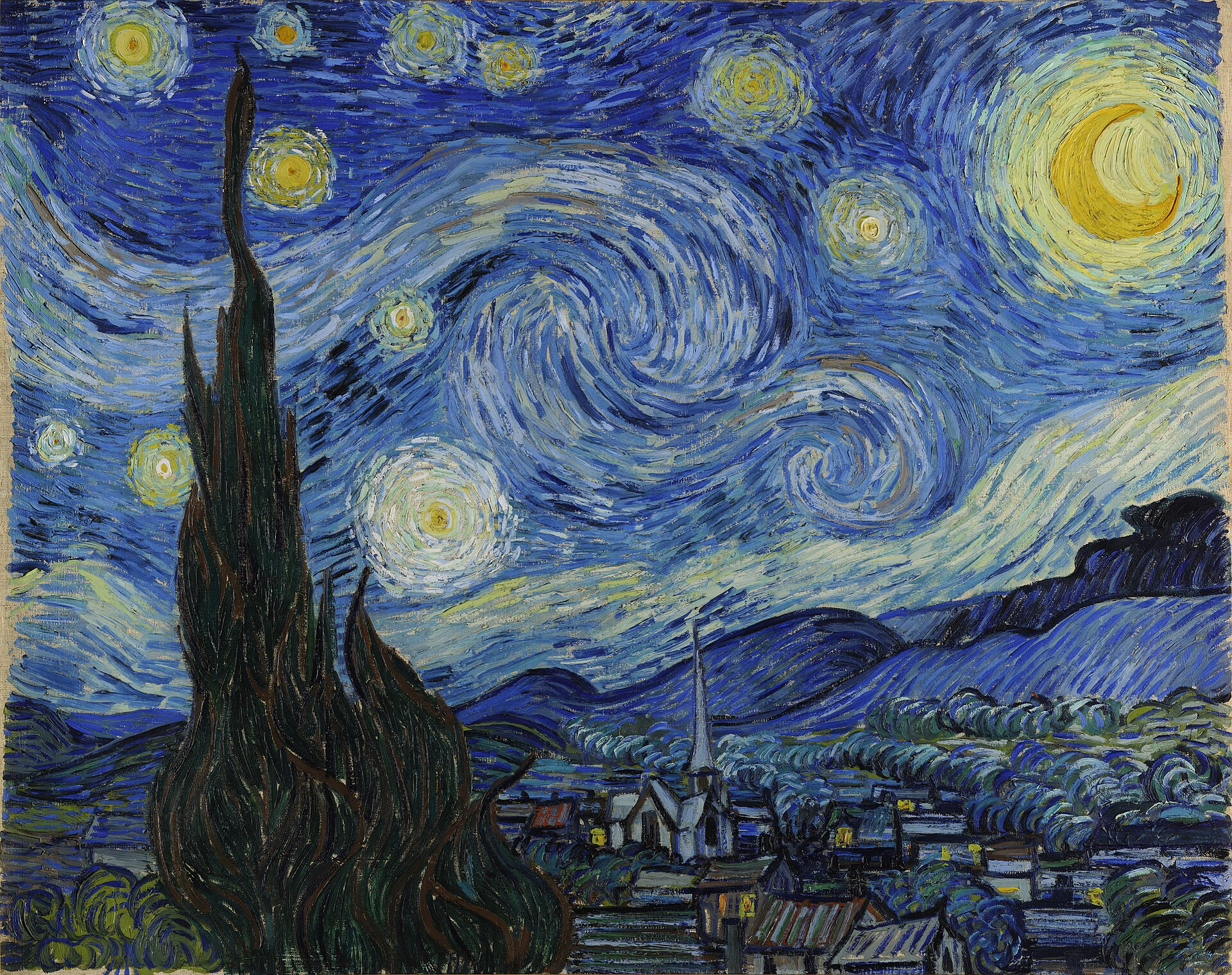
On 8 May 1889, Vincent van Gogh voluntarily admitted himself to the Saint-Paul-de-Mausole asylum near Saint-Rémy-de-Provence, five months after the breakdown that led him to mutilate his own ear. The former monastery catered to wealthy patients and was less than half full, which meant Van Gogh could keep both a second-story bedroom and a ground-floor studio. It was there, through an iron-barred window facing east, that he watched an enclosed square of wheat field and, beyond it, the low rolling hills of the Alpilles.
He painted that view again and again — twenty-one variations in all — under sunrise, moonrise, sun, clouds, wind, and once rain. Hospital staff would not let him paint inside his bedroom, so he sketched there in ink or charcoal and carried the images down to his studio, building newer versions on top of earlier ones.
Around 18 June 1889, Van Gogh wrote to his brother Theo that he had produced a new study of a starry sky. That painting was The Starry Night. It shows the view from his bedroom window just before sunrise, with an imaginary village added, and though it was painted during the day in his studio rather than at the actual hour it depicts, it would be inaccurate to call it a painting from memory alone — it grew from a view he had studied and sketched again and again. The sky holds Venus, visible at the time, and a moon whose position is not astronomically accurate — reminders that this was invention layered atop observation.
The cypress trees dominating the foreground were dramatically enlarged compared to their true scale, brought close to the picture plane the way he had done in a related work, Wheat Field with Cypresses. Van Gogh's own letters suggest he found the cypresses visually striking rather than symbolically loaded. The village nestled below the swirling sky, meanwhile, was entirely imagined — sketched rather than seen from his window, an invented cluster of rooftops and a church spire folded into a real landscape.
Scientific analysis has since confirmed the palette Van Gogh reached for that June: ultramarine and cobalt blue for the churning sky, indian yellow and zinc yellow for the stars and moon. Yet Van Gogh himself was unconvinced by what he'd made. In letters to Theo, he singled out other works — a wheat field, a mountain, an orchard, blue-tinted olives, a portrait, the entrance to a quarry — as the ones he believed succeeded, while dismissing much of the rest, including this canvas, as failures that told the viewer nothing.
More from Art

The Painting With No Foreground
A single robed figure stares out at an empty grey sea — and the emptiness itself became a scandal. When it was unveiled in Berlin in 1810, no one knew quite what to do with it.

The Painter Who Chased the Light
For a few purple minutes each evening, an American exile knelt in an English garden and raced the dying sun to paint two little girls lighting lanterns. It took him two years to finish.

When a President Became a God
Look straight up inside the U.S. Capitol dome and you will find George Washington enthroned among the clouds, surrounded by goddesses — the founding father transformed into myth.

Marble Brought Back to Life
A corpse asleep, a wing barely brushing her skin — and marble somehow learns to breathe. This is the moment Antonio Canova dared to carve.

The World Turned Upside Down
Look closely at a sixteenth-century Flemish village and you'll find a man biting a pillar, another carrying daylight in a basket, and a wife slipping a blue cloak over her husband's shoulders. Every gesture is a joke — if you know the language.

The Girl in the Glass Case
She stood two-thirds life size, dressed in a real tutu and human hair — and the critics who saw her in 1881 recoiled as if she were something obscene.