The Nine Days' Queen, Painted 300 Years Later
A teenage queen, blindfolded, reaches blindly for a wooden block. She never wore the crown for more than a fortnight — but a Frenchman, three centuries on, made her final seconds unforgettable.
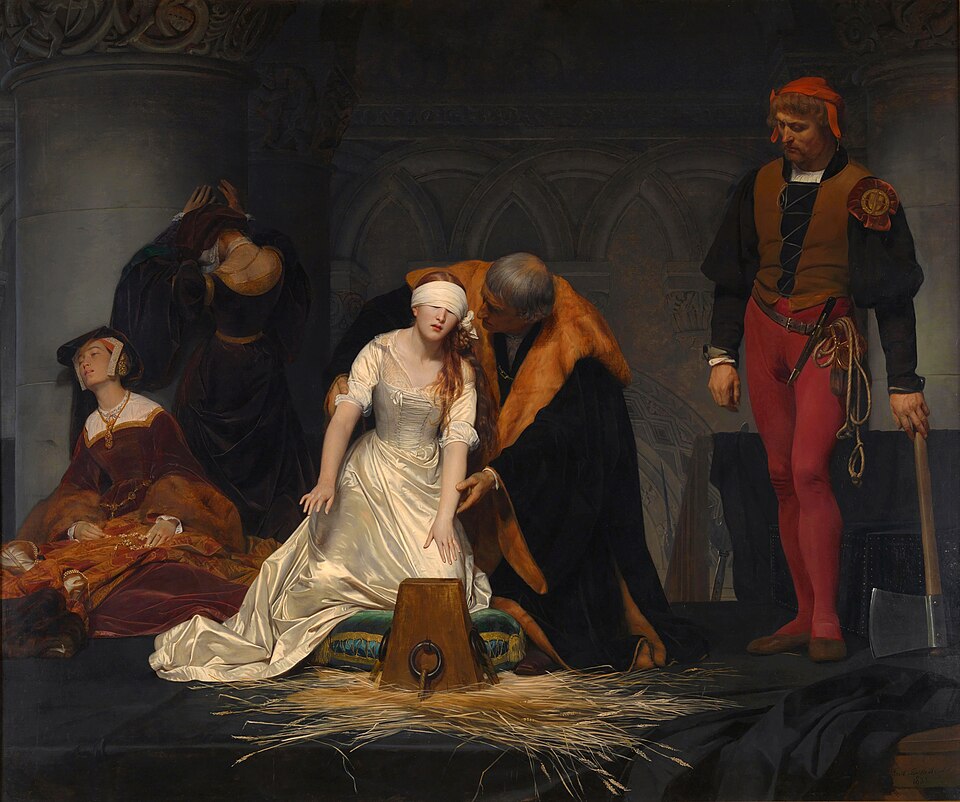
On 12 February 1554, a seventeen-year-old girl was led to a scaffold inside the Tower of London and beheaded. Her name was Jane Grey, and just months earlier she had briefly been Queen of England. She was a great-granddaughter of Henry VII and cousin to the boy-king Edward VI; when Edward died, Jane was proclaimed queen ahead of Henry VIII's own daughters, Mary and Elizabeth. Her reign lasted nine days before Mary, backed by the English people, seized the throne, and Jane relinquished her claim.
Jane, her husband Lord Guilford Dudley, and her father were imprisoned in the Tower on charges of high treason. Tried in November, she was sentenced to death, though the sentence was not carried out immediately. In February 1554, her father, who had been freed, joined Wyatt's Rebellion against Mary. That rebellion sealed Jane's fate. On Friday 12 February, Mary had Jane and her husband executed; her father was beheaded eleven days later.
Nearly 300 years afterward, in 1833, the French painter Paul Delaroche turned to this story for one of his most famous works, The Execution of Lady Jane Grey, now held in London's National Gallery. Delaroche had made his name in the Paris salons with large, realistic depictions of dramatic historical moments, and he drew on contemporary historical sources to render the scene — though, as was common for painters of his generation, he freely altered details to sharpen the drama.
The canvas captures the instant before the axe falls: Jane, blindfolded, her hand groping uncertainly for the block. She is guided by a man identified as John Brydges, 1st Baron Chandos, who was Lieutenant of the Tower at the time. Two grieving ladies-in-waiting appear beside her — one of them, according to the record, had been Jane's own nursemaid in infancy.
More from Art

The Painting With No Foreground
A single robed figure stares out at an empty grey sea — and the emptiness itself became a scandal. When it was unveiled in Berlin in 1810, no one knew quite what to do with it.

The Painter Who Chased the Light
For a few purple minutes each evening, an American exile knelt in an English garden and raced the dying sun to paint two little girls lighting lanterns. It took him two years to finish.

When a President Became a God
Look straight up inside the U.S. Capitol dome and you will find George Washington enthroned among the clouds, surrounded by goddesses — the founding father transformed into myth.

Marble Brought Back to Life
A corpse asleep, a wing barely brushing her skin — and marble somehow learns to breathe. This is the moment Antonio Canova dared to carve.

The World Turned Upside Down
Look closely at a sixteenth-century Flemish village and you'll find a man biting a pillar, another carrying daylight in a basket, and a wife slipping a blue cloak over her husband's shoulders. Every gesture is a joke — if you know the language.

The Girl in the Glass Case
She stood two-thirds life size, dressed in a real tutu and human hair — and the critics who saw her in 1881 recoiled as if she were something obscene.