The Odalisque Who Broke the Rules
She has an extra vertebra she shouldn't have — and for two centuries, critics couldn't decide if that was a mistake or the whole point.
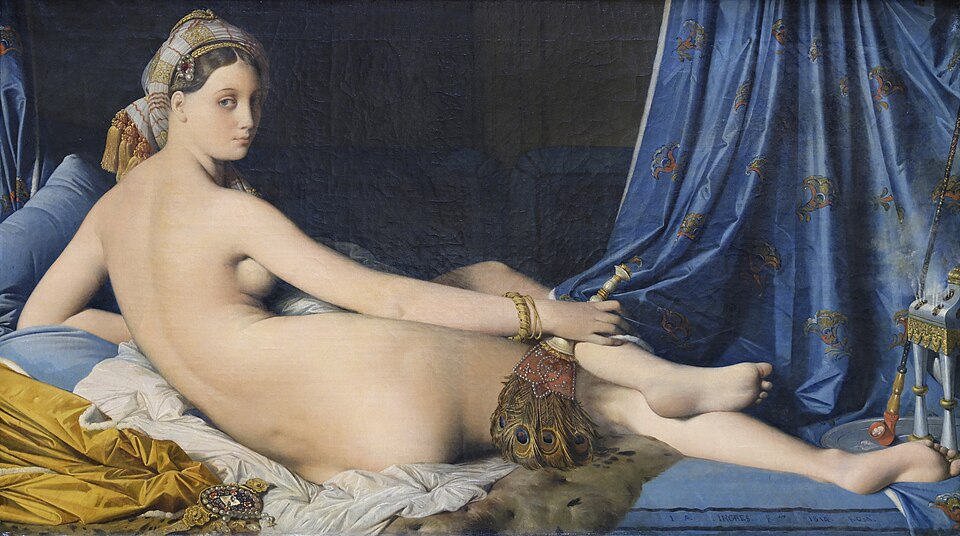
In 1814, a reclining woman turned her back to the world and looked over her shoulder, and French art criticism has not fully recovered since. The painting was Grande Odalisque, commissioned by Caroline Murat, Queen of Naples and sister of Napoleon Bonaparte, and painted by Jean-Auguste-Dominique Ingres. It depicts an odalisque — a concubine — stretched languidly across a bed, her body facing away from the viewer while her face turns back toward it, a composition Ingres borrowed directly from Jacques-Louis David's 1800 Portrait of Madame Récamier.
Ingres was not working in a vacuum. He drew on Giorgione's Dresden Venus and Titian's Venus of Urbino for the tradition of the reclining nude, but he filtered these classical references through the distortions of Mannerist painters like Parmigianino, whose Madonna with the Long Neck was itself notorious for anatomical liberties. The result was something neither fully classical nor fully modern — a small head, elongated limbs, and a cool, even light that flattened volume in favor of sinuous line.
Contemporaries did not know what to make of it. When the painting appeared at the Salon of 1819, one critic wrote that it had 'neither bones nor muscle, neither blood, nor life, nor relief, indeed nothing that constitutes imitation.' The verdict of the age was that Ingres had simply gotten the body wrong — that his odalisque was an anatomical failure dressed up as art. He was hounded by this criticism well into the mid-1820s.
What later generations discovered was that the errors were not errors at all. Careful measurement against real female proportions showed that the odalisque's spine curves and her pelvis rotates in ways no human body could replicate, and that her left arm is noticeably shorter than her right. Where early critics guessed at two or three extra vertebrae, later study concluded the real number was five — an elongation that stretched not just the lumbar spine but the pelvis and lower back as well.
This was not carelessness; it was calculation. Ingres favored long, unbroken lines to convey curvature and sensuality over strict anatomical truth, and the deliberate distortion of the pelvic region has been read as something more pointed still — a symbolic exaggeration tied to the odalisque's assumed role as an object existing solely to satisfy. Her face, meanwhile, is often described as giving away almost nothing, a gaze that either conceals a complex inner life or simply reflects none at all. The distance between that unreadable face and the exaggerated pelvis has been interpreted as the painting's real subject: the gap between a woman's inner life and the way her body is asked to speak for her.
More from Art

The Painting With No Foreground
A single robed figure stares out at an empty grey sea — and the emptiness itself became a scandal. When it was unveiled in Berlin in 1810, no one knew quite what to do with it.

The Painter Who Chased the Light
For a few purple minutes each evening, an American exile knelt in an English garden and raced the dying sun to paint two little girls lighting lanterns. It took him two years to finish.

When a President Became a God
Look straight up inside the U.S. Capitol dome and you will find George Washington enthroned among the clouds, surrounded by goddesses — the founding father transformed into myth.

Marble Brought Back to Life
A corpse asleep, a wing barely brushing her skin — and marble somehow learns to breathe. This is the moment Antonio Canova dared to carve.

The World Turned Upside Down
Look closely at a sixteenth-century Flemish village and you'll find a man biting a pillar, another carrying daylight in a basket, and a wife slipping a blue cloak over her husband's shoulders. Every gesture is a joke — if you know the language.

The Girl in the Glass Case
She stood two-thirds life size, dressed in a real tutu and human hair — and the critics who saw her in 1881 recoiled as if she were something obscene.