The Oldest Dream Ever Carved
Forty thousand years ago, someone took a mammoth's tusk and a flint blade and imagined a creature that never existed — half lion, half human. Then war buried the truth for thirty years.
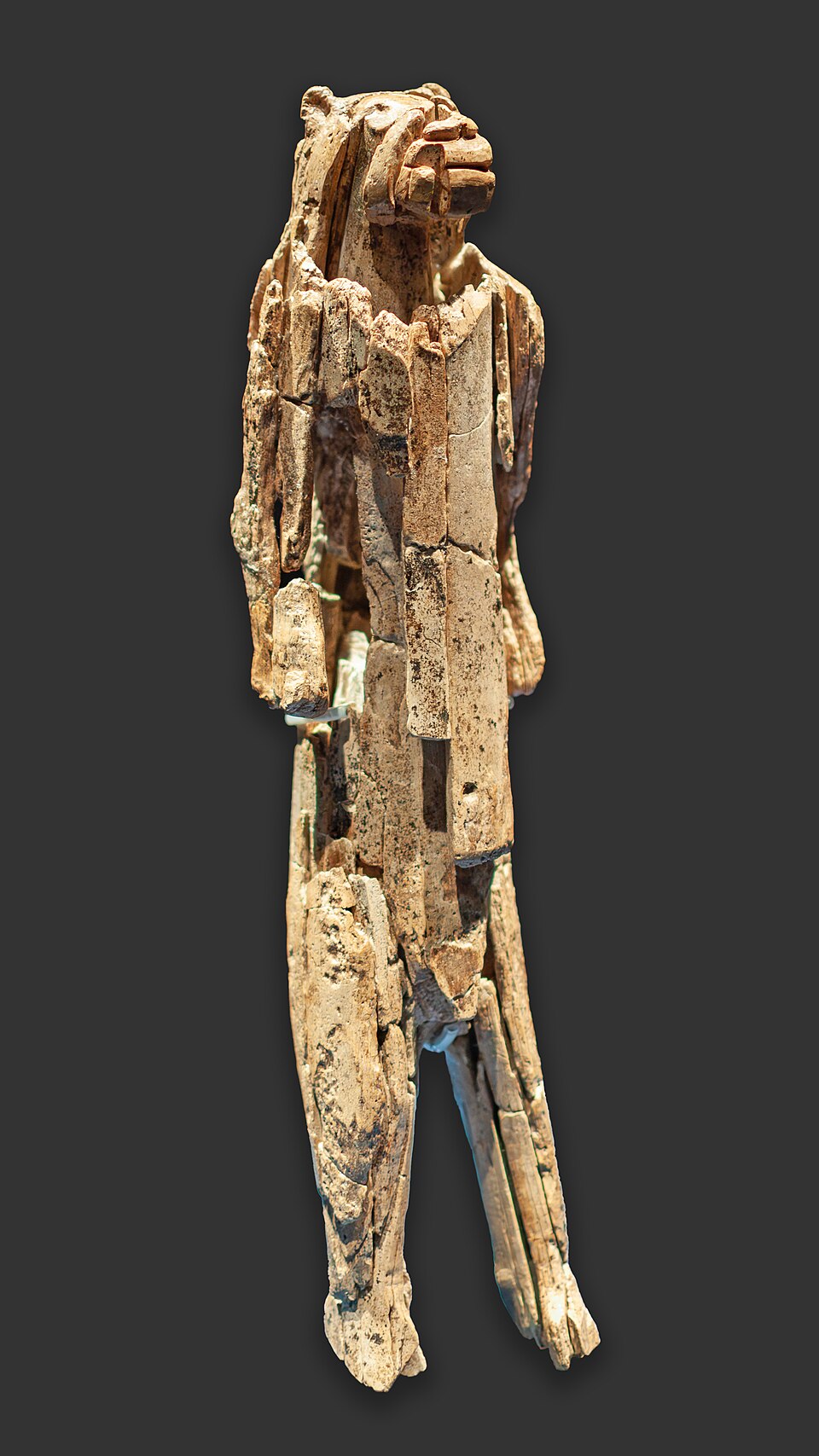
On 25 August 1939, geologist Otto Völzing was digging in a chamber deep inside Hohlenstein-Stadel, a cave in southern Germany, when he uncovered fragments of carved mammoth ivory. The excavation, led by historian Robert Wetzel since 1937, had stumbled onto something extraordinary. But there was no time to understand it. One week later, World War II began. The trenches were hastily backfilled with the same soil that had held the ivory for millennia, and the broken pieces were carried to the Museum Ulm, where they sat forgotten for roughly thirty years.
It took archaeologist Joachim Hahn to finally see what lay in the boxes. Sorting through more than 200 fragments, he began piecing together a figure unlike anything from the Ice Age: a body that was unmistakably human, topped with the unmistakable head of a cave lion. Carved from mammoth ivory using nothing but a flint stone knife, it bore seven parallel, transverse gouges cut into its left arm — deliberate marks whose purpose remains unknown.
Carbon dating placed the layer in which it was found between 35,000 and 41,000 years old, tying it to the Aurignacian culture of the Upper Paleolithic. That age makes the figurine, now known as the Löwenmensch — 'lion-person' — one of the oldest known examples of representational art, and the oldest confirmed statue ever discovered.
The reconstruction was far from finished with Hahn. Wetzel kept excavating summers at the site until 1961, and further ivory fragments turned up on the cave floor through the 1970s. In 1982, paleontologist Elisabeth Schmid folded these new pieces into Hahn's version, correcting errors and adding parts of the nose and mouth that sharpened the figure's feline character. A far more thorough restoration followed in 1987 at the Landesmuseum Württemberg, led by Ute Wolf working with Schmid. Over more than six months, they realized the figurine was only about two-thirds complete — the back badly damaged, the legs missing ivory lamellae — and filled the gaps with a reversible mixture of beeswax, artificial wax, and chalk.
The story did not end there. Fresh excavations in 2008 sifted every layer of the cave and turned up minute new fragments, which researchers first tested by simulating additions virtually. In 2012, a second full restoration began under Nicole Ebinger-Rist at the State Office for the Preservation of Historical Monuments in Esslingen. The figure was taken apart entirely; old artificial fillings were discarded and replaced with genuine fragments wherever possible. By the time the work finished in late 2013, the Löwenmensch had grown from 296 to 311 millimetres tall — a more complete, more accurate creature than anyone had seen in 40,000 years.
More from Archaeology

The Bronze Disc That Rewrote the Sky
Two looters with a metal detector dug up something illegal, invisible in value, and older than Stonehenge's final stones — a map of the heavens buried for over three thousand years.

The Faceless Women of the Ice Age
Long before writing, before cities, before the wheel, someone carved a woman's body into stone and ivory — and left no name, no face, no explanation.

The Pebble That Might Be Human
A palm-sized stone found on a Moroccan riverbank may be humanity's oldest attempt to see itself — or simply a trick of erosion.

The Crown That Vanished: Deshret and the Red Land
A crown worn by kings for three thousand years has never once been found in a tomb — not one. So where did it go?

The Face That Traveled Between Empires
A farm worker's shovel struck stone in 1897 and unearthed a face so striking it would be sold to France, seized as war booty, and finally traded back for a Velázquez.

The Boy in the Dark Tunnel
A schoolboy fell into black water inside an ancient tunnel and surfaced with his fingers brushing letters no one had noticed for 2,600 years.