The Oseberg Ship: A Viking Queen's Grave
In 1904, diggers in a Norwegian field struck oak — and pulled a Viking ship, two women's skeletons, and a lost world out of the earth.
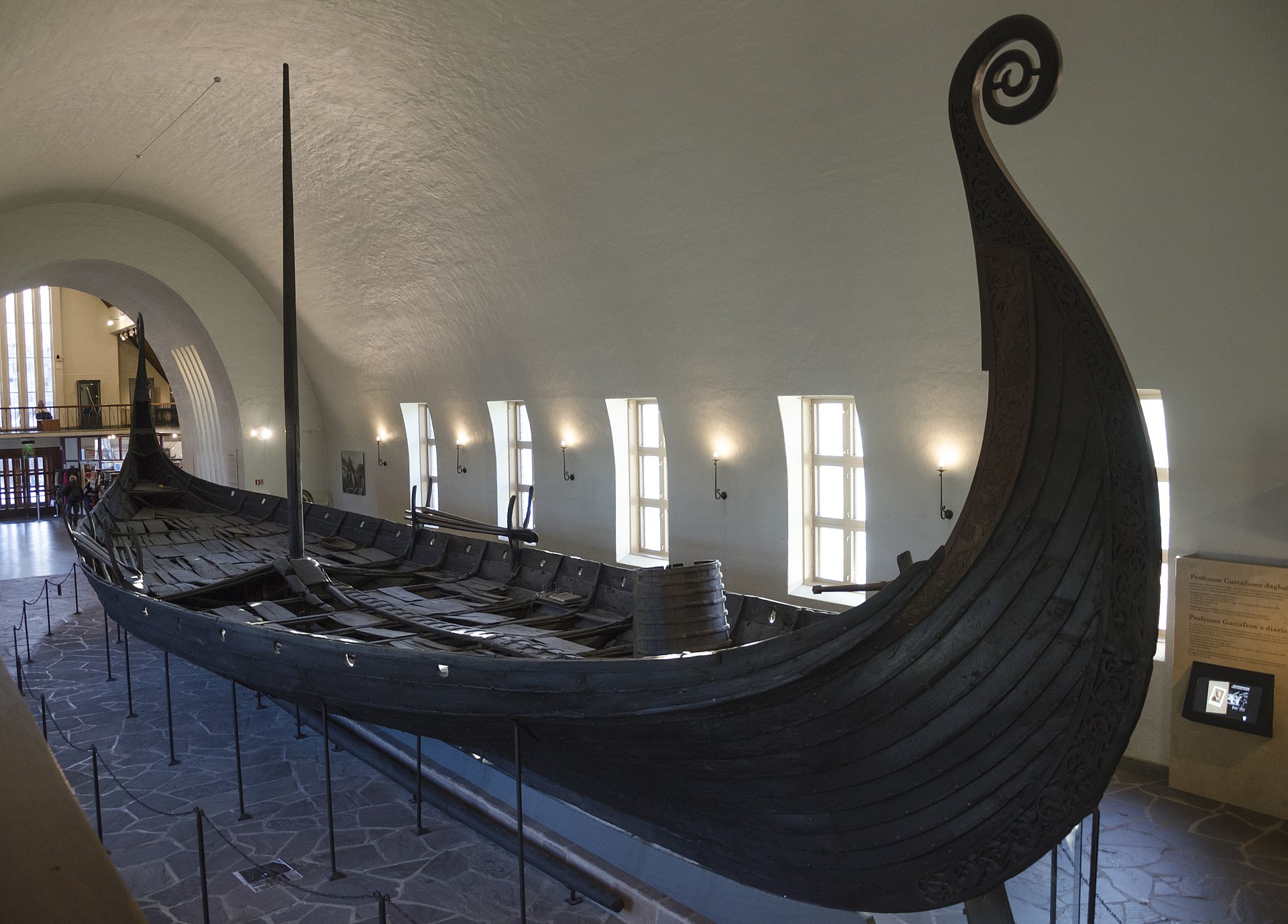
On the Oseberg farm near Tønsberg in Vestfold, Norway, a burial mound had sat quietly for over a thousand years, its secrets pressed beneath layers of clay and turf. In 1904 and 1905, Swedish archaeologist Gabriel Gustafson and his Norwegian colleague Haakon Shetelig began to excavate it, and what emerged stunned them: an almost completely intact wooden longship, built largely of oak, buried as the centerpiece of a grave.
The vessel, a type known as a karve, stretched 21.58 metres long and 5.10 metres wide, once carrying a mast roughly 9 to 10 metres tall. With an estimated sail area of 90 square metres, it could have reached speeds up to 10 knots. Fifteen pairs of oar-holes meant up to 30 people could row it, and it carried an anchor, a steering oar, a gangplank, and a bailer. Its bow and stern were carved with astonishing skill in the swirling 'gripping beast' style now called the Oseberg style — proof that this was no ordinary craft, but a masterwork.
Inside the burial chamber lay two female skeletons, together in one bed, dated by tree-ring analysis to the autumn of 834, though parts of the ship's timber dated back to around 800 or earlier. One woman was around 80 years old and suffered severe arthritis; she also had Morgagni's syndrome, which would have given her a masculine appearance and a beard. The other was long thought to be 25 to 30, though later tooth analysis suggested she was actually 50 to 55. Historians still don't know which woman held higher status, or whether one had been sacrificed to accompany the other into death. An early theory that the younger woman's broken collarbone proved sacrifice fell apart once examination showed the bone had already been healing for weeks.
Their clothing hinted at rank: one wore a fine red wool dress woven in a luxurious lozenge twill pattern, paired with a delicate white linen veil, while the other wore a plainer blue wool dress with a simple wool veil — perhaps a sign of social distinction between them. Neither wore garments entirely of silk, though small silk strips had been sewn onto a tunic beneath the red dress. Their diet, made mostly of meat rather than the fish most Vikings relied on, was itself a mark of privilege, and the younger woman's teeth showed wear consistent with using a metal toothpick — a rare luxury for the 9th century.
Speculation about the high-ranking woman's identity has long swirled. Some have proposed she was Queen Åsa of the Yngling clan, mother of Halfdan the Black and grandmother of Harald Fairhair, since later tests suggested the women had lived in Agder, Åsa's home region. Others argue she may have been a shaman instead. Genetic testing once suggested the younger woman's maternal ancestry traced to the Pontic region, possibly Iran, but subsequent studies could not confirm this, and the DNA samples were likely too degraded or contaminated to trust.
More from Archaeology

The Bronze Disc That Rewrote the Sky
Two looters with a metal detector dug up something illegal, invisible in value, and older than Stonehenge's final stones — a map of the heavens buried for over three thousand years.

The Faceless Women of the Ice Age
Long before writing, before cities, before the wheel, someone carved a woman's body into stone and ivory — and left no name, no face, no explanation.

The Pebble That Might Be Human
A palm-sized stone found on a Moroccan riverbank may be humanity's oldest attempt to see itself — or simply a trick of erosion.

The Crown That Vanished: Deshret and the Red Land
A crown worn by kings for three thousand years has never once been found in a tomb — not one. So where did it go?

The Face That Traveled Between Empires
A farm worker's shovel struck stone in 1897 and unearthed a face so striking it would be sold to France, seized as war booty, and finally traded back for a Velázquez.

The Boy in the Dark Tunnel
A schoolboy fell into black water inside an ancient tunnel and surfaced with his fingers brushing letters no one had noticed for 2,600 years.