The Painter Who Crowned an Emperor Twice
In a former chapel near the Sorbonne, a painter spent years building a scene that never quite happened — and the man who commissioned it loved it anyway.
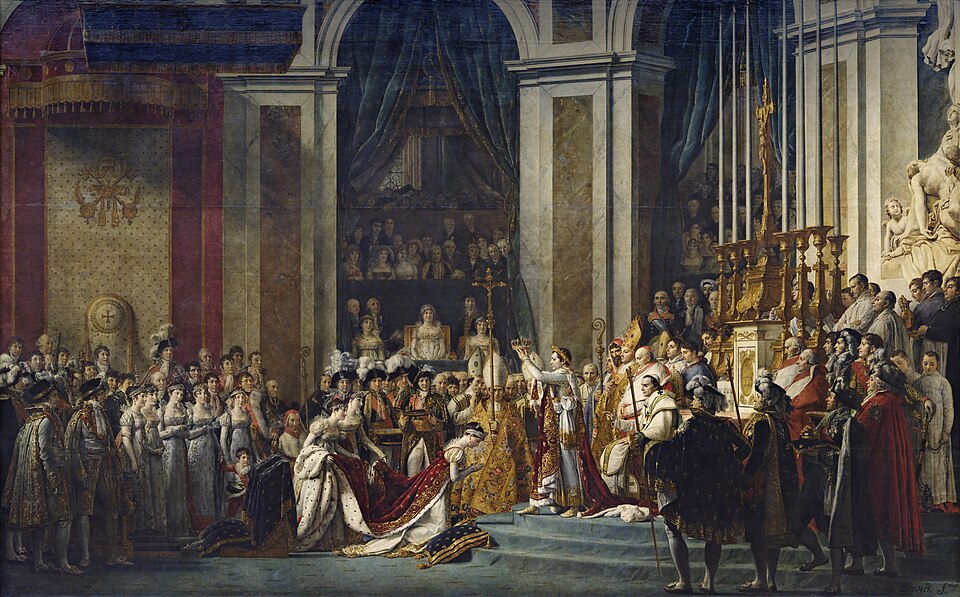
In September 1804, Napoleon gave an oral commission to Jacques-Louis David, his official painter, to memorialize the coronation that would take place that December at Notre-Dame de Paris. David began the actual canvas on 21 December 1805, working in the former chapel of the College of Cluny, near the Sorbonne, which had been converted into his studio. Assisted by his student Georges Rouget, he labored over the painting for more than two years, completing the work in 1807 and adding the finishing touches in January 1808.
The result was enormous: an oil canvas nearly ten meters wide and just over six meters tall, organized with the strict geometry of neoclassicism. A vertical axis runs through a cross in the composition, while a diagonal line connects the pope to the empress. Every gaze in the painting is drawn toward Napoleon himself, who stands at the center in robes recalling Roman emperors. Underneath the visible paint, traces remain of an earlier version — one in which Napoleon held the crown above his own head, as if to crown himself.
Joséphine de Beauharnais kneels before him in the submissive posture prescribed by the French Civil Code, receiving the crown not from the pope but from her husband's hands. Her silk-trimmed robe may have been a deliberate nod to the Lyon silk manufacturers who had suffered during the Revolution. Nearby, David placed Napoleon's mother, Maria Letizia Ramolino, in a position of honor greater than the pope's — despite the fact that she had not actually attended the ceremony, staying away in protest over Napoleon's friction with his brothers Lucien and Joseph. She reportedly asked David to give Lucien a place of honor in the painting instead.
Other family members populate the scene: Louis Bonaparte, who became King of Holland and married Josephine's daughter Hortense; Joseph Bonaparte, later Prince Imperial and eventually King of Naples in 1806 and Spain in 1808; and the young Napoleon Charles Bonaparte, son of Louis and Hortense. Napoleon's sisters appear as well, one of them in a pink dress in the later replica — the sole alteration David made when painting that second version from memory.
The painting is crowded with the men who ran the new empire. Charles-François Lebrun, third consul, holds the sceptre. Cambacérès, arch-chancellor prince of the empire, holds the hand of justice. Berthier, marshal and former war minister, carries the globe topped with a cross. Talleyrand stands as grand chamberlain, and Joachim Murat, Napoleon's brother-in-law and future King of Naples, is also present. Pope Pius VII, invited to lend legitimacy to the regime after the Concordat of 1801, appears with his hand raised in blessing — a gesture Napoleon himself is said to have insisted upon, to make clear the pope's role was purely ceremonial. Among the clergy stands Dom Raphaël de Monachis, a Greek-Egyptian monk, and further off in the stands is the Ottoman ambassador Halet Efendi, along with David himself, watching his own creation from within it.
More from Art

The Painting With No Foreground
A single robed figure stares out at an empty grey sea — and the emptiness itself became a scandal. When it was unveiled in Berlin in 1810, no one knew quite what to do with it.

The Painter Who Chased the Light
For a few purple minutes each evening, an American exile knelt in an English garden and raced the dying sun to paint two little girls lighting lanterns. It took him two years to finish.

When a President Became a God
Look straight up inside the U.S. Capitol dome and you will find George Washington enthroned among the clouds, surrounded by goddesses — the founding father transformed into myth.

Marble Brought Back to Life
A corpse asleep, a wing barely brushing her skin — and marble somehow learns to breathe. This is the moment Antonio Canova dared to carve.

The World Turned Upside Down
Look closely at a sixteenth-century Flemish village and you'll find a man biting a pillar, another carrying daylight in a basket, and a wife slipping a blue cloak over her husband's shoulders. Every gesture is a joke — if you know the language.

The Girl in the Glass Case
She stood two-thirds life size, dressed in a real tutu and human hair — and the critics who saw her in 1881 recoiled as if she were something obscene.