The Painting Built on a Scandalous Request
A nobleman wanted his mistress swung by a bishop while he peeked up her skirts. What he got instead became one of the most seductive paintings in history.
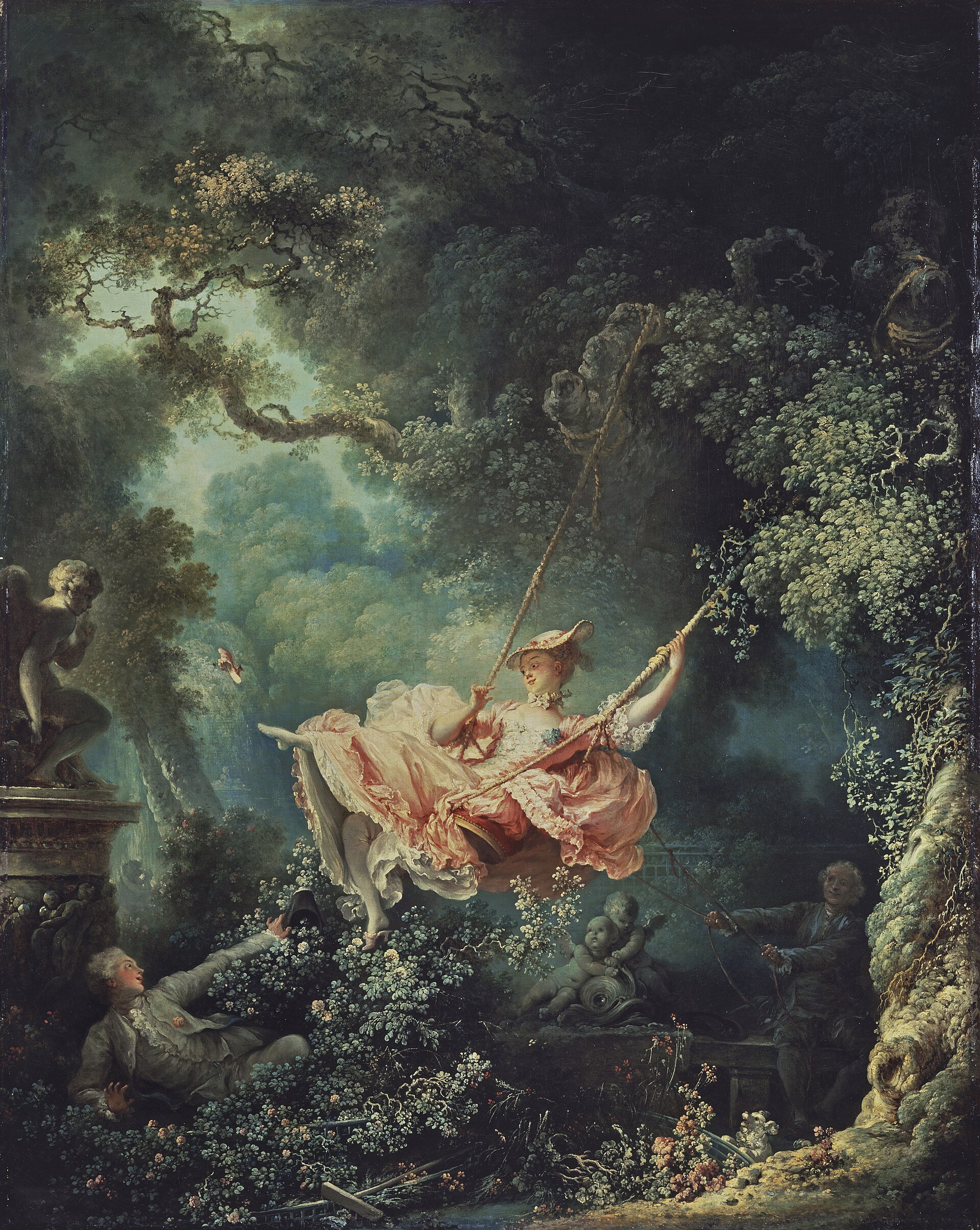
According to the memoirs of the dramatist Charles Collé, an unnamed courtier once approached the history painter Gabriel François Doyen with an unusual commission: paint my mistress on a swing, pushed by a bishop, while I watch from below. Doyen, uncomfortable with such a frivolous scene, declined — but passed the job along to a younger painter with fewer scruples about scandal, Jean-Honoré Fragonard.
Fragonard softened the blasphemy but kept the mischief. In the finished painting, a bishop becomes an anonymous older man, smiling in the shadows on the right, pulling the swing's ropes. Below and to the left, a young man hides in the bushes, hat in hand, grinning up at the swinging woman's billowing pink dress. She flings one shoe from an outstretched foot, her bergère — shepherdess — hat perched playfully on her head, a small white dog barking somewhere near the action.
Two stone putti watch the scene unfold. One, above the hidden young man, presses a finger to its lips — a silent accomplice. The rest of the painting hums with the same conspiratorial energy: light, green, teasing, indifferent to consequence. It is Rococo distilled into a single moment of suspended motion, right before the shoe lands and the secret is, perhaps, given away.
This kind of playful, erotic frivolity did not sit well with everyone. As the Enlightenment gathered force, philosophers began demanding an art of gravity and moral seriousness — one that elevated humanity rather than delighted in its games. Fragonard's swing, with its stolen glances and flying footwear, became exactly the kind of art they scorned.
The painting's early ownership history is murky. What is certain is that by the time of the French Revolution it belonged to the tax farmer Marie-François Ménage de Pressigny, who was guillotined in 1794 — after which the revolutionary government seized his property, the painting included. It passed possibly through the Marquis des Razins de Saint-Marc before landing definitively with the Duc de Morny. When Morny died in 1865, the painting was auctioned in Paris and bought by Lord Hertford, whose collection would become the founding core of the Wallace Collection in London, where it remains today.
More from Art

The Painting With No Foreground
A single robed figure stares out at an empty grey sea — and the emptiness itself became a scandal. When it was unveiled in Berlin in 1810, no one knew quite what to do with it.

The Painter Who Chased the Light
For a few purple minutes each evening, an American exile knelt in an English garden and raced the dying sun to paint two little girls lighting lanterns. It took him two years to finish.

When a President Became a God
Look straight up inside the U.S. Capitol dome and you will find George Washington enthroned among the clouds, surrounded by goddesses — the founding father transformed into myth.

Marble Brought Back to Life
A corpse asleep, a wing barely brushing her skin — and marble somehow learns to breathe. This is the moment Antonio Canova dared to carve.

The World Turned Upside Down
Look closely at a sixteenth-century Flemish village and you'll find a man biting a pillar, another carrying daylight in a basket, and a wife slipping a blue cloak over her husband's shoulders. Every gesture is a joke — if you know the language.

The Girl in the Glass Case
She stood two-thirds life size, dressed in a real tutu and human hair — and the critics who saw her in 1881 recoiled as if she were something obscene.