The Painting Gauguin Meant as His Last Word
Before he swallowed the arsenic, he wanted to leave behind one enormous canvas that answered every question he'd ever been asked as a boy. What he painted instead became the closest thing he had to a suicide note.
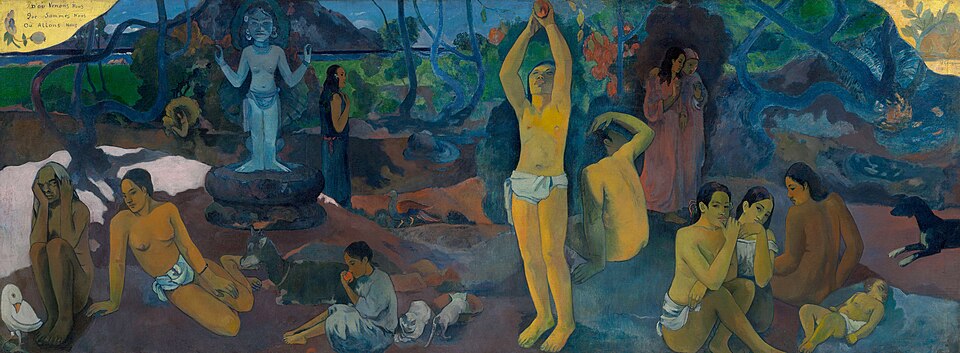
Long before Tahiti, before the syphilis and the debts and the dead daughter in Copenhagen, there was a classroom outside Orléans where an eleven-year-old Paul Gauguin sat through lessons in Catholic liturgy taught by the Bishop of Orléans himself, Félix-Antoine-Philibert Dupanloup. Dupanloup had built his own catechism, one meant to guide young minds toward spiritual reflection, and it rested on three questions: where does humanity come from, where is it going, and how does it proceed? Gauguin grew into a fiercely anticlerical man, but those three questions never left him. They became the scaffolding of everything he later tried to paint.
In 1891 he sailed for Tahiti, chasing a society he imagined as simpler and more elemental than the France he'd left behind. Over the following years he produced a body of work steeped in his own invented mythology, and in 1897 he arrived at the painting that would carry Dupanloup's questions almost word for word into its title: D'où venons-nous? Que sommes-nous? Où allons-nous? He inscribed the title himself in the upper left corner, in capital letters, without question marks or dashes, and signed and dated it P. Gauguin / 1897 in the upper right corner.
The canvas came out of one of the darkest stretches of his life. He was battling eczema, syphilis, and conjunctivitis. He was sinking into debt. And he had just learned that his daughter had died in Copenhagen. In a letter to his friend Daniel de Monfreid, Gauguin confessed he intended to kill himself before the year's end — but not before he finished one final, monumental painting that would stand as the culmination of everything he had thought and felt.
Read from right to left, the painting moves through a full life cycle. On the right, three crouched women sit beside a sleeping child, marking birth. A girl surrounded by kittens embodies the purity of girlhood. At the center, a figure reaches up to pick fruit from a tree in what Gauguin framed as a Garden of Eden — a deliberate echo of Eve and the idea of sin entering daily adult life. Nearby, a mature woman wears a bracelet and a collar-wearing white goat stands beside her, images Gauguin used to suggest domestic submission.
Moving further left, age and mortality take over. An old woman, in Gauguin's own words, 'appears reconciled and resigned to her thoughts' as she approaches death. At her feet crouches a strange white bird, which the artist said represented 'the futility of words' — or, in another phrasing, the uselessness of vain speech. Two sorrowful women stand near a tree apart from the rest, interpreted by scholars as embodying a tension between enlightenment and older, more superstitious traditions. Behind it all looms a blue idol, set outside the entire cycle of birth, sin, and death — what Gauguin called simply 'the Beyond.'
More from Art

The Painting With No Foreground
A single robed figure stares out at an empty grey sea — and the emptiness itself became a scandal. When it was unveiled in Berlin in 1810, no one knew quite what to do with it.

The Painter Who Chased the Light
For a few purple minutes each evening, an American exile knelt in an English garden and raced the dying sun to paint two little girls lighting lanterns. It took him two years to finish.

When a President Became a God
Look straight up inside the U.S. Capitol dome and you will find George Washington enthroned among the clouds, surrounded by goddesses — the founding father transformed into myth.

Marble Brought Back to Life
A corpse asleep, a wing barely brushing her skin — and marble somehow learns to breathe. This is the moment Antonio Canova dared to carve.

The World Turned Upside Down
Look closely at a sixteenth-century Flemish village and you'll find a man biting a pillar, another carrying daylight in a basket, and a wife slipping a blue cloak over her husband's shoulders. Every gesture is a joke — if you know the language.

The Girl in the Glass Case
She stood two-thirds life size, dressed in a real tutu and human hair — and the critics who saw her in 1881 recoiled as if she were something obscene.