The Painting Nobody Wanted
A quiet English river scene failed to sell in its own country — then set Paris on fire and won a gold medal from a king.
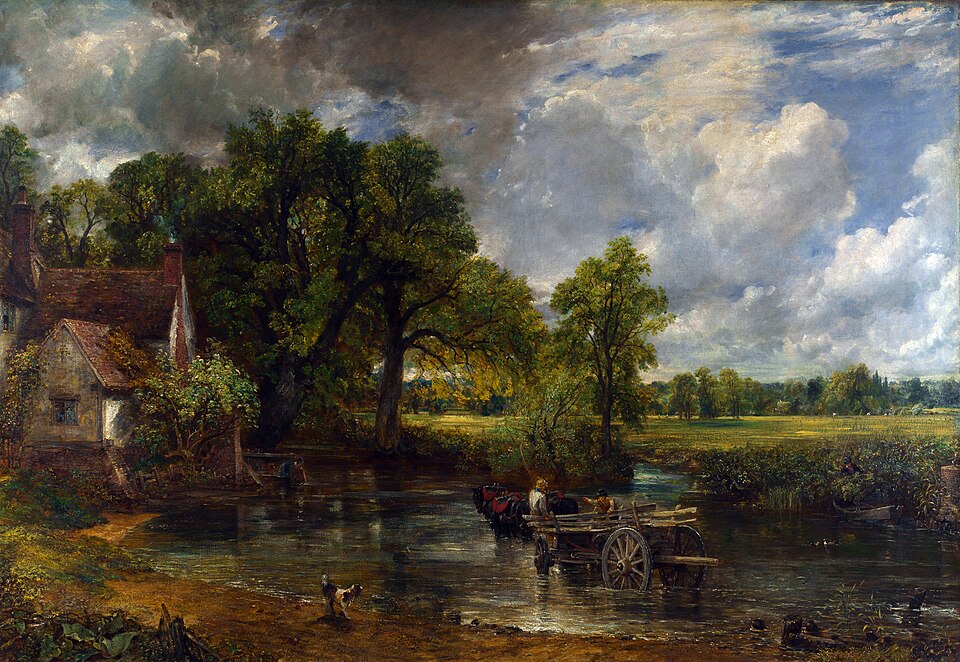
In 1821, at the Royal Academy Exhibition in Somerset House, a large canvas titled Landscape: Noon was exhibited and failed to find a buyer. It showed three horses hauling a farm wain across a shallow river, a thatched cottage on the left bank, willows and clouds pressing low over quiet English fields. The painter was John Constable, and the scene was one he knew intimately: the River Stour, dividing Suffolk from Essex, near Flatford Mill, which his father owned.
The cottage in the painting belonged to a real neighbour, Willy Lott, a tenant farmer said to have been born in that house and never to have left it for more than four days in his entire life. The building still stands today, almost unchanged, though every tree Constable painted around it is long gone. The scene, however calm it looks, was not simply copied from nature. Constable built it deliberately, adding and rearranging elements — fields shaped by agriculture, a landscape as managed as it was picturesque.
Constable painted the work as one of his 'six-footers,' a series of large-scale canvases meant for the Academy's summer exhibitions. As with the others, he first produced a full-scale oil sketch, worked with a palette knife, now held at the Victoria and Albert Museum. A smaller sketch, his first experiment with extending the composition further to the right, is today in the Yale Center for British Art.
Though it found no buyer at home, the French response was different. The painting travelled to the Paris Salon of 1824, alongside two other Constable works, and caused a sensation. Théodore Géricault praised it; the writer Stendhal, visiting the exhibition, wrote: 'We have never seen anything like these pictures before. It is their truthfulness that is so striking.' Charles X of France awarded it a gold medal, a cast of which was later set into the painting's frame. Eugène Delacroix and a new generation of French painters took note.
At that same Salon, the canvas was sold along with three other Constables to the dealer John Arrowsmith. It was then brought back to England by another dealer, D. T. White, who sold it to a Mr. Young residing on the Isle of Wight. There it caught the eye of collector Henry Vaughan and painter Charles Robert Leslie. When Young died, Vaughan bought the painting from his estate, and in 1886 gave it to the National Gallery in London, where it remains.
More from Art

The Painting With No Foreground
A single robed figure stares out at an empty grey sea — and the emptiness itself became a scandal. When it was unveiled in Berlin in 1810, no one knew quite what to do with it.

The Painter Who Chased the Light
For a few purple minutes each evening, an American exile knelt in an English garden and raced the dying sun to paint two little girls lighting lanterns. It took him two years to finish.

When a President Became a God
Look straight up inside the U.S. Capitol dome and you will find George Washington enthroned among the clouds, surrounded by goddesses — the founding father transformed into myth.

Marble Brought Back to Life
A corpse asleep, a wing barely brushing her skin — and marble somehow learns to breathe. This is the moment Antonio Canova dared to carve.

The World Turned Upside Down
Look closely at a sixteenth-century Flemish village and you'll find a man biting a pillar, another carrying daylight in a basket, and a wife slipping a blue cloak over her husband's shoulders. Every gesture is a joke — if you know the language.

The Girl in the Glass Case
She stood two-thirds life size, dressed in a real tutu and human hair — and the critics who saw her in 1881 recoiled as if she were something obscene.