The Painting That Eats Ships
Two polar bears gnaw on the bones of British ambition — and a century later, students still won't sit near it during exams.
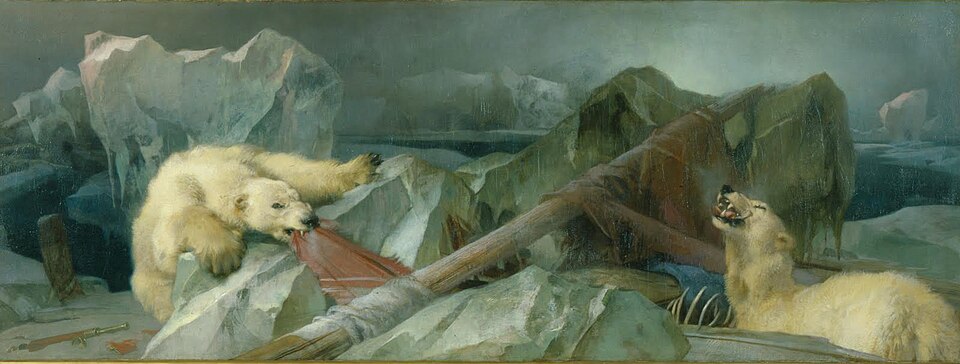
In May 1845, Sir John Franklin sailed out of Greenhithe with 134 men aboard two ironclad steamships, HMS Erebus and HMS Terror, bound for the Northwest Passage. Five men left the expedition early. The remaining 129 were last spotted by a whaling ship in Lancaster Sound in July 1845. Then they vanished.
Years passed with no word. Search parties combed the Arctic. In 1854, Inuit accounts reached Captain John Rae of the Hudson's Bay Company, describing sightings from 1850 and grim discoveries of dead bodies on King William Island — along with troubling suggestions of cannibalism among the last survivors. In 1859, Francis Leopold McClintock published his own account, The Voyage of the Fox in the Arctic Seas, detailing the remains of two crewmen he'd found on King William Island, alongside a ship's boat and other debris.
Out of this haunting mystery, the artist Sir Edwin Landseer painted Man Proposes, God Disposes in 1864. The canvas shows an imagined Arctic aftermath: two polar bears prowling among the wreckage of Franklin's doomed voyage — a broken telescope, the shredded remains of a red ensign, a torn sail, and scattered human rib bones. The critic William Michael Rossetti called these bones 'the saddest of membra disjecta.' Landseer painted in the dark palette of his later career, and the image reads as nature triumphant over human ambition — a quiet rebuke to the swaggering imperial confidence of mid-Victorian Britain.
The painting may also owe something to earlier works: Caspar David Friedrich's The Sea of Ice from 1824, and Frederic Edwin Church's The Icebergs, exhibited in New York in 1861 and in London in 1863.
The title itself borrows an old phrase. 'Man proposes, but God disposes' translates the Latin 'Homo proponit, sed Deus disponit,' found in Thomas à Kempis's fifteenth-century The Imitation of Christ. The sentiment is older still — Lucian's Symposium, written around 150 AD, closes with a line adapted from Euripides, some six centuries before Christ: the gods, it says, bring many matters to surprising ends.
More from Art

The Painting With No Foreground
A single robed figure stares out at an empty grey sea — and the emptiness itself became a scandal. When it was unveiled in Berlin in 1810, no one knew quite what to do with it.

The Painter Who Chased the Light
For a few purple minutes each evening, an American exile knelt in an English garden and raced the dying sun to paint two little girls lighting lanterns. It took him two years to finish.

When a President Became a God
Look straight up inside the U.S. Capitol dome and you will find George Washington enthroned among the clouds, surrounded by goddesses — the founding father transformed into myth.

Marble Brought Back to Life
A corpse asleep, a wing barely brushing her skin — and marble somehow learns to breathe. This is the moment Antonio Canova dared to carve.

The World Turned Upside Down
Look closely at a sixteenth-century Flemish village and you'll find a man biting a pillar, another carrying daylight in a basket, and a wife slipping a blue cloak over her husband's shoulders. Every gesture is a joke — if you know the language.

The Girl in the Glass Case
She stood two-thirds life size, dressed in a real tutu and human hair — and the critics who saw her in 1881 recoiled as if she were something obscene.