The Painting That Made a Queen Ask for Privacy
A boy's small cut on a carpentry floor sparked one of the fiercest art scandals of Victorian England — and Charles Dickens couldn't hold his tongue.
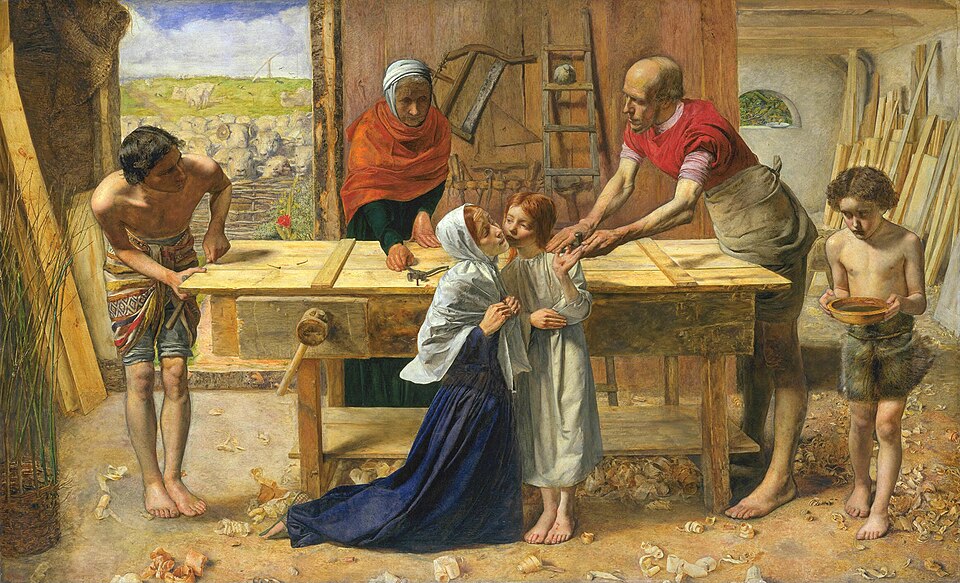
In 1849, a young painter named John Everett Millais set to work on a canvas that would depict something almost unbearably ordinary: a carpenter's workshop, cluttered with wood shavings and tools, where a boy has cut his hand on a nail. But the boy was Jesus, the carpenter was Joseph, and the painting was Christ in the House of His Parents.
Millais rendered the scene with unflinching realism. Jesus stands beside Joseph's work-table, where a door is being built, blood trickling from a wound in his palm down to his foot — a deliberate echo of the stigmata and a foreshadowing of the crucifixion to come. His grandmother Anne works the nail free with pincers while his mother Mary leans in, offering her cheek, her face etched with concern. Joseph bends to examine the wound himself.
The painting is dense with quiet symbolism. A boy who would grow up to be John the Baptist carries in a basin of water to cleanse the cut, a gesture that anticipates his future baptism of Christ. An assistant standing nearby represents the apostles yet to come. A ladder propped against the back wall recalls Jacob's Ladder, and a dove perched upon it stands for the Holy Spirit. Carpentry tools scattered through the scene gesture toward the Holy Trinity, while sheep glimpsed through the open door hint at the Christian flock still to be gathered. Millais likely drew this visual language from Albrecht Dürer's Melancholia I and from Quattrocento painting, and he may have been influenced both by John Rogers Herbert's Our Saviour Subject to His Parents at Nazareth and by a workshop scene once attributed to Annibale Carracci.
When the painting was exhibited, the reaction was ferocious. Viewers were scandalized not by the symbolism but by the grime — the literal dirt and clutter of the workshop floor, and the plain, even unlovely appearance of the holy figures themselves. One critic complained it was painful to see 'the youthful Saviour' rendered as 'a red-headed Jew boy.'
No response cut deeper than that of Charles Dickens, who described Millais's Christ as a 'wry-necked, blubbering red-headed boy in a bed-gown' who looked as if he'd just been struck while playing in a gutter. Dickens went further still, accusing Millais of portraying Mary as an alcoholic — a woman so hideous that she would stand out as a monster in the vilest cabaret in France or the lowest gin-shop in England. Other critics claimed the family showed signs of rickets and disease, as though Millais had painted slum-dwellers rather than the Holy Family.
More from Art

The Painting With No Foreground
A single robed figure stares out at an empty grey sea — and the emptiness itself became a scandal. When it was unveiled in Berlin in 1810, no one knew quite what to do with it.

The Painter Who Chased the Light
For a few purple minutes each evening, an American exile knelt in an English garden and raced the dying sun to paint two little girls lighting lanterns. It took him two years to finish.

When a President Became a God
Look straight up inside the U.S. Capitol dome and you will find George Washington enthroned among the clouds, surrounded by goddesses — the founding father transformed into myth.

Marble Brought Back to Life
A corpse asleep, a wing barely brushing her skin — and marble somehow learns to breathe. This is the moment Antonio Canova dared to carve.

The World Turned Upside Down
Look closely at a sixteenth-century Flemish village and you'll find a man biting a pillar, another carrying daylight in a basket, and a wife slipping a blue cloak over her husband's shoulders. Every gesture is a joke — if you know the language.

The Girl in the Glass Case
She stood two-thirds life size, dressed in a real tutu and human hair — and the critics who saw her in 1881 recoiled as if she were something obscene.