The Painting That Never Left the Studio
An unfinished altarpiece, a hidden sketch of a horse's skull, and a psychoanalyst who saw a vulture where there wasn't one — the strange afterlife of Leonardo's last great composition.
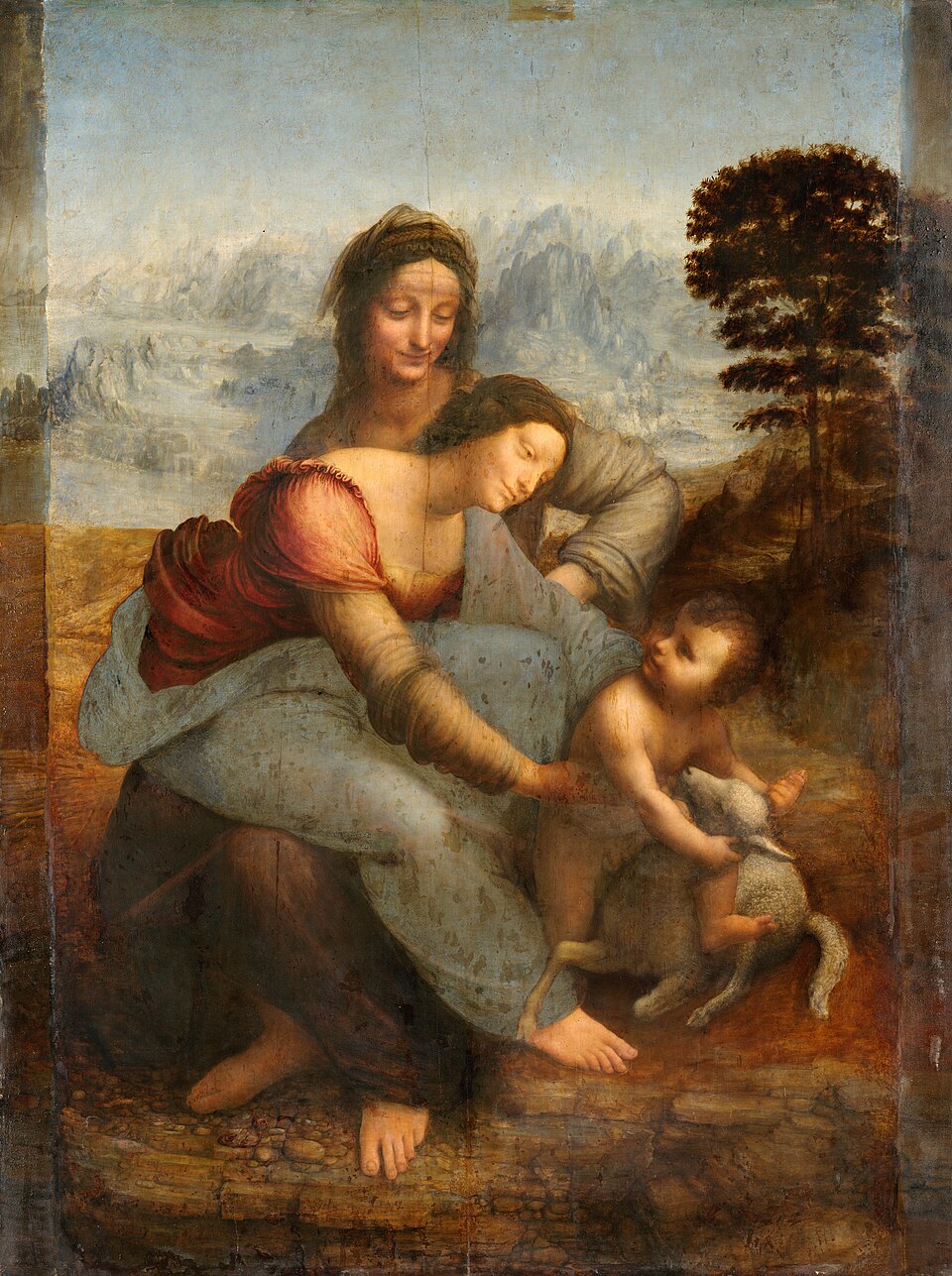
For nearly two decades, Leonardo da Vinci kept returning to the same tender arrangement of figures: a grandmother, her daughter, and a child reaching for a lamb. The Virgin and Child with Saint Anne, painted in oil sometime between 1501 and 1519, was left unfinished at his death, yet it remains one of the most studied works in the history of art. It was commissioned as the high altarpiece for the Church of Santissima Annunziata in Florence, though the theme of Anne, Mary, and Christ together had preoccupied Leonardo long before that commission arrived.
Historians believe the painting may actually trace back to King Louis XII of France, who is thought to have commissioned it after the birth of his daughter in 1499. If so, it was never delivered to him. Before settling on the final oil composition, Leonardo worked through the problem of uniting these three figures in the Burlington House Cartoon, now held at the National Gallery in London, a large preparatory drawing that let him test the interlocking poses of grandmother, mother, and child.
In 2008, a Louvre curator made a startling discovery on the back of the panel itself: faint sketches, invisible to the naked eye, revealed through infrared reflectography. One was a seven-by-four-inch drawing of a horse's head, recalling studies Leonardo had made before painting The Battle of Anghiari. Another showed half a skull, six and a half by four inches. A third depicted the infant Jesus playing with a lamb, echoing the finished composition on the front. The Louvre called it the first time a drawing had ever been found on the reverse of one of Leonardo's works.
On the front of the panel, the scene itself is quietly intimate. Mary sits on the knee of her mother, Saint Anne, reaching toward the baby Jesus, who plays with a lamb. Art historian Tom Gurney has described a joyful atmosphere, the two women delighting in the child as he looks to his mother for guidance. Scholar Michael Alan Anderson has noted the realism with which Jesus's lineage is expressed, Mary seated on the lap of a strikingly young Anne, both women gazing at the Christ Child as his hand grasps the Lamb of God, a symbol of his coming Passion.
The painting also became an unlikely centerpiece of psychoanalytic theory. In 1910, Sigmund Freud wrote an essay on Leonardo da Vinci in which he claimed the folds of the Virgin's garment concealed the outline of a vulture. Freud linked this to a childhood memory Leonardo recorded in the Codex Atlanticus, in which a bird struck the infant Leonardo's lips with its tail while he lay in his cradle. Freud saw in this a manifestation of repressed childhood fantasy, and further speculated that Leonardo's fascination with the double figure of Mary and Anne reflected his own upbringing by two mothers, his birth mother and his father's wife.
More from Art

The Painting With No Foreground
A single robed figure stares out at an empty grey sea — and the emptiness itself became a scandal. When it was unveiled in Berlin in 1810, no one knew quite what to do with it.

The Painter Who Chased the Light
For a few purple minutes each evening, an American exile knelt in an English garden and raced the dying sun to paint two little girls lighting lanterns. It took him two years to finish.

When a President Became a God
Look straight up inside the U.S. Capitol dome and you will find George Washington enthroned among the clouds, surrounded by goddesses — the founding father transformed into myth.

Marble Brought Back to Life
A corpse asleep, a wing barely brushing her skin — and marble somehow learns to breathe. This is the moment Antonio Canova dared to carve.

The World Turned Upside Down
Look closely at a sixteenth-century Flemish village and you'll find a man biting a pillar, another carrying daylight in a basket, and a wife slipping a blue cloak over her husband's shoulders. Every gesture is a joke — if you know the language.

The Girl in the Glass Case
She stood two-thirds life size, dressed in a real tutu and human hair — and the critics who saw her in 1881 recoiled as if she were something obscene.