The Painting That Refused to Stay in the Past
A woman stands naked before strangers while a man checks her teeth like livestock — painted in exquisite detail, sold for profit, and 150 years later, weaponized in a political ad.
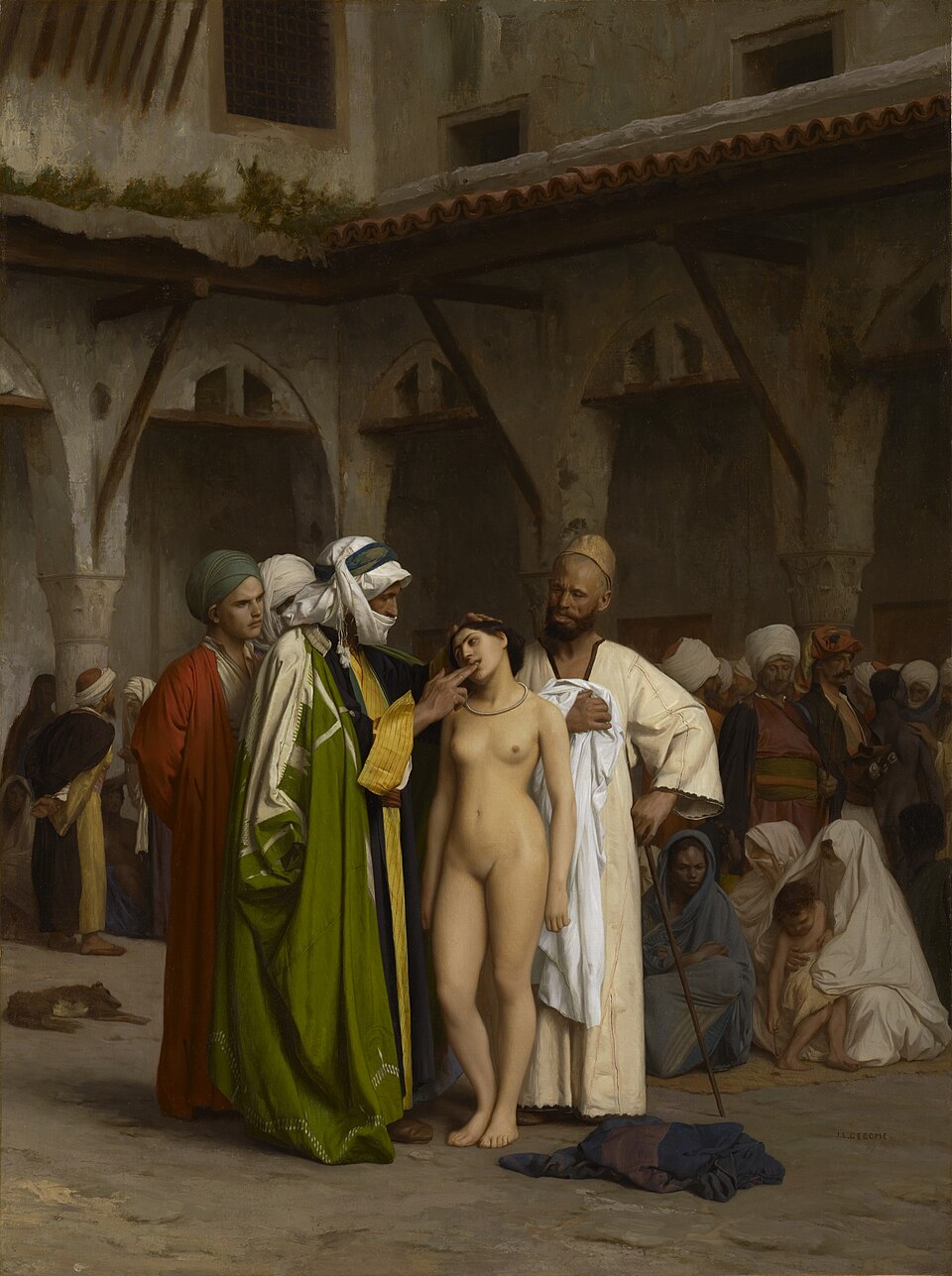
In 1866, Jean-Léon Gérôme finished a canvas that would haunt art history for generations. The Slave Market shows a scene set somewhere in West Asia or North Africa: a man leans forward, inspecting the teeth of a nude Abyssinian woman, evaluating her as a buyer might evaluate a horse. Around them, other transactions unfold — in the background, buyers examine a nude, dark-skinned male slave. The painting is meticulous, almost photographic in its rendering of fabric, skin, and shadow, the hallmark of Gérôme's academic style.
Adolphe Goupil, an art dealer, purchased the work on 23 August 1866, and it debuted the following year at the Paris Salon of 1867 — the premier showcase for French art of the era. There, critic Maxime Du Camp, who had traveled extensively in the Near East, reviewed it. He placed the scene specifically in Cairo's slave market and praised it as 'a scene done on the spot,' as though Gérôme had simply captured reality rather than constructed it. Du Camp described the central figure, identified as an Abyssinian woman, as 'submissive, humble, resigned,' and characterized the trader beside her as having 'the fine head of a brigand accustomed to every sort of abduction and violence.'
The painting changed hands multiple times over the following decades, part of the brisk market for Orientalist works that fascinated European buyers eager for exoticized visions of the East. In 1930, the American collector Robert Sterling Clark acquired it. Twenty-five years later, in 1955, it entered the permanent collection of the Clark Art Institute in Massachusetts, where it remains today.
The Slave Market wasn't an isolated interest for Gérôme. He had painted slave-trading scenes before, including Buying a Slave in 1857, set in the ancient Greek or Roman world, where racial distinctions between buyer, seller, and enslaved figure were less pronounced. He returned to the theme again in 1871 with another version titled The Slave Market, and later in Slave Market in Ancient Rome, around 1884, which depicted two enslaved men — one Black, one white — in its background. Even his 1881 painting Cave Canem touched on bondage, showing a chained, collared man in ancient Rome beneath a warning sign meaning 'Beware the Dog.'
Art historians have long noted how these works, alongside countless other Orientalist harem scenes of the era, constructed a particular fantasy: domestic spaces inhabited by women, with men appearing only in roles tied to violence or sexual conquest. The Slave Market crystallizes this dynamic starkly — a nude Abyssinian woman rendered vulnerable and passive, a male trader rendered predatory, all staged in a setting meant to evoke the 'exotic' Muslim world for European audiences.
More from Art

The Painting With No Foreground
A single robed figure stares out at an empty grey sea — and the emptiness itself became a scandal. When it was unveiled in Berlin in 1810, no one knew quite what to do with it.

The Painter Who Chased the Light
For a few purple minutes each evening, an American exile knelt in an English garden and raced the dying sun to paint two little girls lighting lanterns. It took him two years to finish.

When a President Became a God
Look straight up inside the U.S. Capitol dome and you will find George Washington enthroned among the clouds, surrounded by goddesses — the founding father transformed into myth.

Marble Brought Back to Life
A corpse asleep, a wing barely brushing her skin — and marble somehow learns to breathe. This is the moment Antonio Canova dared to carve.

The World Turned Upside Down
Look closely at a sixteenth-century Flemish village and you'll find a man biting a pillar, another carrying daylight in a basket, and a wife slipping a blue cloak over her husband's shoulders. Every gesture is a joke — if you know the language.

The Girl in the Glass Case
She stood two-thirds life size, dressed in a real tutu and human hair — and the critics who saw her in 1881 recoiled as if she were something obscene.