The Painting That Scandalized London
A woman lies lifeless across a bed, a demon crouched on her chest, a blind-eyed horse pushing through the curtains behind her — and by 1782, all of London couldn't stop staring.
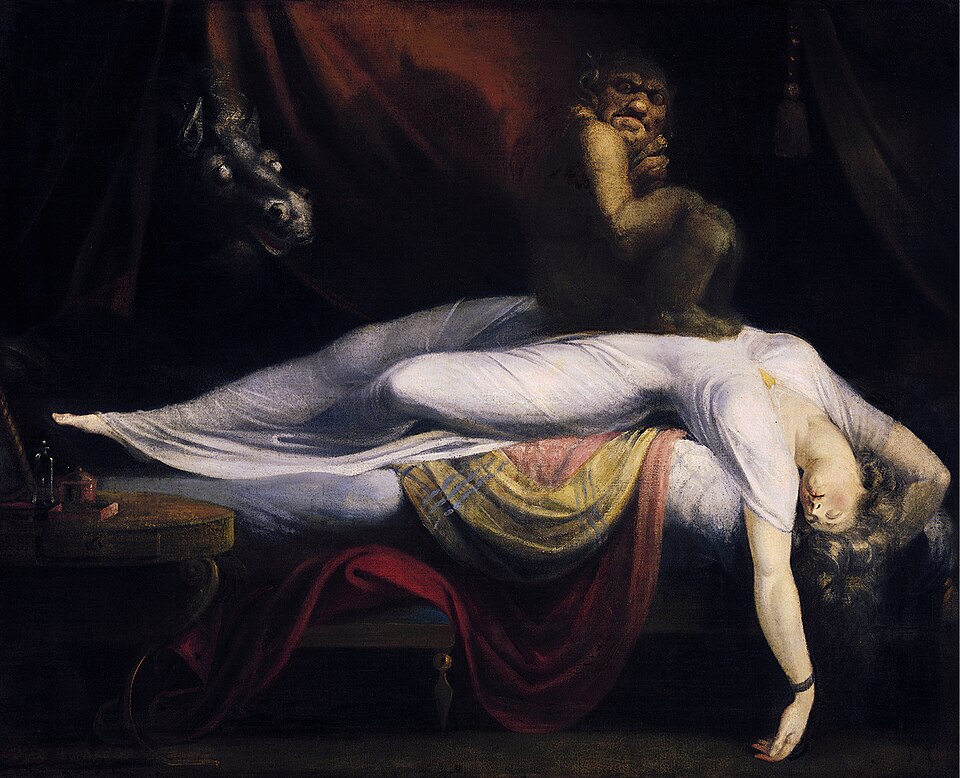
When Henry Fuseli painted The Nightmare in 1781, he had spent years exhibiting at the Royal Academy of London without success. When it was shown there in 1782, everything changed. Critics recoiled and stared in equal measure, unsettled by a painting that seemed to expose something raw and forbidden about the human mind, decades before anyone had language for the unconscious.
The scene itself is simple and strange. A woman in a white gown is draped backward over the end of a bed, her head hanging, her long neck exposed, her arms thrown limp beneath her. Astride her chest sits an incubus, a demonic, ape-like creature staring directly out at the viewer. Behind them, parting the red velvet curtains, the blind, pupil-less head of a horse pushes into the room — the 'night-mare' of the title made literal.
Fuseli set the woman's pale, luminous body against a background of deep reds, yellows and ochres, using sharp contrasts of light and shadow to heighten the painting's theatrical, dreamlike unease. A small table nearby holds a mirror, a phial and a book, fixtures of a fashionable contemporary bedroom that ground the supernatural scene in a very real, very domestic space.
The title's strangeness has roots in old folklore. The word 'nightmare' descends from mara, a Scandinavian term for a spirit that tormented sleepers, sitting on their chests and suffocating them. Germanic legends told of demons and hags who visited people sleeping alone, giving rise to phrases like 'hag-riding' and 'mare-riding.' Fuseli, though an ordained minister well versed in art history, chose here to abandon literary or religious reference entirely — a rarity in his body of work — and paint the folklore raw.
Scholars have traced echoes of older art in the painting's composition: the woman's pose recalling the Vatican's Ariadne, the incubus resembling figures from the ancient site of Selinunte in Sicily, the horse possibly inspired by a Hans Baldung woodcut or the marble Horse Tamers on Rome's Quirinal Hill. Notably, the horse appears to have been an afterthought — a preliminary chalk sketch of the composition didn't include it at all.
More from Art

The Painting With No Foreground
A single robed figure stares out at an empty grey sea — and the emptiness itself became a scandal. When it was unveiled in Berlin in 1810, no one knew quite what to do with it.

The Painter Who Chased the Light
For a few purple minutes each evening, an American exile knelt in an English garden and raced the dying sun to paint two little girls lighting lanterns. It took him two years to finish.

When a President Became a God
Look straight up inside the U.S. Capitol dome and you will find George Washington enthroned among the clouds, surrounded by goddesses — the founding father transformed into myth.

Marble Brought Back to Life
A corpse asleep, a wing barely brushing her skin — and marble somehow learns to breathe. This is the moment Antonio Canova dared to carve.

The World Turned Upside Down
Look closely at a sixteenth-century Flemish village and you'll find a man biting a pillar, another carrying daylight in a basket, and a wife slipping a blue cloak over her husband's shoulders. Every gesture is a joke — if you know the language.

The Girl in the Glass Case
She stood two-thirds life size, dressed in a real tutu and human hair — and the critics who saw her in 1881 recoiled as if she were something obscene.