The Painting That Vanished Into the Storm
For 357 years it survived pirates of provenance and the passage of empires — then two men dressed as police officers walked into a Boston museum and made it disappear forever.
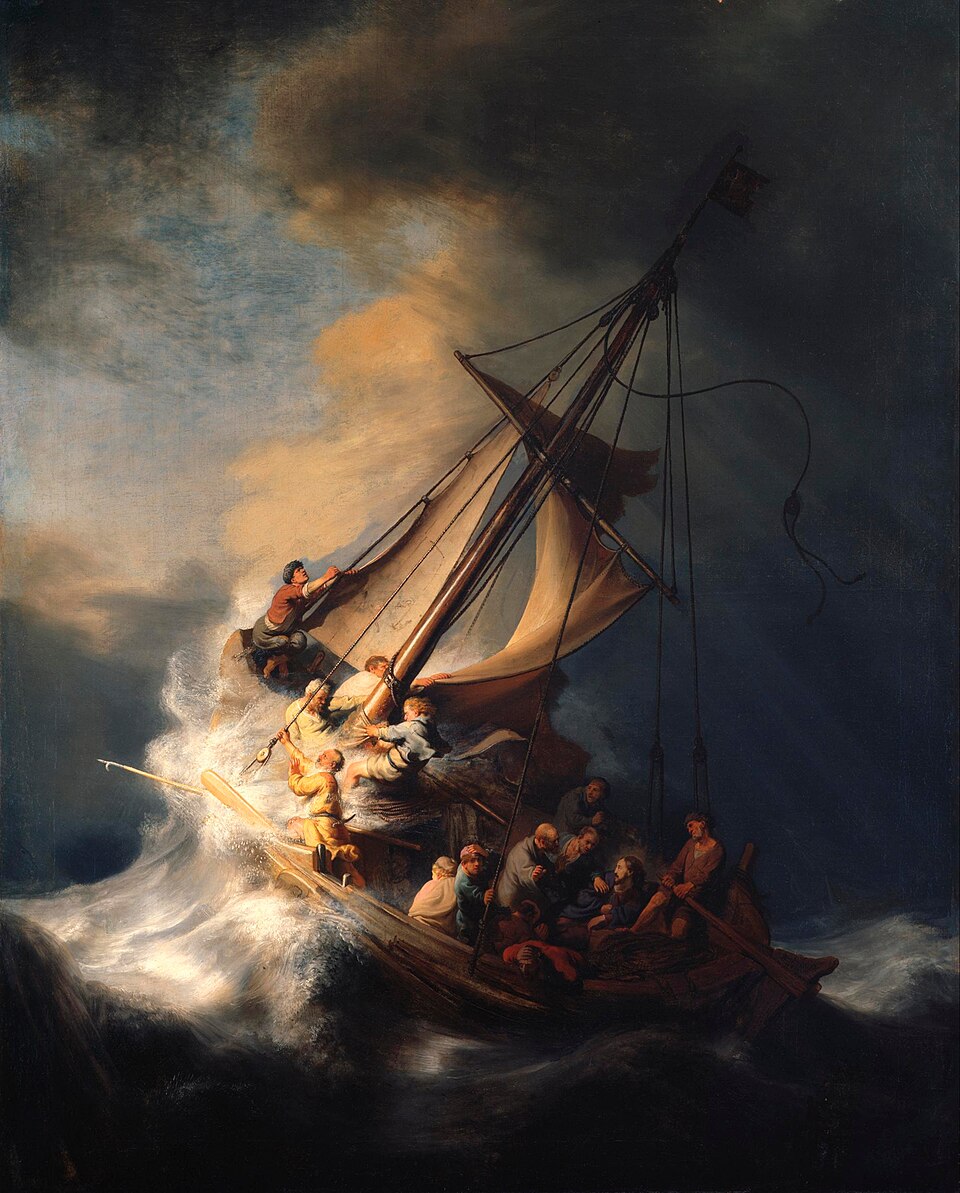
In 1633, a twenty-seven-year-old painter named Rembrandt van Rijn, newly arrived in Amsterdam from Leiden, set his brush to a canvas nearly five and a half feet tall. The result, Christ in the Storm on the Sea of Galilee, would become his largest early work and, strangely, the only seascape he would ever paint. It depicted the biblical account from the Gospel of Mark, chapter four: Jesus asleep in a boat while his disciples fought a violent squall, waking him in terror, and watching him calm the wind and the water with a word.
Rembrandt's canvas is a study in contrasts. A towering wave shreds the sail and crashes over the bow. One disciple vomits over the side in sheer panic. Another stares directly out at the viewer — Rembrandt's own self-portrait, inserted into the chaos as his signature gesture. And on the right, untouched by the frenzy, Christ sits in serene stillness. Light pours in from the upper left, cutting through the storm's gloom, while the right side of the composition sinks into shadow.
Art historians have traced the painting's composition to a 1583 engraving by Adriaen Collaert, based on a design by Maerten de Vos, part of a twelve-part series on the life of Christ published by the Sadeler family in Antwerp. Rembrandt borrowed its vertical format and the forward-tilting angle of the boat, but reshaped the vessel itself — modeled loosely on a hoeker, a common North Sea fishing boat — thickening its mast and distorting its hull for dramatic effect rather than nautical accuracy.
The painting's ownership trail begins in 1644, when Dutch merchant and whaling magnate Tymen Jacobsz Hinloopen acquired it under the title A Painting of St. Peter's Ship. It changed hands repeatedly over the following centuries until 1898, when Henry Francis Pelham-Clinton-Hope sold it to dealers Asher Wertheimer and P. & D. Colnaghi & Co. That same year, the art historian Bernard Berenson — who had already helped secure Titian's The Rape of Europa for American collector Isabella Stewart Gardner in 1896 — negotiated its purchase for her for $6,000, a sum worth roughly $232,200 today.
The painting found a home in the Isabella Stewart Gardner Museum in Boston, hanging alongside a Rembrandt self-portrait and other treasures of her collection. It remained there for nearly a century, a fixture of one of America's great private museums, until the early hours of March 18, 1990.
More from Art

The Painting With No Foreground
A single robed figure stares out at an empty grey sea — and the emptiness itself became a scandal. When it was unveiled in Berlin in 1810, no one knew quite what to do with it.

The Painter Who Chased the Light
For a few purple minutes each evening, an American exile knelt in an English garden and raced the dying sun to paint two little girls lighting lanterns. It took him two years to finish.

When a President Became a God
Look straight up inside the U.S. Capitol dome and you will find George Washington enthroned among the clouds, surrounded by goddesses — the founding father transformed into myth.

Marble Brought Back to Life
A corpse asleep, a wing barely brushing her skin — and marble somehow learns to breathe. This is the moment Antonio Canova dared to carve.

The World Turned Upside Down
Look closely at a sixteenth-century Flemish village and you'll find a man biting a pillar, another carrying daylight in a basket, and a wife slipping a blue cloak over her husband's shoulders. Every gesture is a joke — if you know the language.

The Girl in the Glass Case
She stood two-thirds life size, dressed in a real tutu and human hair — and the critics who saw her in 1881 recoiled as if she were something obscene.