The Painting That Waited at Its Maker's Deathbed
An unfinished altarpiece lay at the head of a dying painter's coffin — and became the most talked-about oil painting in the world for three centuries.
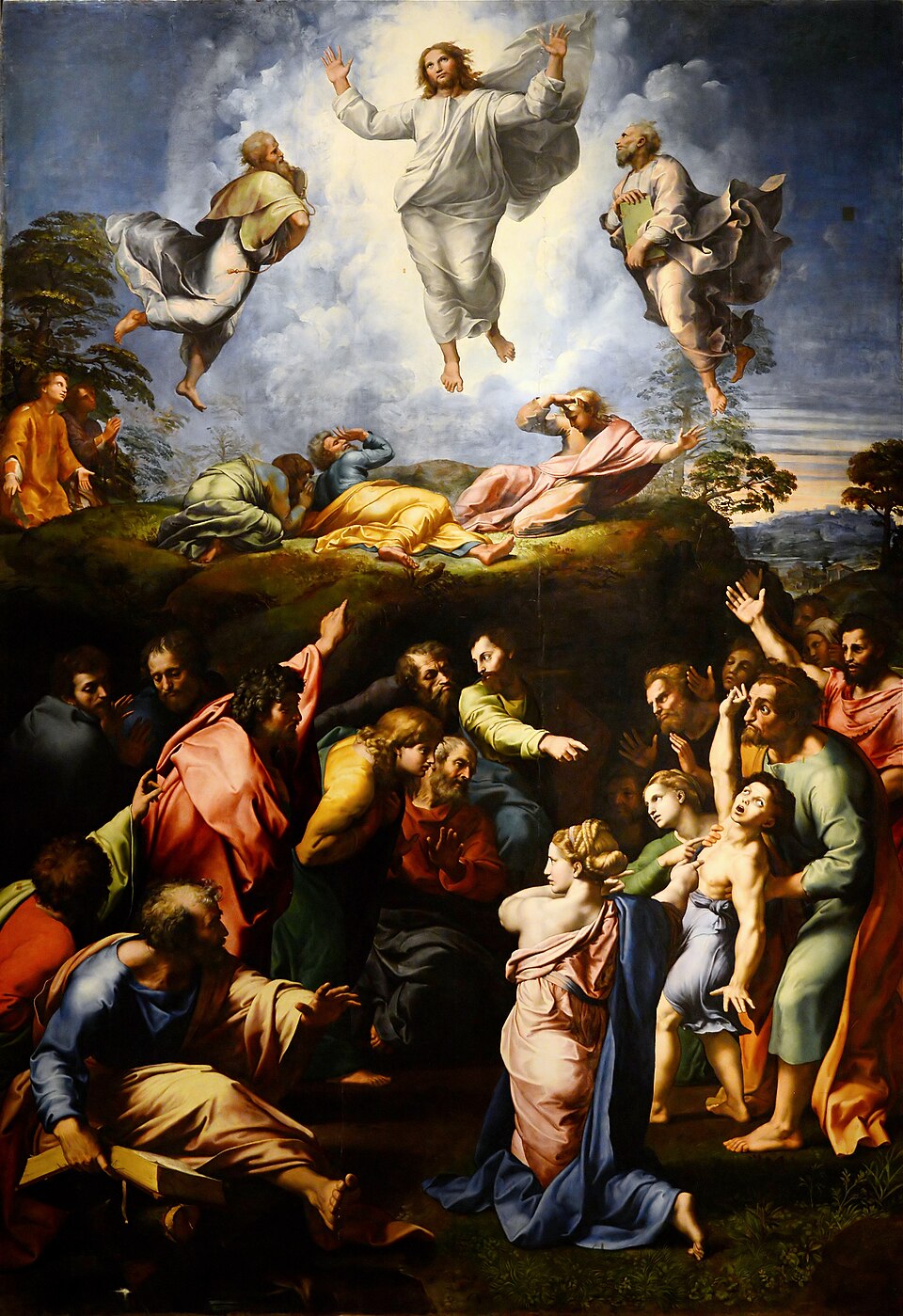
By December 1517, Cardinal Giulio de Medici had a plan and a rivalry to fuel. As cousin and vice-chancellor to Pope Leo X, he had already been endowed with the legation of Bologna and the bishoprics of Albi, Ascoli, Worcester, and Eger, among others; from February 1515, this also included the archbishopric of Narbonne. He commissioned two altarpieces for Narbonne Cathedral: The Raising of Lazarus from Sebastiano del Piombo, with drawings supplied by Michelangelo, and The Transfiguration of Christ from Raphael. It was a deliberate rekindling of the old contest between Michelangelo and Raphael that had already played out in the Stanze and the Sistine Chapel.
The project began modestly. An early modello by Raphael's studio assistant Giulio Romano showed a simple, traditional scene: Christ on Mount Tabor, Moses and Elijah floating toward him, John and James kneeling at right, Peter at left, and God the Father with angels above. But everything changed once Raphael saw how far along his rival's Lazarus had progressed. By October 1518, Sebastiano's painting was unofficially on view; Raphael, by contrast, had barely started his own. Evidence suggests he then worked feverishly, expanding his composition to include a second scene — the healing of a possessed boy — and nineteen figures in total. A surviving modello, now in the Louvre, captures this dramatic transformation; it is a workshop copy of a lost drawing by Raphael's assistant Gianfrancesco Penni.
When Sebastiano's Raising of Lazarus was formally inspected by Pope Leo X on 11 December 1519, the third Sunday of Advent, Raphael's Transfiguration was still unfinished. Later technical examination would reveal more than sixteen incomplete areas and pentimenti — the visible traces of an artist changing his mind.
One theory for the painting's unusual double subject points to the writings of Blessed Amadeo Menes da Silva, an influential friar, healer, and visionary who was also the Pope's confessor and a diplomat for the Vatican State. After his death in 1502, his sermons were compiled into the Apocalypsis Nova, a tract well known to Leo X and consulted as a spiritual guide by Cardinal Giulio's predecessor as bishop of Narbonne, Guillaume Briçonnet, and his sons. Amadeo's writings describe the Transfiguration and the healing of the possessed boy as consecutive episodes — the Transfiguration prefiguring the Last Judgment and the defeat of the Devil, the healing linking Christ's divinity to his power to cure.
Raphael never saw the work reach France. He died on 6 April 1520, and for several days the painting lay at the head of his catafalque in his house in the Borgo. A week later, his Transfiguration and Sebastiano's Lazarus were exhibited together in the Vatican — the paragone finally staged in public. Though some speculated that pupils Giulio Romano and Gianfrancesco Penni painted background figures in the lower right, cleaning conducted from 1972 to 1976 showed that assistants had only finished a few lower-left figures; the rest was Raphael's own hand.
More from Art

The Painting With No Foreground
A single robed figure stares out at an empty grey sea — and the emptiness itself became a scandal. When it was unveiled in Berlin in 1810, no one knew quite what to do with it.

The Painter Who Chased the Light
For a few purple minutes each evening, an American exile knelt in an English garden and raced the dying sun to paint two little girls lighting lanterns. It took him two years to finish.

When a President Became a God
Look straight up inside the U.S. Capitol dome and you will find George Washington enthroned among the clouds, surrounded by goddesses — the founding father transformed into myth.

Marble Brought Back to Life
A corpse asleep, a wing barely brushing her skin — and marble somehow learns to breathe. This is the moment Antonio Canova dared to carve.

The World Turned Upside Down
Look closely at a sixteenth-century Flemish village and you'll find a man biting a pillar, another carrying daylight in a basket, and a wife slipping a blue cloak over her husband's shoulders. Every gesture is a joke — if you know the language.

The Girl in the Glass Case
She stood two-thirds life size, dressed in a real tutu and human hair — and the critics who saw her in 1881 recoiled as if she were something obscene.