The Painting Vermeer Would Never Sell
He painted his own studio in exquisite, obsessive detail — then refused to part with the canvas, even as his creditors circled.
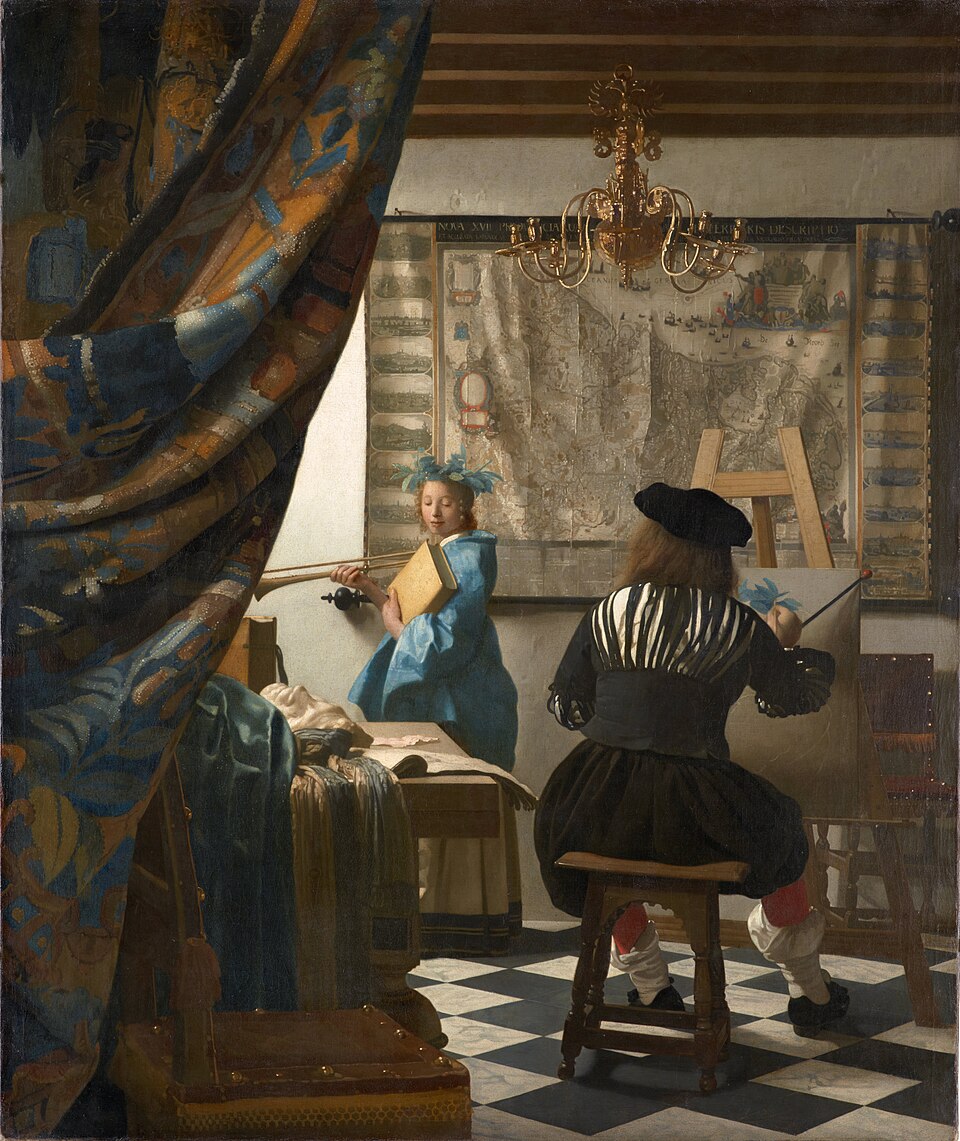
In a quiet room lit from a hidden window, a man in an elegant black doublet sits before an easel, his back to us, sketching the beginning of a laurel crown onto a fresh canvas. Facing him, a young woman stands still, eyes downcast, a trumpet in one hand, a book in the other, a wreath of laurel on her head. This is The Art of Painting, painted by Johannes Vermeer sometime between 1665 and 1668, and today it hangs in the Kunsthistorisches Museum in Vienna, owned by the Austrian Republic.
It is Vermeer's most ambitious composition, and after Christ in the House of Martha and Mary and The Procuress, his largest canvas. Art historians consider it his most complex work, a picture that folds meaning within meaning. The 19th-century critic Thoré-Bürger, who rediscovered Vermeer for the modern world, called it the artist's most interesting painting. Scholars since — Svetlana Alpers, Walter Liedtke, Albert Blankert — have praised it as a virtuoso staging of an imagined studio, where naturalistic technique, luminous space, and intricate composition fuse without a flaw.
The painter at the easel is widely believed to be a self-portrait of Vermeer himself, dressed in fashionable slashed sleeves, puffed breeches, and orange stockings — a costume echoed in a well-known Rubens self-portrait of the era. The woman posing for him has been proposed, by scholar Jean-Louis Vaudoyer, to be Vermeer's own daughter, though her true identity remains uncertain. A heavy tapestry curtain and an empty chair in the foreground pull the viewer's eye into the scene, a technique called repoussoir, while the visible ceiling recalls a similar device in Vermeer's Allegory of Faith.
Every object in the room seems to carry meaning. A plaster mask on the table may nod to the old debate about which art form — painting or sculpture — reigns supreme. A folio, a scrap of cloth, and leather goods are linked by scholars to the traditional symbols of the Liberal Arts. The marble-tiled floor and the ornate gold chandelier show off Vermeer's mastery of perspective and his sensitivity to how light behaves differently across stone, metal, and cloth.
Behind the two figures hangs an enormous map of the Seventeen Provinces of the Netherlands, framed by twenty small views of Dutch cities, published originally by Claes Janszoon Visscher in 1636. Similar maps survive in the Bibliothèque Nationale in Paris and at Skokloster in Sweden, and comparable versions appear in paintings by Jacob Ochtervelt and Nicolaes Maes. In the map's corner, two allegorical women appear — one holding a cross-staff and compasses, the other a palette, brush, and city view.
More from Art

The Painting With No Foreground
A single robed figure stares out at an empty grey sea — and the emptiness itself became a scandal. When it was unveiled in Berlin in 1810, no one knew quite what to do with it.

The Painter Who Chased the Light
For a few purple minutes each evening, an American exile knelt in an English garden and raced the dying sun to paint two little girls lighting lanterns. It took him two years to finish.

When a President Became a God
Look straight up inside the U.S. Capitol dome and you will find George Washington enthroned among the clouds, surrounded by goddesses — the founding father transformed into myth.

Marble Brought Back to Life
A corpse asleep, a wing barely brushing her skin — and marble somehow learns to breathe. This is the moment Antonio Canova dared to carve.

The World Turned Upside Down
Look closely at a sixteenth-century Flemish village and you'll find a man biting a pillar, another carrying daylight in a basket, and a wife slipping a blue cloak over her husband's shoulders. Every gesture is a joke — if you know the language.

The Girl in the Glass Case
She stood two-thirds life size, dressed in a real tutu and human hair — and the critics who saw her in 1881 recoiled as if she were something obscene.