The Peacock Throne: Nader Shah's Vanished Masterpiece
A throne so lavish it cost twice as much as the Taj Mahal — and it vanished from history in a single looted convoy leaving Delhi.
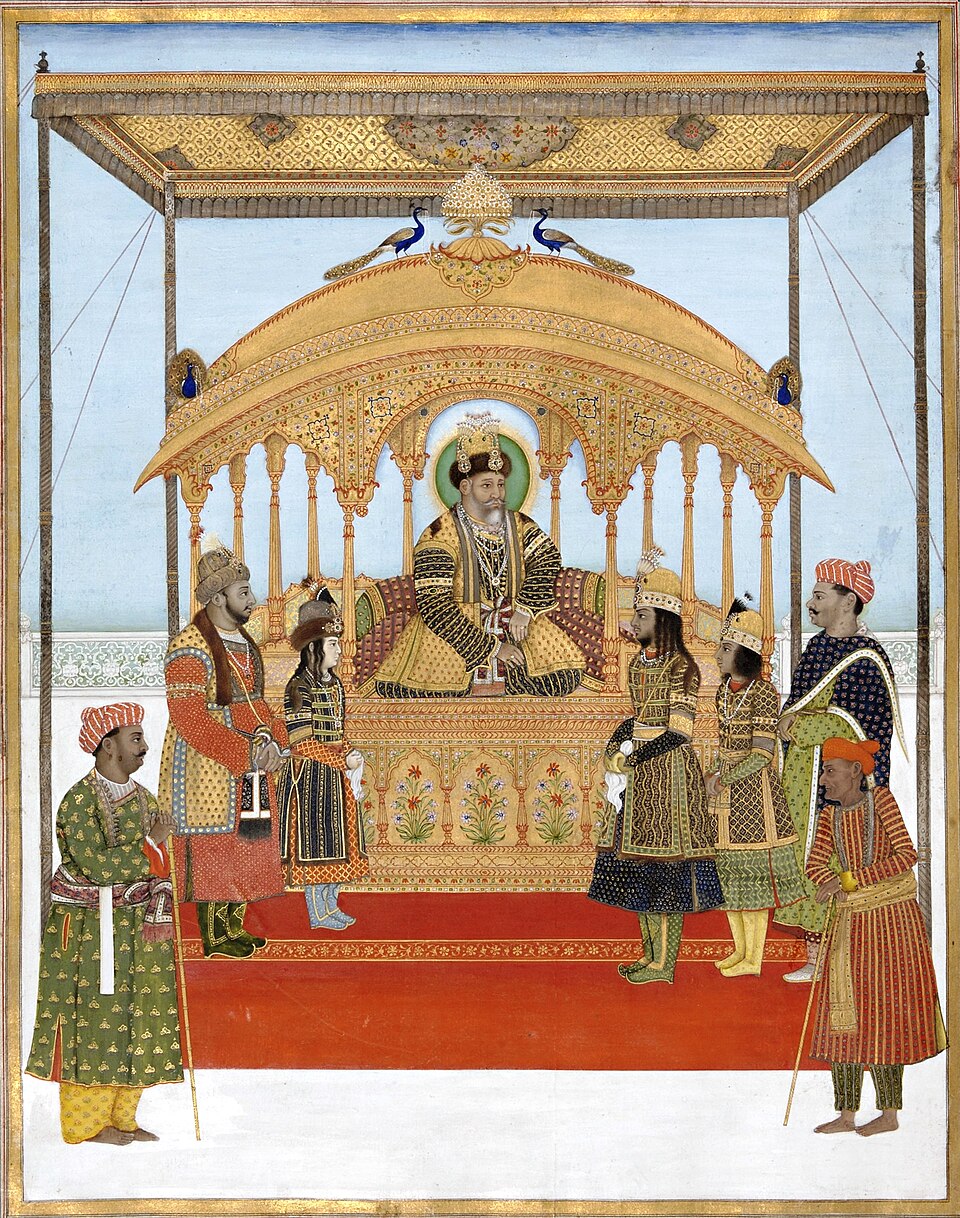
On 22 March 1635, on a date astrologers had calculated with almost obsessive precision, Emperor Shah Jahan walked into the Diwan-i-Khas of his new capital, Shahjahanabad, and took his seat upon a throne unlike any that had come before it. The day was triple-blessed: the formal seventh anniversary of his accession, the joyous close of Ramadan at Eid al-Fitr, and Nowruz, the Persian New Year. Astrologers had determined that the third day of Nowruz was the most auspicious moment for the emperor to enter his capital and ascend what would become known to history as the Peacock Throne.
The throne was Shah Jahan's answer to legend. Mughal court culture imagined the ideal ruler enthroned as Solomon once was, floating above the earth on a seat worthy of paradise, covered in gold and jewels and reached by steps that lifted him closer to heaven. To build this vision, the emperor commissioned Said Gilani, a master of the imperial goldsmiths' department, who spent seven years shaping vast quantities of solid gold, precious stones, and pearls into a masterpiece of Mughal artistry. It was, even judged by the extravagant standards of the Mughal Golden Age, staggering in its cost — twice what it had taken to raise the Taj Mahal.
Its name came later. In its own time it was simply the Takht-Murassa, the 'Jeweled Throne' or 'Ornamented Throne.' Only afterward did later historians christen it for the two figures of peacocks, tails displayed in gold and stone, mounted upon its canopy — statues, not living birds, but striking enough to give the throne its lasting name. It stood in stark contrast to the throne of Shah Jahan's father, Jahangir — a plain rectangular slab of engraved black basalt — announcing that a new, more radiant era of Mughal power had arrived.
The inauguration itself was steeped in poetry. Muhammad Qudsi, the emperor's favored poet, inscribed twenty verses in emerald and green enamel directly onto the throne, praising the 'heaven-depleting grandeur' of its gold and gems and encoding the date within the phrase 'the throne of the just king.' Another court poet, Abu-Talib Kalim, was paid six pieces of gold for each verse of a sixty-three-couplet poem in the throne's honor. Said Gilani himself was showered with honors — his weight in gold coins and the title 'Peerless Master,' Bibadal Khan — and composed 134 couplets of his own, filled with chronograms: the first twelve giving the date of the emperor's birth, the next thirty-two his first coronation, and the remaining ninety the date of the throne's inauguration.
More from Treasures

The Legend of the Nazi Gold Train
Somewhere beneath the hills of Poland, rumor insists, a train loaded with looted treasure vanished into a tunnel and was never seen again. The story survives because the plunder behind it was terrifyingly real.

The Treasure List Carved in Copper
While every other Dead Sea Scroll was written on parchment or papyrus, one was hammered into metal — a list of buried gold and silver that no one has ever found.

The Diamond That Vanished for a Century
For decades, treasure hunters and novelists spun theories about a lost 137-carat gem — sold, recut, melted into legend. It was sitting in a Quebec bank vault the entire time.

Gold, Ghosts, and the Mountain That Keeps Its Secret
For over a century, treasure hunters have vanished into a jagged Arizona range chasing a fortune that may never have existed at all. What they left behind was not gold, but one of America's most enduring legends.

The King Who Buried a River
When Rome finally cornered the Dacian king, it wasn't a sword that gave up his secret — it was a traitor's whisper about a riverbed.

The Fortune Dutch Schultz Took to His Grave
He asked New York's mob bosses for permission to kill a federal prosecutor — and when they said no, he disobeyed them anyway. It was a decision that would end his life and leave behind a fortune that has never been found.